

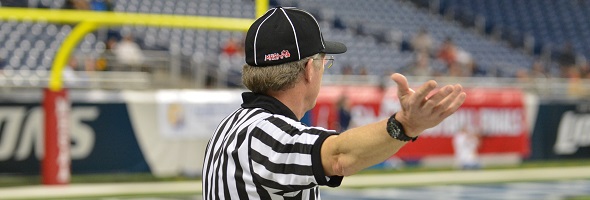
Be the Referee: 40-Second Play Clock
August 29, 2019
This week, MHSAA Assistant Director Brent Rice explains the change in football to a 40-second play clock.
Be The Referee is a series of short messages designed to help educate people on the rules of different sports, to help them better understand the art of officiating, and to recruit officials.
Below is this week's segment - 40-Second Play Clock - Listen
One of the rules changes in high school football this year involves timing between downs.
All varsity games will be played with a 40-second play clock that begins after the conclusion of the previous play, with exceptions for things like timeouts, penalties, measurements and at the start of a period – when a 25-second count will be used.
In experiments in Michigan over the past few seasons, the 40-second play clock proved to improve the pace of play and consistency between plays because it is not dependent on the referee’s subjective signal. And while some schools may choose to purchase visible play clocks for their fields, it is not required. The Back Judge, who has the primary responsibility for the play clock, will signal at 10 seconds and count the last five seconds.
Be the Referee: Cheer Judges
By
Paige Winne
MHSAA Director of Brand Management
January 20, 2026
Be The Referee is a series of short messages designed to help educate people on the rules of different sports, to help them better understand the art of officiating, and to recruit officials.
Below is this week's segment – Cheer Judges - Listen
Ready! Set!
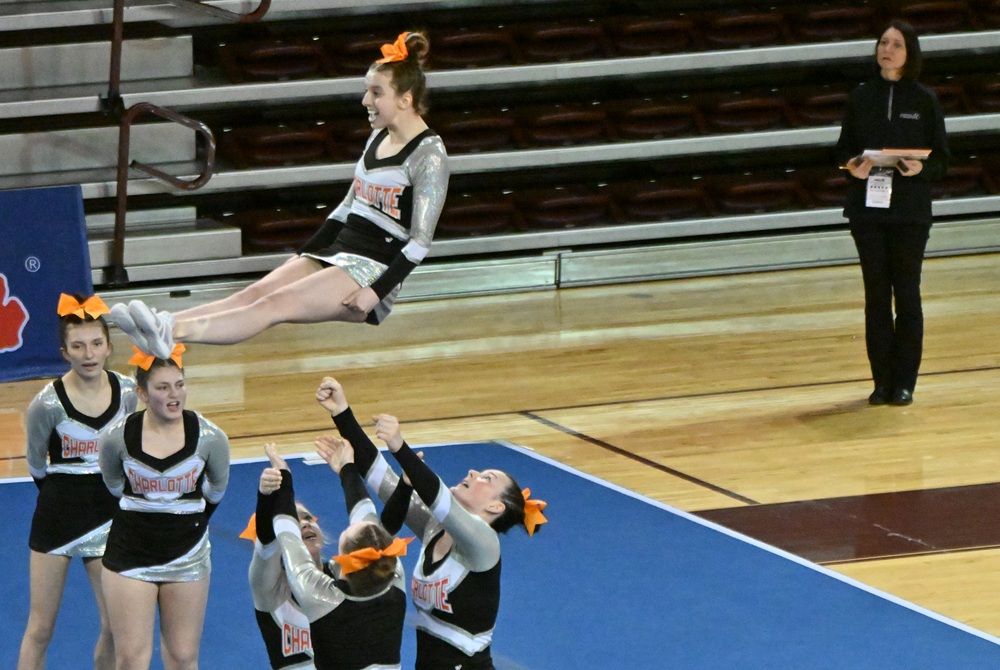
There are a lot of moving parts to a competitive cheer competition, including safety judges.
For each competition there are a minimum of two safety judges and 3 panel judges. But what does each position do?
Safety judges are there for safety – as simple as that sounds. During competition, they are mobile, circling the mat identifying illegal skills, improper spotting techniques, time infractions, and anything else deemed unsafe. They also are counting the number of competitors and floor formations for each team.
Panel judges – and there are three of them – are scoring the round. Each round is made up of skills, floor formations, transition moves and stunts that all must be evaluated.
Both safety and panel judges can deduct points for errors in the routine.
Previous 2025-26 editions
Jan. 13: Basketball Over the Back - Listen
Jan. 6: Bowling Ball Bounces Out of Gutter - Listen
Dec. 9: Puck on Goal Netting - Listen
Dec. 2: Goaltending vs. Basket Interference - Listen
Nov. 25: Football Finals Instant Replay - Listen
Nov. 18: Volleyball Libero Uniforms - Listen
Nov. 11: Illegal Substitution/Participation - Listen
Nov. 4: Losing a Shoe - Listen
Oct. 28: Unusual Soccer Goals - Listen
Oct. 21: Field Hockey Penalty Stroke - Listen
Oct. 14: Tennis Double Hit - Listen
Oct. 7: Safety in Football - Listen
Sept. 30: Field Hockey Substitution - Listen
Sept 23: Multiple Contacts in Volleyball - Listen
Sept. 16: Soccer Penalty Kick - Listen
Sept. 9: Forward Fumble - Listen
Sept. 2: Field Hockey Basics - Listen
Aug. 26: Golf Ball Bounces Out - Listen