

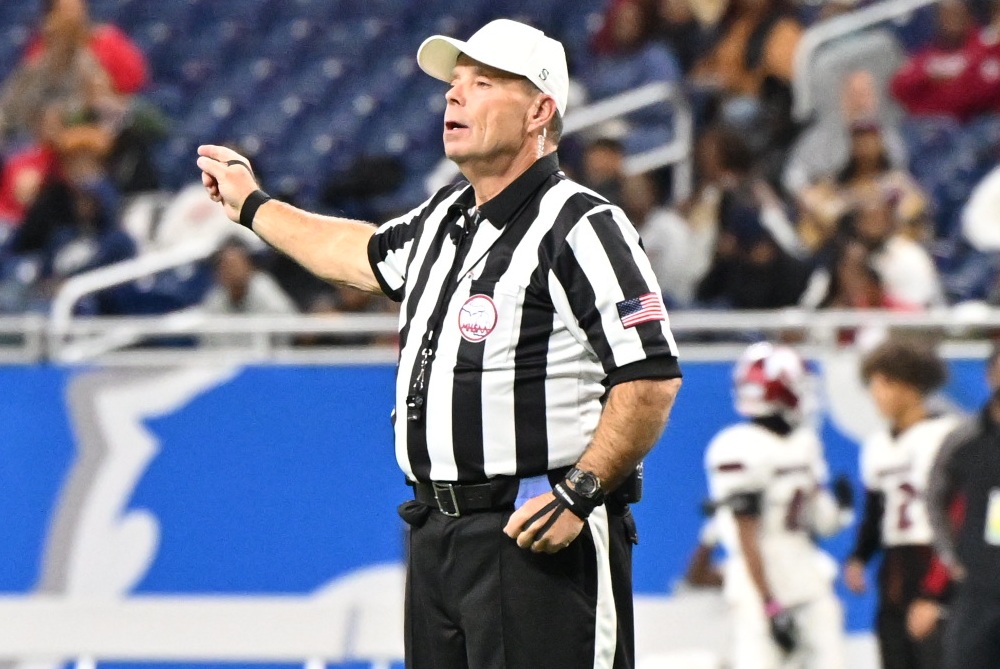
Be the Referee: Defensive Holding
By
Paige Winne
MHSAA Director of Brand Management
October 6, 2026
Be The Referee is a series of short messages designed to help educate people on the rules of different sports, to help them better understand the art of officiating, and to recruit officials.
Below is this week's segment – Defensive Holding - Listen
Team A has the ball on their own 20-yard line and its 4th-and-15. They decide to go for it. The quarterback drops back to pass and is sacked at his 15-yard line, a five-yard loss.
But during the play, Team B – the defense – is flagged for holding an eligible wide receiver.
How is the penalty administered?
- Is it 4th-and-5 from Team A’s 30?
- Is it 4th-and-10 from Team A’s 25?
- Is it 1st-and-10 from Team A’s 30?
- Or is it 1st-and-10 from Team A’s 25?
If you said it is 4th-and-5 from Team A’s 30 – you are correct.
Defensive holding is a 10-yard penalty from the previous spot – which was the 20-yard line. Team A now has possession at the 30, needing to get to the 35 for first down.
Previous 2026-27 editions
Sept. 29: Minimum Number of Volleyball Players - Listen
Sept 22: Soccer Changes - Listen
Sept: 15: Dead Ball Penalty - Listen
Sept. 8: Libero Ejected - Listen
Sept. 1: Soccer Foul After Shot on Goal - Listen
Aug. 25: Fumble Out of Bounds - Listen

Be the Referee: Football Overtime
October 1, 2014
This week, MHSAA assistant director Mark Uyl explains how football overtime is played at the high school level.
"Be the Referee" is designed to help educate people on the rules of different sports, to help them better understand the art of officiating and to recruit officials. The segment can be heard on Mondays, Wednesdays and Fridays during the school year on The Drive With Jack Ebling on WVFN-AM, East Lansing.
Below is this week's segment - Overtime - Listen
There is nothing better for a football fan than a close game, and the ultimate is when that close game ends up going into overtime.
The high school overtime rules are quite similar to those used at the college level. In other words, both teams are going to be guaranteed one possession of the ball starting out first down and goal to go from the 10-yard line. A couple of key differences are if the defense gets possession of the ball on an interception or on a fumble, the ball is dead and the teams switch offense and defense, In other words, that ball can’t be returned for a defensive score to end the game.
There is also no requirement that the offense at any point after a touchdown be required to go for two (points). If the game would go seven or eight overtimes, teams can continue to simply kick the one point extra point.
Past editions
Aug. 25 - Targeting - Listen
Sept. 4 - Concussions - Listen
Sept. 11 - Pass Interference - Listen
Sept. 18 - Tackle Box - Listen
Sept. 25 - Field Goals - Listen