

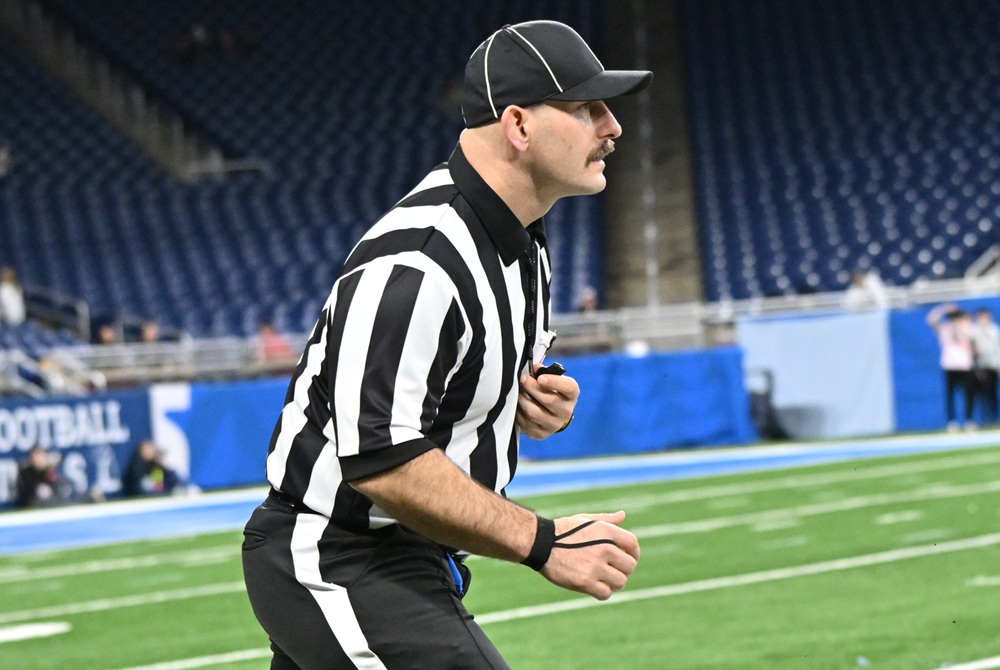
Be the Referee: Pass Interference
By
Paige Winne
MHSAA Director of Brand Management
November 3, 2026
Be The Referee is a series of short messages designed to help educate people on the rules of different sports, to help them better understand the art of officiating, and to recruit officials.
Below is this week's segment – Pass Interference - Listen
How well do you know the rules regarding pass interference and passes behind the line of scrimmage? Let’s find out.
The blue team has the ball. The quarterback throws a forward pass to a receiver who is positioned behind the line of scrimmage. Before the receiver can make the catch, a red team defender makes contact with him, and the pass falls incomplete.
Is this defensive pass interference?
The answer is no.
Under high school football rules, pass interference restrictions only apply to forward passes that cross the line of scrimmage. Because this pass was thrown to a receiver behind the line of scrimmage and did not cross it, there is no pass interference.
The same rule applies to backward passes. Pass interference cannot be called on a backward pass, regardless of where the receiver is positioned.
Previous 2026-27 editions
Oct: 27: Field Hockey Substitutions - Listen
Oct. 20: Foot Save in Volleyball - Listen
Oct. 13: Soccer Advantage - Listen
Oct. 6: Defensive Holding - Listen
Sept. 29: Minimum Number of Volleyball Players - Listen
Sept 22: Soccer Changes - Listen
Sept: 15: Dead Ball Penalty - Listen
Sept. 8: Libero Ejected - Listen
Sept. 1: Soccer Foul After Shot on Goal - Listen
Aug. 25: Fumble Out of Bounds - Listen

Sweating the Small Stuff - #3
June 5, 2018
I’m sure it discouraged some of our state’s high school football coaches to learn that the Representative Council of the Michigan High School Athletic Association did not approve at its May 6-7 meeting what some people refer to as the “enhanced strength of schedule proposal” for determining 256 qualifiers to the MHSAA’s 11-player football playoffs.
There was desire among some Council members to appease those who keep trying to reduce the difficulties that a football tournament causes for regular season scheduling and conference affiliations. Others noted that the proposal, as presented, could cause as much harm to some schools and conferences as it would help others, that it did not solve the scheduling problem but shifted it.
During spirited discussion, some Council members resurrected two ideas that have been rejected previously, such as (1) doubling the playoffs once again (and shortening the regular season to eight games), and (2) coupling a six- or seven-win minimum with the revised strength of schedule criteria. The pros and cons of each idea flowed freely.
And therein is the problem. If one digs down into the details of proposals, both old and new, there are both positive and negative aspects apparent, both intended and unintended consequences likely.
There can be paralysis in analysis; but when we are dealing with more than 600 high school programs and a physically demanding sport with fewer regular-season contests permitted than in any other sport, one cannot be too careful. Eliminating one of just nine regular-season games? Increasing first-round tournament mismatches? Disadvantaging larger schools locked in leagues or areas of the state where smaller schools predominate? These are not minor matters.
And until there are sensible answers, these are not trivial questions.