

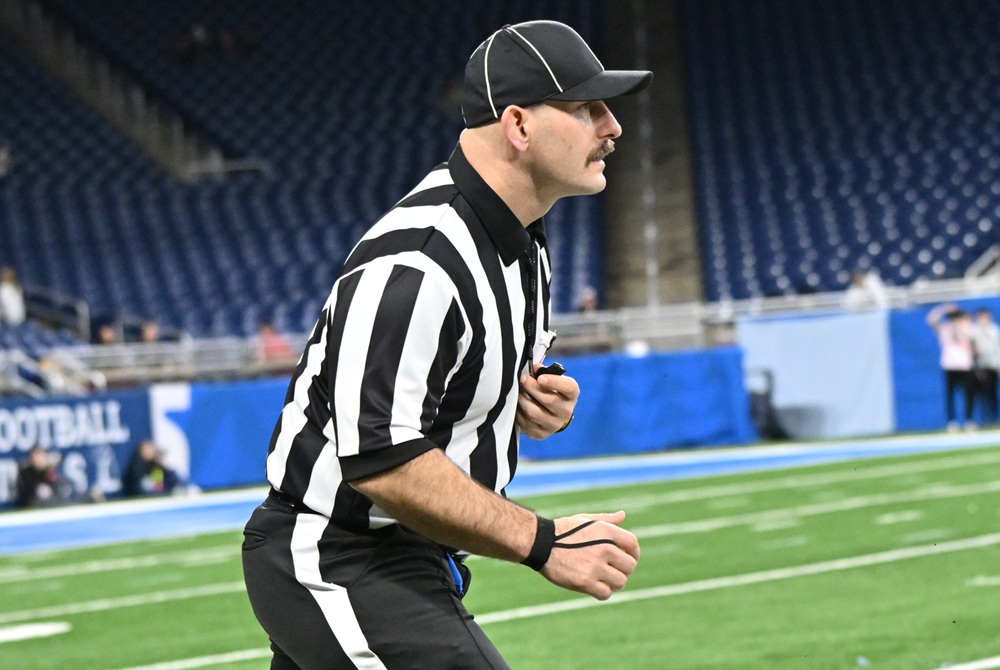
Be the Referee: Pass Interference
By
Paige Winne
MHSAA Director of Brand Management
November 3, 2026
Be The Referee is a series of short messages designed to help educate people on the rules of different sports, to help them better understand the art of officiating, and to recruit officials.
Below is this week's segment – Pass Interference - Listen
How well do you know the rules regarding pass interference and passes behind the line of scrimmage? Let’s find out.
The blue team has the ball. The quarterback throws a forward pass to a receiver who is positioned behind the line of scrimmage. Before the receiver can make the catch, a red team defender makes contact with him, and the pass falls incomplete.
Is this defensive pass interference?
The answer is no.
Under high school football rules, pass interference restrictions only apply to forward passes that cross the line of scrimmage. Because this pass was thrown to a receiver behind the line of scrimmage and did not cross it, there is no pass interference.
The same rule applies to backward passes. Pass interference cannot be called on a backward pass, regardless of where the receiver is positioned.
Previous 2026-27 editions
Oct: 27: Field Hockey Substitutions - Listen
Oct. 20: Foot Save in Volleyball - Listen
Oct. 13: Soccer Advantage - Listen
Oct. 6: Defensive Holding - Listen
Sept. 29: Minimum Number of Volleyball Players - Listen
Sept 22: Soccer Changes - Listen
Sept: 15: Dead Ball Penalty - Listen
Sept. 8: Libero Ejected - Listen
Sept. 1: Soccer Foul After Shot on Goal - Listen
Aug. 25: Fumble Out of Bounds - Listen

Our Place in the Sun
August 22, 2017
Today’s blog was written by MHSAA Website and Publications Coordinator Rob Kaminski
Millions of people across the country yesterday were mesmerized and fascinated by a once-in-a-lifetime show staged by the solar system: a total solar eclipse, which spanned the contiguous United States from Oregon to South Carolina.
The “Great American Eclipse” (because everything needs a title these days) was preceded by countless hours of coverage to prep enthusiasts on a variety of topics: the best places in which to view “totality;” the time frame in which the phenomenon would occur; the manner in which to view the orbs without damaging retinas; and, for the more scientifically inclined, detailed explanations as to the cause of the event.
It is somewhat ironic that this temporary traveling blackout began in the Pacific Northwest where people often yearn for even a glimpse of the sun over periods of time, and ended off the coast of South Carolina where residents have endured more than their share of weather disasters and a day of total sun would have been greatly preferred. At widespread locations in between, how many citizens beg for just a little more sunshine each day when the clock runs out on Daylight Saving Time?
The attraction to Monday’s event, of course, was its rarity. Its peculiarity. Its deviation from the norm. The last time a total solar eclipse could be seen anywhere in the United States was 1979, and the last time it went coast to coast was 99 years ago. That was the hook. It was darkness’s day in the sun.
Another MHSAA football season kicks off around the state Friday just clear from the shadows of Monday’s historic, but fleeting, happening. The school sports spotlight shines brightest on fall Friday nights and has for decades, not only in Michigan, but also from shore to shore across the country. It is pep rallies and parades; pizza parlors and burger joints; neighborhood caravans and tailgates; perhaps even a Friday cross country meet or volleyball match, all leading up to the football game, for many years the only game in town.
Now, as college football continues its attempt to upset the natural balance and create its own eclipse, it is our hope that high school fans from state to state will consider this movement a fleeting attention grab. It is our hope that the people who have fueled our product over the course of time will turn their heads and focus on the brightest Friday night stars in their own back yards.