

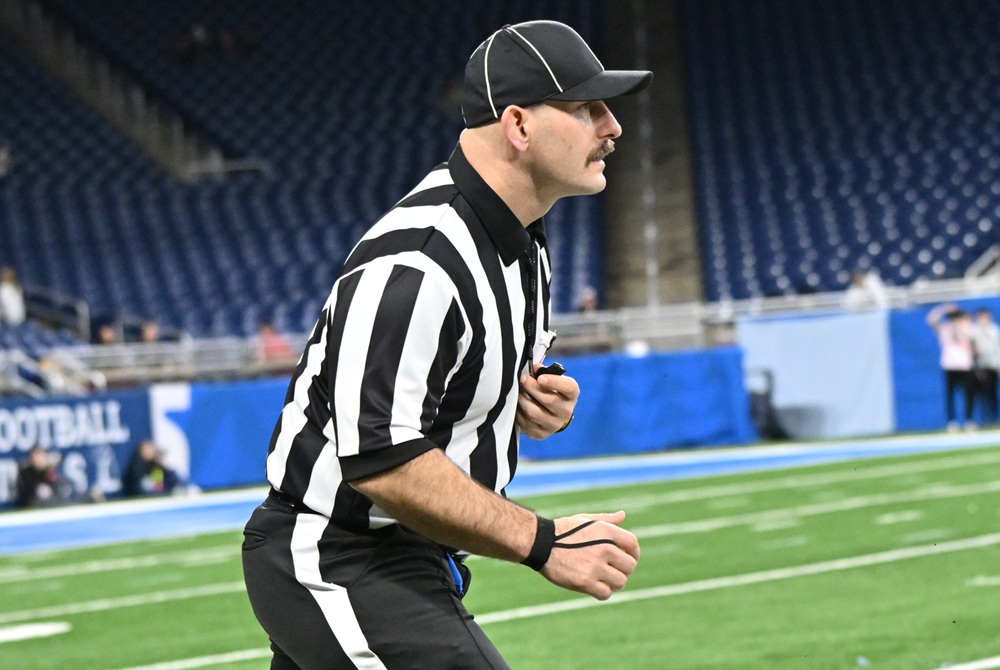
Be the Referee: Pass Interference
By
Paige Winne
MHSAA Director of Brand Management
November 3, 2026
Be The Referee is a series of short messages designed to help educate people on the rules of different sports, to help them better understand the art of officiating, and to recruit officials.
Below is this week's segment – Pass Interference - Listen
How well do you know the rules regarding pass interference and passes behind the line of scrimmage? Let’s find out.
The blue team has the ball. The quarterback throws a forward pass to a receiver who is positioned behind the line of scrimmage. Before the receiver can make the catch, a red team defender makes contact with him, and the pass falls incomplete.
Is this defensive pass interference?
The answer is no.
Under high school football rules, pass interference restrictions only apply to forward passes that cross the line of scrimmage. Because this pass was thrown to a receiver behind the line of scrimmage and did not cross it, there is no pass interference.
The same rule applies to backward passes. Pass interference cannot be called on a backward pass, regardless of where the receiver is positioned.
Previous 2026-27 editions
Oct: 27: Field Hockey Substitutions - Listen
Oct. 20: Foot Save in Volleyball - Listen
Oct. 13: Soccer Advantage - Listen
Oct. 6: Defensive Holding - Listen
Sept. 29: Minimum Number of Volleyball Players - Listen
Sept 22: Soccer Changes - Listen
Sept: 15: Dead Ball Penalty - Listen
Sept. 8: Libero Ejected - Listen
Sept. 1: Soccer Foul After Shot on Goal - Listen
Aug. 25: Fumble Out of Bounds - Listen

Football's Status
June 16, 2017
Football has enjoyed a status within our schools that is unmatched by any other sport.
It attracts more participants than any other interscholastic sport.
Unlike many other sports (think especially of ice hockey, lacrosse and soccer), football began in the high school setting and was not imported from community programs.
And until the past decade, football has not had to cope with out-of-season programs run by non-school groups and commercial entities that are so troublesome – think especially of basketball, ice hockey, soccer and volleyball, but really all sports except football, until recent years.
The growth of 7-on-7 passing leagues and tournaments is the most obvious concern as commercial interests move in to profit from a mostly unregulated summer environment, as began to occur in basketball 30 years ago and has spread to many other sports since.
The Olympic movement has fueled some of this as national governing bodies have engineered programs for younger athletes in efforts to increase medal counts on which the U.S. Olympic Committee bases funding.
The quixotic pursuit of college scholarships is another powerful stimulant; and while the NCAA could have banned its coaches from recruiting away from school venues, it has not done so; and non-school entities have begun to tailor their events toward convenient although costly recruiting venues.
We can expect these events to spread like an invasive species through football unless, learning from the past, the NCAA makes these events off-limits to its coaches, and/or organizations like ours across the country will not only regulate but also conduct programs during the summer.