

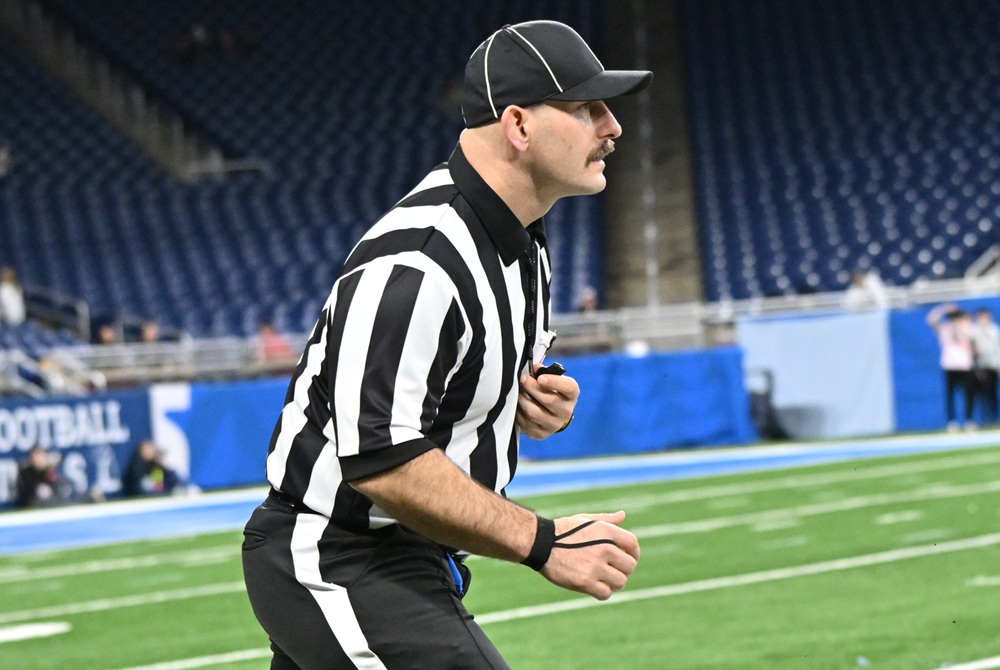
Be the Referee: Pass Interference
By
Paige Winne
MHSAA Director of Brand Management
November 3, 2026
Be The Referee is a series of short messages designed to help educate people on the rules of different sports, to help them better understand the art of officiating, and to recruit officials.
Below is this week's segment – Pass Interference - Listen
How well do you know the rules regarding pass interference and passes behind the line of scrimmage? Let’s find out.
The blue team has the ball. The quarterback throws a forward pass to a receiver who is positioned behind the line of scrimmage. Before the receiver can make the catch, a red team defender makes contact with him, and the pass falls incomplete.
Is this defensive pass interference?
The answer is no.
Under high school football rules, pass interference restrictions only apply to forward passes that cross the line of scrimmage. Because this pass was thrown to a receiver behind the line of scrimmage and did not cross it, there is no pass interference.
The same rule applies to backward passes. Pass interference cannot be called on a backward pass, regardless of where the receiver is positioned.
Previous 2026-27 editions
Oct: 27: Field Hockey Substitutions - Listen
Oct. 20: Foot Save in Volleyball - Listen
Oct. 13: Soccer Advantage - Listen
Oct. 6: Defensive Holding - Listen
Sept. 29: Minimum Number of Volleyball Players - Listen
Sept 22: Soccer Changes - Listen
Sept: 15: Dead Ball Penalty - Listen
Sept. 8: Libero Ejected - Listen
Sept. 1: Soccer Foul After Shot on Goal - Listen
Aug. 25: Fumble Out of Bounds - Listen

Be the Referee: Pitch Counts
February 23, 2017
This week, MHSAA assistant director Mark Uyl explains the new baseball pitch count rule that will take effect this spring.
Be The Referee is a series of short messages designed to help educate people on the rules of different sports, to help them better understand the art of officiating, and to recruit officials.
Below is this week's segment – Pitch Counts - Listen
One of the most significant changes to the game of high school baseball will take place this coming spring with the institution of the new pitch count rule.
In past years, pitchers were limited to how much that they could throw based on outs or innings pitched. Starting in the spring of 2017, pitchers will now be limited to each individual pitch thrown.
The maximum number of pitches is 105 pitches in a game. Pitchers also have to have required days of rest whenever they throw at least 50 pitches, 75 pitches, or the maximum of 105. This new rule is yet another way player safety is the number one priority.
Past editions
Feb. 16: Recruiting Officials - Listen
Feb. 9: Ejections - Listen
Feb. 2: Wrestling & Technology - Listen
Jan. 26: Post Play - Listen
Jan. 19: Ice Hockey Overtime - Listen
Jan. 12: Free Throw Change - Listen
Jan. 5: Ratings - Listen
Dec. 22: Video Review - Part 2 - Listen
Dec. 15: Video Review - Part 1 - Listen
Dec. 8: Registration - Part 2 - Listen
Dec. 1: Registration - Part 1 - Listen
Nov. 24: You Make the Call - Sleeper Play - Listen
Nov. 17: Automatic 1st Downs - Listen
Nov. 10: Uncatchable Pass - Listen
Nov. 3: The Goal Line - Listen
Oct. 27: Help Us Retain Officials - Listen
Oct. 20: Point After Touchdown - Listen
Oct. 13: Untimed Down - Listen
Oct. 6: Soccer Penalty Kick Change - Listen
Sept. 29: Preparation for Officials - Listen
Sept 22: You Make the Call: Returning Kickoffs - Listen
Sept. 15: Concussions - Listen
Sept 8: Equipment Covering the Knees - Listen
Sept. 1: Play Clock Experiment - Listen
Aug. 25: Clipping in the Free Blocking Zone - Listen