

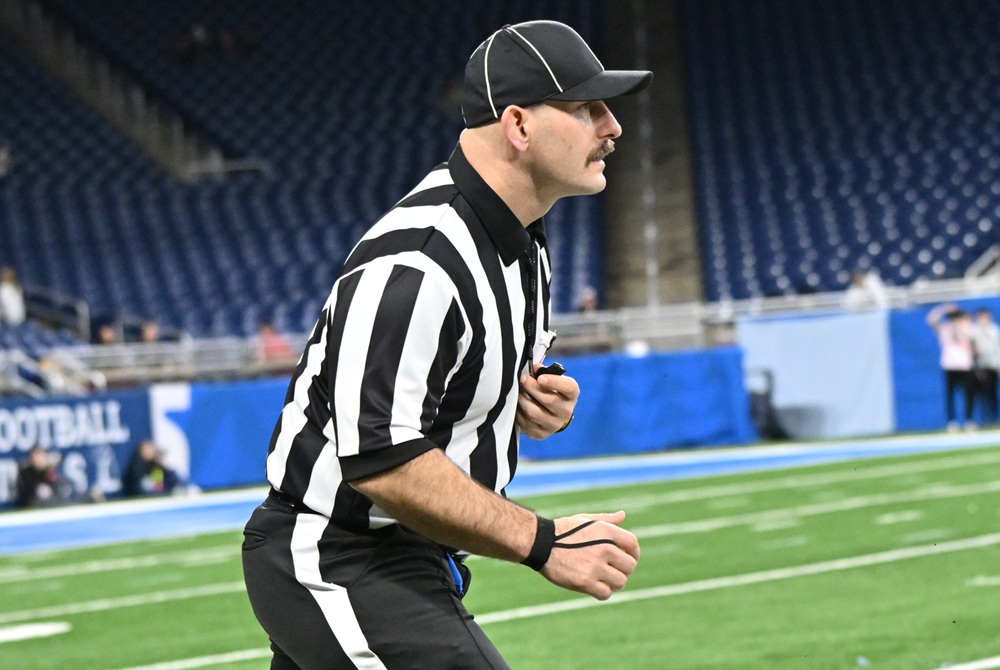
Be the Referee: Pass Interference
By
Paige Winne
MHSAA Director of Brand Management
November 3, 2026
Be The Referee is a series of short messages designed to help educate people on the rules of different sports, to help them better understand the art of officiating, and to recruit officials.
Below is this week's segment – Pass Interference - Listen
How well do you know the rules regarding pass interference and passes behind the line of scrimmage? Let’s find out.
The blue team has the ball. The quarterback throws a forward pass to a receiver who is positioned behind the line of scrimmage. Before the receiver can make the catch, a red team defender makes contact with him, and the pass falls incomplete.
Is this defensive pass interference?
The answer is no.
Under high school football rules, pass interference restrictions only apply to forward passes that cross the line of scrimmage. Because this pass was thrown to a receiver behind the line of scrimmage and did not cross it, there is no pass interference.
The same rule applies to backward passes. Pass interference cannot be called on a backward pass, regardless of where the receiver is positioned.
Previous 2026-27 editions
Oct: 27: Field Hockey Substitutions - Listen
Oct. 20: Foot Save in Volleyball - Listen
Oct. 13: Soccer Advantage - Listen
Oct. 6: Defensive Holding - Listen
Sept. 29: Minimum Number of Volleyball Players - Listen
Sept 22: Soccer Changes - Listen
Sept: 15: Dead Ball Penalty - Listen
Sept. 8: Libero Ejected - Listen
Sept. 1: Soccer Foul After Shot on Goal - Listen
Aug. 25: Fumble Out of Bounds - Listen

Wrong End of the Microscope
October 14, 2016
Those who love and lead high school football in Michigan may be looking through the wrong end of the microscope.
Attention to large schools, varsity programs and the postseason is a waste of time if we fail to closely examine smaller schools, lower level programs and the start of the season.
Are we adequately nurturing our roots and promoting the future of the game? Do high school coaches spend more time with civic and parent groups describing the benefits and defending the safety record of school-sponsored football than they do airing their grievances against other coaches in the media?
Do we understand how increasing the number and enrollment ranges of 8-player football programs affects our smallest schools, whether they conduct 11- or 8-player programs? Do we see where and how the same proposal can serve one school very well but another school terribly?
Do we understand what's happening in junior high/middle school programs? Do we play enough games to be attractive to kids and their parents, and do the practice policies and playing rules of this level promote an extra degree of participant health and safety?
Do we understand how starting practice so much earlier than academic classes in the fall may turn off kids and parents, especially at lower levels of play; and are we keeping up with rapidly changing calendar changes of member schools?
Ultimately, the future health of varsity high school football programs depends on the outcome of these kinds of questions, answers and efforts ... and has little to do with the size and system of the postseason playoffs. And positive efforts will be negatively affected by coaches airing dirty laundry in public.