

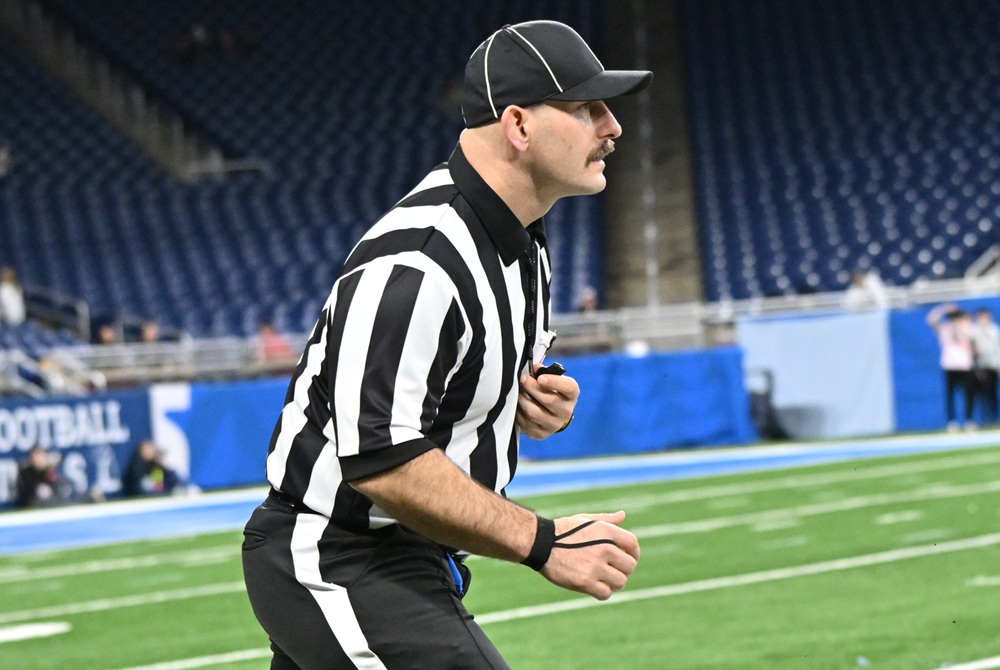
Be the Referee: Pass Interference

By Paige Winne
MHSAA Director of Brand Management

November 3, 2026

Be The Referee is a series of short messages designed to help educate people on the rules of different sports, to help them better understand the art of officiating, and to recruit officials.

Below is this week's segment – Pass Interference - Listen

How well do you know the rules regarding pass interference and passes behind the line of scrimmage? Let’s find out.

The blue team has the ball. The quarterback throws a forward pass to a receiver who is positioned behind the line of scrimmage. Before the receiver can make the catch, a red team defender makes contact with him, and the pass falls incomplete.

Is this defensive pass interference?

The answer is no.

Under high school football rules, pass interference restrictions only apply to forward passes that cross the line of scrimmage. Because this pass was thrown to a receiver behind the line of scrimmage and did not cross it, there is no pass interference.

The same rule applies to backward passes. Pass interference cannot be called on a backward pass, regardless of where the receiver is positioned.

Previous 2026-27 editions

Oct: 27: Field Hockey Substitutions - Listen
Oct. 20: Foot Save in Volleyball - Listen
Oct. 13: Soccer Advantage - Listen
Oct. 6: Defensive Holding - Listen
Sept. 29: Minimum Number of Volleyball Players - Listen
Sept 22: Soccer Changes - Listen
Sept: 15: Dead Ball Penalty - Listen
Sept. 8: Libero Ejected - Listen
Sept. 1: Soccer Foul After Shot on Goal - Listen
Aug. 25: Fumble Out of Bounds - Listen

Membership Mentality

September 16, 2014

The Michigan High School Athletic Association is a membership organization – an association of schools, not individuals – that usually doesn’t think of itself as such. Most member-based organizations work hard to recruit and retain members because member dues are an important revenue source.

That’s not true for the MHSAA which charges no membership dues, no sport sponsorship assessments and no tournament entry fees. The MHSAA is free to join and its tournaments are free to enter.

But that doesn’t mean we shouldn’t think like a member-based organization or that none of the dynamics of membership-based organizations apply here.

For example, we are in the business of recruiting and retaining contest officials; and while we registered approximately 10,600 officials last year, that number is significantly lower than six years ago, and the average age is increasing. So, like any other member-based organization, we need strategies for attracting and holding new, young officials.

A new tactic launched this fall is the “Be The Referee” feature (Click Here) on a Lansing-based sports talk daily radio show and weekly television show. Our staff explains rules and points of emphasis, and then we make a pitch for new officials.

But the most fundamental strategy for recruiting and retaining officials is consistent, ceaseless efforts to improve officials’ working environment. This means improving the assigner-official relationship before events and the sportsmanship at events.

Ultimately, if assigners treat new officials unprofessionally and spectators treat them abusively, we have no chance to increase the numbers and decrease the age of MHSAA registered officials.