

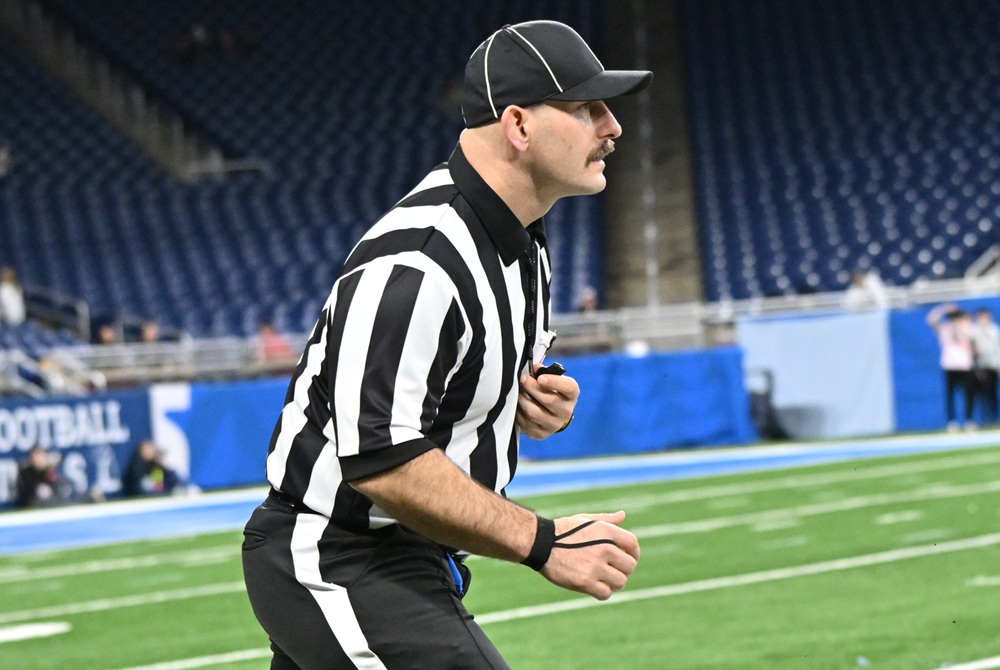
Be the Referee: Pass Interference
By
Paige Winne
MHSAA Director of Brand Management
November 3, 2026
Be The Referee is a series of short messages designed to help educate people on the rules of different sports, to help them better understand the art of officiating, and to recruit officials.
Below is this week's segment – Pass Interference - Listen
How well do you know the rules regarding pass interference and passes behind the line of scrimmage? Let’s find out.
The blue team has the ball. The quarterback throws a forward pass to a receiver who is positioned behind the line of scrimmage. Before the receiver can make the catch, a red team defender makes contact with him, and the pass falls incomplete.
Is this defensive pass interference?
The answer is no.
Under high school football rules, pass interference restrictions only apply to forward passes that cross the line of scrimmage. Because this pass was thrown to a receiver behind the line of scrimmage and did not cross it, there is no pass interference.
The same rule applies to backward passes. Pass interference cannot be called on a backward pass, regardless of where the receiver is positioned.
Previous 2026-27 editions
Oct: 27: Field Hockey Substitutions - Listen
Oct. 20: Foot Save in Volleyball - Listen
Oct. 13: Soccer Advantage - Listen
Oct. 6: Defensive Holding - Listen
Sept. 29: Minimum Number of Volleyball Players - Listen
Sept 22: Soccer Changes - Listen
Sept: 15: Dead Ball Penalty - Listen
Sept. 8: Libero Ejected - Listen
Sept. 1: Soccer Foul After Shot on Goal - Listen
Aug. 25: Fumble Out of Bounds - Listen

Official Treatment
March 7, 2014
A book I quoted in this space three times last November – How: Why HOW We Do Anything Means Everything by Dov Seidman – has me thinking about sports officiating.
One premise of the book is that the Internet era has made the world so transparent and connected that there is no such thing anymore as “private” behavior or a “minor” mistake. Everything can become a public matter – instantly. Anything can become a major problem – overnight. Worldwide.
So, when our local real estate agent, who officiates junior varsity basketball, misses a call that an invested spectator captures with his or her smart phone camera, and sends to his or her relatives and a local media outlet that night, there is no limit to where that video could appear by the next morning.
And while major college and professional officials may now receive four-figure fees to work under those conditions, officials at the junior high/middle school and high school levels – sometimes working for little more than gas money - wonder if it’s worth the hassle.
There are many obstacles to recruiting and retaining officials for school sports, including poor business practices by assigners and bad sportsmanship by coaches and spectators; but a significant factor not to be overlooked is the adverse potential of immediate worldwide criticism for a call that had to be made in the blink of an eye.
The human factor of sports is now subject to inhuman expectations. In an enterprise that strives for fairness, it appears that it’s the official who is being treated least fairly.