

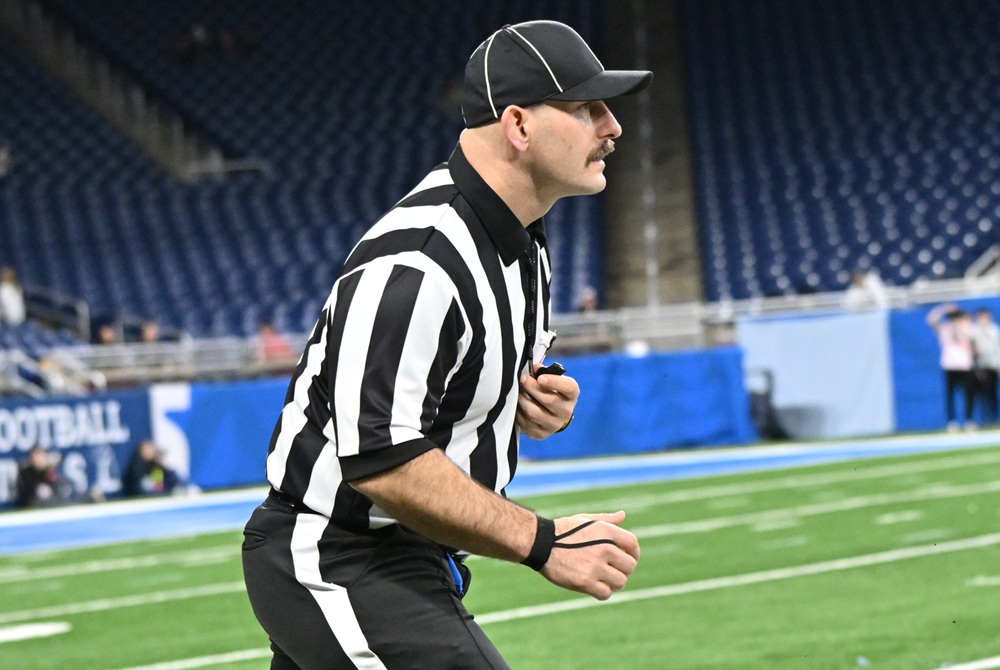
Be the Referee: Pass Interference
By
Paige Winne
MHSAA Director of Brand Management
November 3, 2026
Be The Referee is a series of short messages designed to help educate people on the rules of different sports, to help them better understand the art of officiating, and to recruit officials.
Below is this week's segment – Pass Interference - Listen
How well do you know the rules regarding pass interference and passes behind the line of scrimmage? Let’s find out.
The blue team has the ball. The quarterback throws a forward pass to a receiver who is positioned behind the line of scrimmage. Before the receiver can make the catch, a red team defender makes contact with him, and the pass falls incomplete.
Is this defensive pass interference?
The answer is no.
Under high school football rules, pass interference restrictions only apply to forward passes that cross the line of scrimmage. Because this pass was thrown to a receiver behind the line of scrimmage and did not cross it, there is no pass interference.
The same rule applies to backward passes. Pass interference cannot be called on a backward pass, regardless of where the receiver is positioned.
Previous 2026-27 editions
Oct: 27: Field Hockey Substitutions - Listen
Oct. 20: Foot Save in Volleyball - Listen
Oct. 13: Soccer Advantage - Listen
Oct. 6: Defensive Holding - Listen
Sept. 29: Minimum Number of Volleyball Players - Listen
Sept 22: Soccer Changes - Listen
Sept: 15: Dead Ball Penalty - Listen
Sept. 8: Libero Ejected - Listen
Sept. 1: Soccer Foul After Shot on Goal - Listen
Aug. 25: Fumble Out of Bounds - Listen

Heads and Heat
August 16, 2012
We are engaged in very serious discussions. They’re not only complicated, with unintended negative consequences possible from what are thought to be positive actions; they’re also a matter of life and death.
The topic is football – the high school sport under most scrutiny today and suffering from the most criticism it’s seen since the 1970s when catastrophic neck injuries spiked, liability awards soared, many insurers balked, and most helmet manufacturers abandoned the business altogether.
During recent years we have learned about the devastating long-term effects of repeated blows to the head; and we’re trying to reduce such hits. We’ve learned that 70 percent of concussions in football result from helmet-to-helmet contact, and we’re trying to have coaches teach blocking and tackling differently and have officials penalize “high hits” consistently and rigorously.
During the past several years we’ve learned that serious heat illness and heat-related deaths are 100 percent preventable, yet nationwide there were 35 heat-related deaths in high school football alone from 1995 to 2010; and we’re promoting practices that acclimatize athletes more gradually than “old school” traditionalists might advocate.
As we simultaneously address issues of heads and heat in football, some coaches may think we’re being overbearing, while many in medical fields say we’re out of date, citing higher standards of the American Academy of Pediatrics, National Athletic Trainers Association and National Federation of State High School Associations, as well as many of our counterpart organizations across the country.
As we consider in-season changes to improve athlete acclimatization and reduce blows to the head, we should be open to making out-of-season changes that work toward rather than in opposition to those objectives. There can be no sacred cows. The topic is too serious.
Ultimately, if we err in the outcome of this year’s discussions about heads and heat in football, it must be on the side of safety, on minimizing risks for student participants. They deserve it and, once again, the sport of football needs it.