

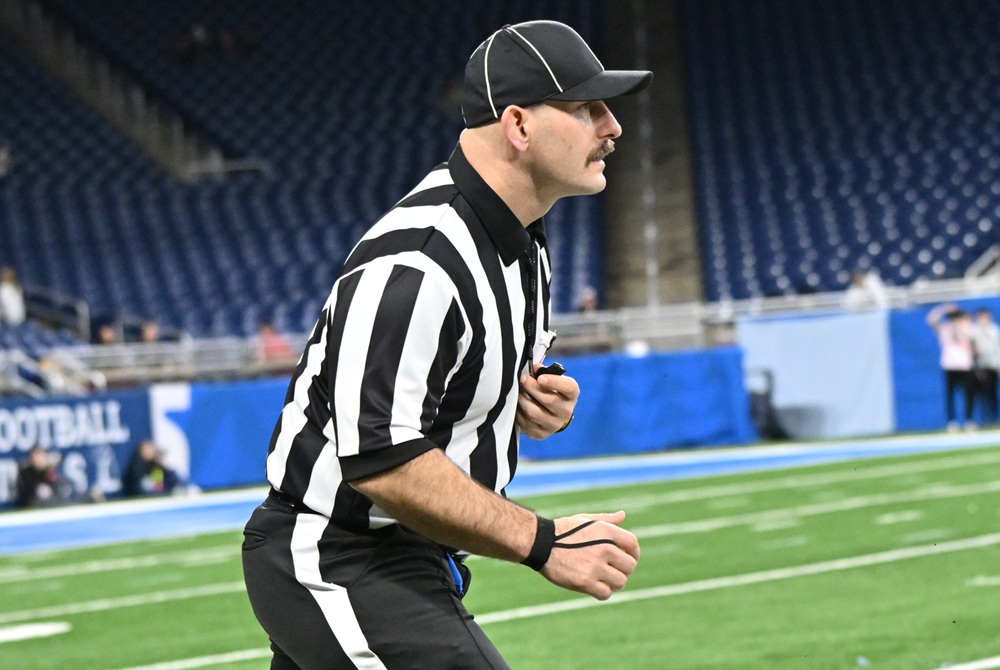
Be the Referee: Pass Interference
By
Paige Winne
MHSAA Director of Brand Management
November 3, 2026
Be The Referee is a series of short messages designed to help educate people on the rules of different sports, to help them better understand the art of officiating, and to recruit officials.
Below is this week's segment – Pass Interference - Listen
How well do you know the rules regarding pass interference and passes behind the line of scrimmage? Let’s find out.
The blue team has the ball. The quarterback throws a forward pass to a receiver who is positioned behind the line of scrimmage. Before the receiver can make the catch, a red team defender makes contact with him, and the pass falls incomplete.
Is this defensive pass interference?
The answer is no.
Under high school football rules, pass interference restrictions only apply to forward passes that cross the line of scrimmage. Because this pass was thrown to a receiver behind the line of scrimmage and did not cross it, there is no pass interference.
The same rule applies to backward passes. Pass interference cannot be called on a backward pass, regardless of where the receiver is positioned.
Previous 2026-27 editions
Oct: 27: Field Hockey Substitutions - Listen
Oct. 20: Foot Save in Volleyball - Listen
Oct. 13: Soccer Advantage - Listen
Oct. 6: Defensive Holding - Listen
Sept. 29: Minimum Number of Volleyball Players - Listen
Sept 22: Soccer Changes - Listen
Sept: 15: Dead Ball Penalty - Listen
Sept. 8: Libero Ejected - Listen
Sept. 1: Soccer Foul After Shot on Goal - Listen
Aug. 25: Fumble Out of Bounds - Listen

Be the Referee: Feet Rule on Soccer Throw-In
By
Paige Winne
MHSAA Director of Brand Management
September 13, 2023
Be The Referee is a series of short messages designed to help educate people on the rules of different sports, to help them better understand the art of officiating, and to recruit officials.
Below is this week's segment – Feet Rule on Soccer Throw-In - Listen
In basketball, when a player is inbounding the ball, his or her feet have to be behind the line when passing the ball. Their feet can’t be touching the line.
But in soccer, a player just has to be on the line to complete a throw-in – even if their heels are both barely touching the line and the majority of their body is in the field of play.
It is considered a legal soccer throw-in if any part of both feet is either touching the line or behind the line, including if the player does a somersault or front-flip style throw-in. As long as they flip and land with both feet on or behind the line and throw the ball – it’s a legal throw-in.
Previous Editions
Sept. 6: Volleyball Jewelry - Listen
Aug. 30: Football Rules Similarities - Listen
Aug. 23: Football Rules Differences - Listen