

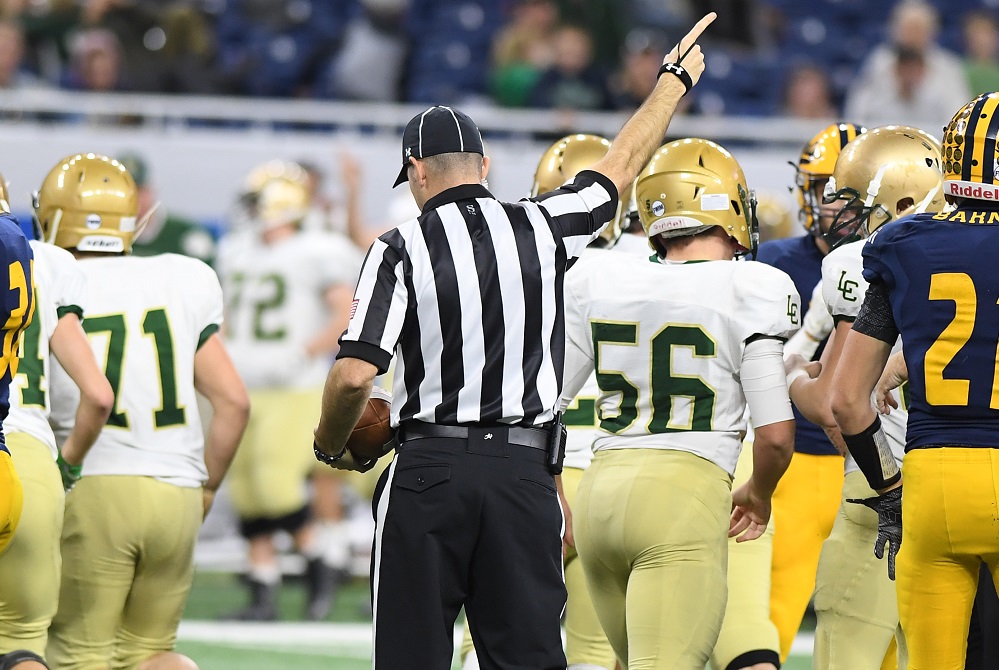
Be the Referee: Pass Interference
By
Geoff Kimmerly
MHSAA.com senior editor
September 2, 2021
This week, MHSAA officials coordinator Sam Davis explains the differences in high school pass interference rules from those at the college and pro levels.
Be The Referee is a series of short messages designed to help educate people on the rules of different sports, to help them better understand the art of officiating, and to recruit officials.
Below is this week's segment – Pass Interference – Listen
One of the big differences between high school football and the college or pro game is how pass interference is called.
In high school, there is no such thing as an “uncatchable” pass. If there is illegal contact by the defender while the ball is in the air, that’s pass interference, no matter where the pass ultimately ends up.
Also – in high school – a defender can “face guard” as long as no contact is made with the receiver. That is not pass interference, even if the defender does not look back for the ball.
Both of those interpretations differ from the college and pro game. Both (of those) levels have an uncatchable exception, and neither allows for face guarding.
Keep that in mind the next time you think you’ve spotted pass interference at the high school level.
Previous editions
Aug. 26: Protocols and Mechanics – Listen
Historic Finish May be Only Start as Cabrini Adds 1st Regional Title to Building Effort
By
Keith Dunlap
Special for MHSAA.com
November 28, 2025
ALLEN PARK — The result in its Division 8 Semifinal wasn’t what Allen Park Cabrini had hoped.
 But in the end, the 2025 season might turn out to be the year a small-school powerhouse was born.
Before this fall, Cabrini had never advanced past the Regional round of the MHSAA Playoffs and had won only four playoff games in school history.
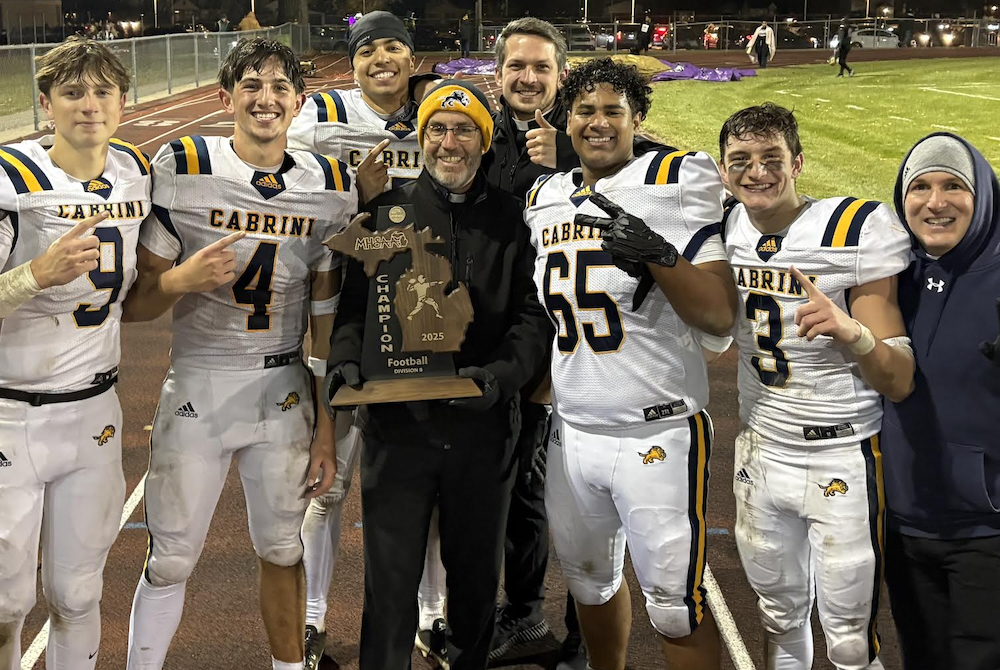
That changed this year, with Cabrini amassing an 11-2 record and winning its first Regional title before falling the next week to No. 1-ranked Hudson.
It was all part of the vision head coach and Cabrini alum R.J. Chidester had when he took over the job three years ago after spending years as a college assistant coach, with Division I Lehigh his last stop before moving home.
“I believe God brought me back home to Cabrini to use the gifts he has given me to show these kids how to develop their spirit and become the best Catholic American young men they can be,” Chidester said. “They develop their spirit with their faith, attitude, love and effort. If they focus on that, God takes over and everything else falls into place. Three years later, they are making their own beds, tuck their shirts in, go to church on their own and continuously push their minds and bodies to the max. That is why we have gotten the results we have.”
Eddie Hughes, a senior for Cabrini, said it’s been amazing to see that plan fulfilled almost verbatim.
“I talked to a teacher about this,” Hughes said. “He told us what was going to happen, and he said, ‘You guys can believe me or not.’ The day he took over the coaching job, he said if we all buy in, this is what’s going to happen.
“In recent weeks, he’s asked us, ‘The day I got this job three years ago, I told you what was going to happen, and what has not come true?’ None of us could think of a single thing. Everything he told us was going to happen has happened.”
Initially, the hardest step for Chidester was making sure he kept kids in the program. The school historically has had good athletes, but once they got to high school, many would move on to other schools that had historically better football programs.
Knowing that, Chidester made sure to share a message when he took the job with Cabrini’s then-middle schoolers and their parents.
“You have been at Cabrini, and why are you jumping ship?” Chidester said he told players and parents. “I don’t want to say it was a recruiting thing. It was more explaining to them what it was like to be part of a community. From an Xs and Os standpoint, your kid is going to be in great shape. I know the game, and I know how to develop. I’ve coached multiple positions at the college level, and I know coaches who’ll help the kids get to the next level.”
Helping the cause was that Cabrini’s pastor, Father Tim Birney, did something out of the box for the school by hiring Chidester as both a coach and administrator to work in the building.
That has helped because he’s in the school halls and around students every day.
“I’m the first male coach that’s been an employee of the school and in the building” Chidester said. “Father Tim said it had never been done here. He rolled the dice on that.”
As historic as this season was for Cabrini, there’s plenty of reasons to believe it can annually make deep playoff runs.
There are a lot of quality non-seniors on the roster, including junior quarterback Evan Bergdoll, and now younger kids in the K-12 school have seen firsthand that the program can win.
“It’s a way of buying in,” Hughes said. “Some kids didn’t stay and didn’t want to buy in. I don’t want to come off rude, but we’re not really missing them. If they don’t want to buy into our program, then good.”
 Keith Dunlap has served in Detroit-area sports media for more than two decades, including as a sportswriter at the Oakland Press from 2001-16 primarily covering high school sports but also college and professional teams. His bylines also have appeared in USA Today, the Washington Post, the Detroit Free Press, the Houston Chronicle and the Boston Globe. He served as the administrator for the Oakland Activities Association’s website from 2017-2020. Contact him at [email protected] with story ideas for Oakland, Macomb and Wayne counties.
PHOTO Allen Park Cabrini football players and coaches surround Fr. Tim Birney for a photo following a 34-32 win over Madison Heights Madison in their Division 8 Regional Final, which clinched the school's first Regional title. (Photo provided by Allen Park Cabrini football program.)