

Be the Referee: Video Review Success
December 5, 2019
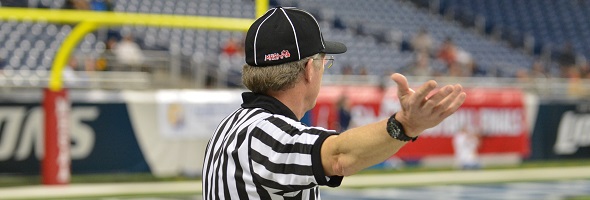
This week, MHSAA assistant director Brent Rice discusses the video review utilized for the first time at last weekend's Football Finals, and how it was successful.
Be The Referee is a series of short messages designed to help educate people on the rules of different sports, to help them better understand the art of officiating, and to recruit officials.
Below is this week's segment - Video Review Success - Listen
For the first time in MHSAA history, video review was utilized to confirm or correct judgment calls on the field for our Football Finals. While there is always some apprehension when adding new technologies to sports, the MHSAA’s approach to a limited replay process, reviewing only those plays that involved turnovers or scores, proved to be a terrific success.
There were a few instances where very close but consequential plays were overturned. However, the biggest confirmation replay provided was something we already knew – that is, that MHSAA officials are putting in hard work and dedication and getting the vast majority of their plays correct in real-time live action.
When needed though, competent replay officials were right on top of the situation to correct the plays without challenges, without controversy and with very little delay in the process.
Past editions
Nov. 28: More Injury Time - Listen
Nov. 21: Football Review - Listen
Nov. 14: Sideline Safety - Listen
Nov. 7: Officials Playlist - Listen
Oct. 31: Most Important Line - Listen
Oct. 24: Automatic 1st Downs - Listen
Oct. 17: Catch Momentum - Listen
Oct. 10: Golf Rules Changes - Listen
Oct. 3: No Tackle Box - Listen
Sept. 26: You Make the Overtime Call - Listen
Sept. 19: Swimming Finishing Touch - Listen
Sept. 12: Curbing Gamesmanship By Substitution - Listen
Sept. 5: Football Safety Rules Changes - Listen
Aug. 29: 40-Second Play Clock - Listen
A Game for Every Fan: Week 6
October 4, 2013
By Geoff Kimmerly
Second Half editor
Admittedly, a number of teams show up regularly in this weekly look at the best high school football games to be played around the state. Their frequent mentions are the product of tough competition they schedule, their past histories of making it to the highest levels of our playoffs, and because of both the overall statewide interest in how those teams fare.
But this week, many of those teams are absent from this list – replaced by some others with similarly strong resumes this season that many probably aren't as used to following.
See below for our best matchups from each region of the state, including four 5-0 vs. 5-0 face-offs.
Some additional fun with numbers: Two teams (Portland and Felch North Dickinson) have qualified for the 11-player playoffs. A total of 76 can qualify with a win tonight. Counting 8-player teams as well, there are 79 teams still undefeated.
Mid-Michigan
Jonesville (5-0) at Homer (5-0)
Neither team has won the Big 8 Conference title since Homer did so in 2005 (although Jonesville finished one game back last season). In fact, Homer hasn’t made the playoffs since 2006 and Jonesville was 1-8 only two seasons ago. But they’re both dominating this fall, and both already have big wins over last season’s league champion, Reading. The winner tonight earns a playoff berth and strong upper hand in the league race with two conference games remaining.
Others that caught my eye: Lansing Everett (4-1) at East Lansing (3-2), Lansing Sexton (5-0) at Holt (3-2), Jackson Lumen Christi (4-1) at Mason (5-0), Williamston (4-1) at Portland (5-0).
West Michigan
Shelby (5-0) at Muskegon Oakridge (5-0)
Oakridge’s 18-game regular-season winning streak is on the line against a team it has beaten in four straight – but also, like Oakridge, a Shelby team that won 10 games last season. The Tigers have romped through its first four games in the West Michigan Conference this fall, while Oakridge did get a scare last week before beating Ravenna 31-27. The winner of this one claims a playoff berth, and Oakridge – with its final league opponents a combined 2-8 – will be touch to catch in the league race if it can prevail.
Others that caught my eye: Allendale (4-1) at Belding (4-1), Lowell (5-0) at East Grand Rapids (3-2), Hudsonville (3-2) at Rockford (4-1), Wyoming Godwin Heights (4-1) at Wyoming Kelloggsville (3-2).
Upper Peninsula
Rapid River (5-0) at Cedarville (5-0)
This has become the regular-season game of the year during the short history of 8-player football in Michigan. Cedarville is tied for the highest playoff points average in 8-player and Rapid River is just behind the three co-leaders. The winner takes a commanding one-game lead in the Bridge-Alliance Conference, but Cedarville has additional motivation: The Trojans beat Rapid River 72-12 during the 2012 regular season and were a heavy favorite to at least make the MHSAA Final – but Rapid River came back to eliminate Cedarville 22-14 in their Regional Final.
Others that caught my eye: Felch North Dickinson (5-0) at Crystal Falls Forest Park (5-0), Lake Linden-Hubbell (3-2) at Hancock (2-3), Kingsford (4-1) at Marquette (4-1), Eagle River Northland Pines, Wis. (5-1) at Houghton (3-2).
Greater Detroit and Southeast
Monroe St. Mary Catholic Central (5-0) at Milan (5-0)
This kind of game has become an annual rite of fall for St. Mary, which has at least 10 wins four of the last five seasons and is used to being in Huron League contention. Milan is getting used to this too; after a dismal 1-8 finish in 2011, the Big Reds ran the table last season and have a 14-game regular-season winning streak on the line. Beating Grosse Ile 21-14 and then St. Mary 35-20 over consecutive weeks last season put the rest of the league on notice, but the rematch of the latter could be both closer and more low-scoring – the Falcons have given up only 22 points this season.
Others that caught my eye: Birmingham Brother Rice (5-0) at Orchard Lake St. Mary's (3-2), Hudson (5-0) at Ida (4-1), Waterford Our Lady (3-2) at Royal Oak Shrine Catholic (5-0), Grass Lake (5-0) at Manchester (4-1).
Lower Up North
McBain (4-1) at Lake City (5-0)
Granted, a giant matchup against reigning MHSAA Division 8 runner-up Beal City looms for Lake City in Week 7. But few teams statewide have been as impressive so far as the Trojans, who have outscored their opponents by a combined 262-6 – yes, 6 – in setting up for another Highland Conference title-deciding showdown with the Aggies. McBain would love to ruin that possibility. The Ramblers did fall to Lake City 28-13 last season, but have beaten Trojans in three of their last five games and already have equaled last season’s win total.
Others that caught my eye: Elk Rapids (4-1) at Grayling (4-1), Mio (4-1) at Rogers City (3-2), Mancelona (3-2) at Pickford (4-1), East Jordan (3-2) at Boyne City (4-1).
Southwest and Border
Schoolcraft (4-1) at Battle Creek Pennfield (5-0)
Did you know? ... Pennfield has qualified for the playoffs 14 straight seasons and can make it 15 tonight. The Panthers have to be careful, however, not to look ahead to next week’s matchup with Olivet – the other team tied for first in the Kalamazoo Valley Association. That shouldn’t be an issue, however, given Schoolcraft won the league last season thanks in large part to a 19-16 win over Pennfield. Schoolcraft already has fallen to Olivet this season, three weeks ago, and likely must win tonight to keep hopes of a shared title alive.
Others that caught my eye: Lawton (5-0) at Hartford (3-2), Mattawan (2-3) at Portage Northern (3-2), Deckerville (3-2) at Lawrence (3-1), Battle Creek Harper Creek (4-1) at Sturgis (3-2).
Bay and Thumb
Frankenmuth (4-1) at Millington (4-1)
The layers of this rivalry stack high, and this game no doubt is the one both have had circled all fall. After three seasons falling to the Cardinals, Frankenmuth broke through for a 12-8 win in the Tri-Valley Conference East opener last season and hung on to win the league title while Millington also didn’t lose again until the District Finals. The Cardinals have fallen to Essexville-Garber in league play this season and trail the Eagles by a win in the standings with two more games to play after tonight.
Others that caught my eye: Vassar (3-2) at Marlette (5-0), Bay City Western (2-3) at Midland Dow (4-1), Cass City (3-2) at Reese (4-1), Fenton (5-0) at Lapeer East (3-2).
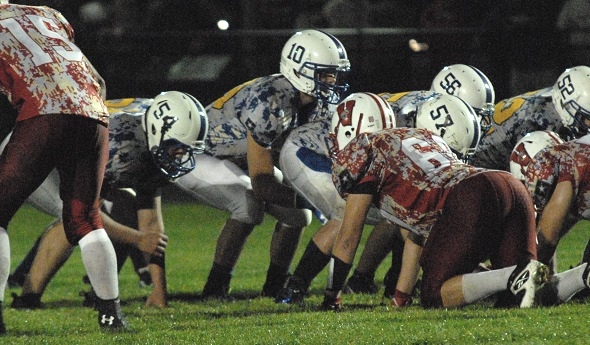
PHOTO: Carson City Crystal – here against Vestaburg in Week 4 – is one of 76 teams statewide that can qualify for the playoffs with a win tonight. The Eagles made the postseason last fall for the first time since 1999. (Click to see more from High School Sports Scene.)