

Bedford Follows Mifsud's Hall-of-Fame Formula to 7-0 Start, SEC Red Title Game
By
Doug Donnelly
Special for MHSAA.com
October 15, 2026
The rumors of Dave Mifsud living across the street from Temperance Bedford High School or being able to see the school from his kitchen window are greatly exaggerated.

Mifsud, in his first year coaching the Kicking Mules, actually lives about five minutes from the stadium. And, no, he can’t see the glow from the Friday night stadium lights from his house.
All joking aside, Mifsud may have found the perfect spot to continue his hall of fame career. After stops at Dearborn, Parma Western, Monroe and Brownstown Woodhaven, Mifsud took over the Bedford program in January and has the Mules off to a remarkable 7-0 start heading into Friday night’s Southeastern Conference showdown with powerhouse Saline.
“I feel like I'm at home right now,” Mifsud said this week. “I feel working and coaching at Bedford, being around this community, I feel like I'm at home.”
The funny part is, he wasn’t looking for one.
Mifsud said he moved to Temperance about five years ago to be closer to his son and three grandchildren in Toledo. He became the head coach at Brownstown Woodhaven and thought he had found his last coaching stop.
“When I took the Woodhaven job, I said, ‘This is it – I’m not going to change jobs again.’ But I put a disclaimer on there – and that was unless the Bedford job opened up.”
This past offseason, it did.
Mifsud said the distance driving to and from Woodhaven was the difference.
“I was driving 39 miles each way to work and spending an awful lot of time in the car,” he said. “I didn’t get to enjoy as many community events as I wanted to be involved in, even just going to basketball games or baseball games and things like that. It was just too far from home. So, this job was definitely a big attraction to me.”
He was hired.
By no means was he taking over a bad program. Quite the opposite. Bedford has been a perennial playoff team – they’ve qualified 14 times since 2009 – and contended among the top half of the SEC Red most of those years.
When Mifsud arrived, however, he had a blank slate. He had to bring in an almost entirely new football staff, overhaul the offense, and create a new-look defense.
“I spent hours and hours and lots of late, late nights interviewing coaching candidates,” he said. “I didn’t really know any of them ahead of time. There was one coach, Sean Stephens, that I had met and talked to a couple of times, but really, I didn’t know any of them.
“The foundation was, the thing that I started off explaining to each and every one of them, was my philosophy and what my goals were and where I was coming from. I wanted them to know how we were going to treat the kids and treat the program.”
Football, he said, teaches great life skills and life lessons.
“Our No. 1 goal is for the kids to have the best memories and the most positive memories from their high school days as being part of the football program,” he said.
He hired coaches from Toledo and the Downriver area, a former Bedford player and one coach who was on a previous Bedford staff. He named a football operations coordinator to handle things like media requests and statistics.
The offense, he said, is a combination of all of the offenses he’s run over the years while building a solid resume at Dearborn and Parma Western.
“We adapted and evolved a little,” he said. “I think we’ve cleaned up some of the things we were doing at Woodhaven.
His defense was constructed with the help of Mike Parker, who had coached at Toledo Whitmer, one of the largest schools in northwest Ohio.
The formula has worked wonders. The 7-0 start is something even Mifsud didn’t see coming.
“Going into it, of course you have high hopes,” he said. “I feel like there was the hope or possibility of being 7-0, but there was also this reality that we could be 3-4 or 4-3. You just don’t know how games are going to play out and how kids are going to respond.”
The biggest win was probably the first, a 20-13 victory over Sterling Heights Stevenson.
“The kids played their hearts out that game, and a really great win,” he said.
What’s followed have been six more in much the same fashion.
“We’ve continued on with the thinking that we just need to go 1-0 each week,” he said. “We’ve had to battle and compete in each game.”
Not only did Mifsud have to create a new coaching staff, but few of last season’s ball carriers were back this fall. One who might have been expected to be a starting running back, for example, transferred to an Ohio school. Other players moved positions and into new roles.
Masyn Moran has emerged as the top ball carrier with 636 yards and 12 touchdowns over seven games. Luke Whetstone has thrown for 841 yards while completing 64 percent of his passes. He’s also rushed for more than 500 yards. Jaxson Lestock has 20 catches for more than 300 yards. The Mules offense has been balanced with 263 rushes and 100 passes.
Bedford’s 7-0 start is the first for the program since 2013 and just the third in school history. Mifsud said the same formula that got Bedford to this point is what he plans on using this week against the also-undefeated Hornets. The winner will own the SEC Red title outright.
“There are some really good kids at Bedford, and they have bought into and committed to the new coach and system,” he said. “The school community has been awesome.”
 Doug Donnelly has served as a news and sports reporter at the Adrian Daily Telegram and the Monroe News for 30 years, including 10 years as city editor in Monroe. He's written a book on high school basketball in Monroe County and compiles record books for various schools in southeast Michigan. He is now publisher and editor of The Blissfield Advance, a weekly newspaper. E-mail him at [email protected] with story ideas for Jackson, Washtenaw, Hillsdale, Lenawee and Monroe counties.
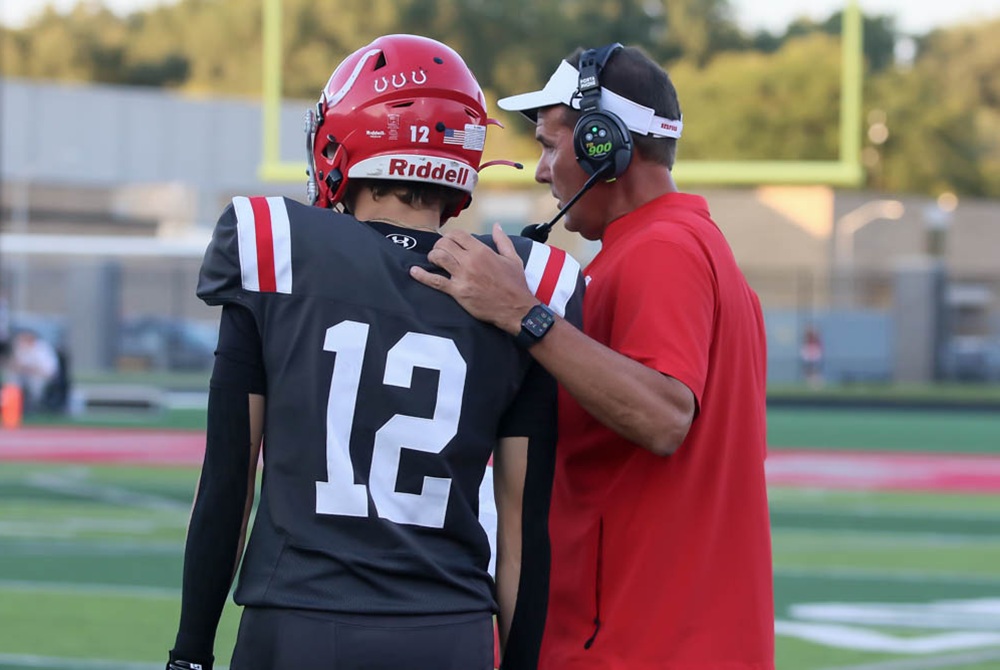
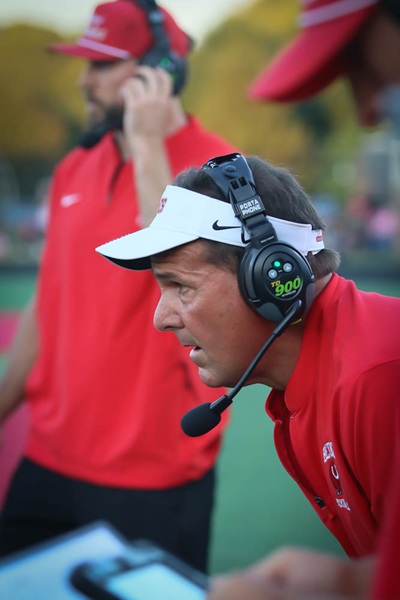
PHOTOS (Top) Temperance Bedford football coach Dave Mifsud instructs player Brady Boisselle during a game this season. (Middle) Mifsud monitors the action from the sideline. (Photos by Jaymee Beard/Temperance Bedford athletics.)

Teaching ABC's of Pressure Situations
October 30, 2013
 By Eric Martin
MSU Institute for the Study of Youth Sports
Coaches have seen the signs: Athletes having too much or not enough energy prior to a game, quickening breathing, sweating more than usual, being unable to focus on important details, and having their minds wander from the present to “what if” scenarios and past mistakes.
Athletes deal with pressure in many ways. Although some handle it well, many do not have the tools to perform to their full abilities in these situations. Most athletes place a high importance on succeeding in sport, and when athletes reach regional, district, or state championships, the pressure they feel may become overwhelming.
How athletes handle this increased pressure can often mean the difference between winning and losing. Therefore, helping athletes deal with it is something coaches should consider prior to athletes encountering these high-stakes situations.
Unfortunately, there is no magic elixir for helping your athletes work under pressure. But if these ABC’s of pressure situations are followed, your athletes will be much better equipped to cope, and the chances of their performance levels dropping significantly will be reduced.
1. Act the Part
How you as coaches act influences your athletes. For better or worse, athletes notice your emotions in response to these situations and take cues from how you handle pressure.
You are a demand on your players’ attention – you can add or reduce your players’ perceived stress by how you act. Understanding the demand you place on players requires self-awareness. How do you respond when a key call goes against you? Do you have nervous habits that athletes may notice? What messages are you providing to your athletes – both verbally and non-verbally? Athletes pick up on these non-verbal cues, so you must be aware of how you respond to these situations.
It is important to remember emotions are not always negative – rather acting differently than normal can be a signal to your athletes that you are stressed. Strive to be consistent in your actions – whether you are coaching during a preseason match or championship contest. These situations are stressful for you too, but you need to be the constant your athletes look to for stability.
2. Breathing – Remember to do it
It seems like a simple thing, but when athletes’ emotions are running high, they forget how to breathe – or, at least, forget how to breathe properly. Worse, they often think they are breathing normally but don’t notice breaths are becoming shorter and shallower. Teaching athletes to breathe properly when not in pressure situations will help them have the tools to rely on when they encounter more intense scenarios.
For proper breathing, athletes need to do so from the belly and not the chest. The pace of this breathing should be 6-2-7; that is, have athletes take a deep breath from the abdomen for six seconds, hold for two seconds, and then finally slowly exhale completely for seven seconds. This breathing strategy is ideal for pregame situations to quiet nerves and help athletes get ready to play, but a condensed version (3-2-3) can also be used for quick breaks in the action like a timeout or court change.
3. Control the controllables
During times of high pressure, athletes sometimes feel they do not have control over their own performances. It is important to help athletes focus on things they can control and not worry about those that cannot be changed or are outside their influence.
Instead of athletes dwelling on aspects that are out of their control like unusual game times for championship finals or a referee’s bad call, help them focus on completing their warm-up preparations and how they can respond to poor calls. Helping focus athletes’ attention on things they can control will help them better handle pressure situations and leave them feeling less helpless
Athletes’ emotions are typically out of their control, but how they view them and respond to these emotions are under their control. Author and preacher Charles R. Swindoll said, “Life is 10 percent what happens to you and 90 percent how you react to it!” Be sure your athletes know how to respond when difficult situations arise.
Conclusion: Fearlessness is an assembly
Not all athletes react to pressure situations in the same manner, but all athletes can benefit from these simple suggestions. Remember to ACT THE PART of how you want your athletes to act, teach your athletes proper BREATHING techniques, and help athletes focus on CONTROLLING THE CONTROLLABLES.
Good preparation is the key to performance. Increase self-monitoring and give athletes the tools to succeed in pressure situations; they, in turn, can be in a better position to succeed. However, like any skills, they must be practiced accordingly, and one session will not solve all issues. Devote the time to train athletes in these skills, and when the need arises they will have them ready to use.
Good luck this season!
Martin is a third-year doctoral student in the Institute for the Study of Youth Sports at Michigan State University. His research interests include athlete motivation and development of passion in youth, sport specialization, and coaches’ perspectives on working with the millennial athlete. He has led many sessions of the MHSAA Captains Leadership Clinic and consulted with junior high, high school, and collegiate athletes. If you have questions or comments, contact him at [email protected].