

Beecher Becoming a Football School Too
November 14, 2012
By Bill Khan
Special to Second Half
FLINT — Basketball is a source of pride at Flint Beecher, with a tradition of excellence that includes four boys and two girls MHSAA championships.
Courtney Hawkins is as proud as anyone, having played on the 1984-85 and 1986-87 championship teams.
But hoops mania is also a source of frustration for Hawkins, the school's football coach and athletic director.
Where basketball is king, other athletic programs can sometimes suffer, as more and more kids are persuaded into specializing in one sport and playing in travel leagues outside of their high school season.
If you want to get Hawkins up on his soap box, ask him about the effect AAU basketball has had on the overall athletic program at Beecher.
Mr. Hawkins, the floor is yours ...
"It kills me to watch some kids who, you know just from the stuff they can do athletically, would be a heck of a football player or could contend for the state championship in the 100 meters or high jump," Hawkins said. "It's absolutely sickening. There are only so many basketball scholarships. They still haven't figured it out. Every year when basketball season is over, there are a number of kids who won't get scholarships, because there are so few. Every single year, there's a handful of boys -- every year -- who come to me and say, 'Coach Hawkins, I wish I would've played football and track.' It's happened seven years in a row and it will happen this year.
"AAU basketball is great. It makes everything seem so good. They get to travel across the country. AAU basketball is big business. It's not the best for every kid, especially when they tell these kids they're going to be the next LeBron James and the next year I see them at the store."
 Hawkins needs only to offer up himself as an example of how an athlete can have success beyond high school while still playing multiple sports as a prep. He was an all-stater in football, basketball, and track and field before focusing on football at Michigan State University. Hawkins went on to play nine seasons as a wide receiver in the NFL. He was a key member of MHSAA championship teams in basketball and track.
Beecher's reputation as a basketball school may finally be changing, albeit slowly.
Hawkins has only two members of last year's Class C championship basketball team on his football roster, but hopes that the team's first-ever run to the MHSAA Semifinals opens some eyes among hoopsters around school.
Beecher (8-4) will face Detroit Loyola (12-0) at 1 p.m. Saturday in a Division 7 Semifinal at Fenton High School. The Buccaneers get a Second Half High 5 this week after overcoming a 3-4 start to make the playoffs as an additional qualifier at 5-4 before winning three postseason games for the first time.
Beecher hopes to become only the fourth team with four losses to win an MHSAA championship. The Buccaneers can look to nearby Flint Powers Catholic, last year's Division 5 champion, for proof that it can be done.
"I didn't want to tell the team that, because they don't like other teams, but I looked at Powers coming in 5-4 and thought, 'Why can't we do the same thing?'" said senior Kermit Craig, a defensive end and tight end.
Beecher is in the playoffs for the sixth straight year, but this was the most unlikely team to advance this far. Beecher's other playoff teams won at least six games, including a 9-0 squad in 2009 that was bounced in the first round.
"Yeah, I'm surprised, but one thing we do is work hard every day," said senior Eric Cooper, a wide receiver and free safety. "I just came to practice every day motivating all the guys to work hard, keep their heads up, and we're going to get a blessing. That's what we got."
The Buccaneers squeaked out a 21-20 victory over Mt. Morris on Oct. 12 to begin their current five-game winning streak. Their crowning achievement so far was knocking off defending Division 7 champion Saginaw Nouvel in the Regional Final, 19-15. Now they're one victory away from a trip to Ford Field.
"I guess with the youth and the fact we snuck in at 5-4, it's surprising that we went this far," Hawkins said. "But with that being said, the way that they've worked and the way they've stayed committed, it's been one of my best groups from that standpoint. I've had some groups that had more success early in the season. This team has great senior leadership. We have some young kids who are just phenomenal in terms of following the senior leaders. They're very coachable, very good kids. This is my first year of having some kids who don't want to play basketball. My starting quarterback, (freshman) Marcus Wright, said, 'Coach, I'm a football player.' We don't get many of those here at Beecher."
There was a time when playoff appearances, let alone trips to the Semifinals, seemed more unlikely than what this 5-4 team has achieved in this postseason.
Hawkins returned to his alma mater in 2006 to take over a program that had 11 straight losing seasons. After a 2-7 inaugural season that saw considerable improvement, Beecher has gone 45-20 while playing as the smallest school in the Genesee Area Conference's Red Division.
"We had to change the attitude," Hawkins said. "There were a lot of people who were, 'We play basketball at Beecher.' That was the approach. Then there was the losing attitude throughout the whole football program. The first year, we were 2-7. We were in a lot of games, but you could see the losing attitude from being beat down all those years. We as a coaching staff stayed on them."
The fact that Hawkins would return to the community after an NFL career gives him considerable credibility with his players.
"That means a lot," Craig said. "Most people look up to him as a father. He came to build the program and led us to where we are now. I learned a lot from him. As a young man, I look up to him. If I have problems, I go to coach Hawkins and talk to him about it. He's more a man than a football coach. He leads you to the right way."
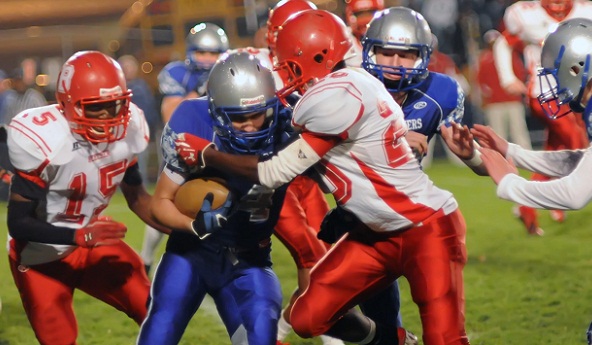
PHOTO: (Top) Beecher linebacker Tyrik Wicks (20) wraps up Saginaw Nouvel's Ryan Sullivan (4) as sophomore Mike Herd (15) also pursues during last weekend's Regional Final. (Middle) Flint Beecher coach Courtney Hawkins, who also played at Michigan State and in the NFL. (Click to see more from the Regional Final at HighSchoolSportsScene.com.)

Committees Fail Critical Issues
June 7, 2013
Typically, each sport committee meets once each year for three to five hours, during which time it considers proposals that come from schools, leagues and the state’s coaches association for the sport; and the proposals most often deal with allowing more regular-season events and more qualifiers to the MHSAA postseason tournament.
Occasionally there is a proposal that might improve sportsmanship. But much more often the proposals would increase conflicts between academics and athletics and/or strain overstressed local budgets. And almost never is there a proposal that would address the health and safety of participants (the Wrestling Committee has been an occasional exception and the Competitive Cheer Committee is a routine exception).
While coaches associations must shoulder some of the blame because they’ve brought MHSAA committees “trivial” topics, at least in comparison to the tougher health and safety topics, much of the cause of MHSAA committee ineffectiveness is that the committees don’t meet long enough or often enough to research serious problems and develop well-thought-out solutions. That is forgivable because it is difficult to get commitments from busy people all across Michigan to be absent from their regular jobs and travel dozens or even hundreds of miles, and to do so multiple times each year – which is what it takes to more fully understand complex problems and more carefully construct solutions. Meetings have to be few and they have to be efficient.
However, facing the worst publicity football has seen since the mid-1970s, we knew we had to supplement the football committee process. We did so by appointing a special Football Task Force of optimum size and experienced, representative makeup to meet on however many occasions are necessary during 2013 to accomplish three purposes:
- Review practice policies to improve acclimatization of players and reduce head trauma.
- Review competition rules to reduce head trauma and the frequency of the sport’s most injurious game situations.
- Develop promotions that extol the value of football to students, schools and communities and the safety record of school-based football.
The promotional efforts have begun to be rolled out; game rule modifications are being investigated; and four proposals for changing football practice policies have been prepared. They will be the topic of our next posting.