

Beecher Becoming a Football School Too
November 14, 2012
By Bill Khan
Special to Second Half
FLINT — Basketball is a source of pride at Flint Beecher, with a tradition of excellence that includes four boys and two girls MHSAA championships.
Courtney Hawkins is as proud as anyone, having played on the 1984-85 and 1986-87 championship teams.
But hoops mania is also a source of frustration for Hawkins, the school's football coach and athletic director.
Where basketball is king, other athletic programs can sometimes suffer, as more and more kids are persuaded into specializing in one sport and playing in travel leagues outside of their high school season.
If you want to get Hawkins up on his soap box, ask him about the effect AAU basketball has had on the overall athletic program at Beecher.
Mr. Hawkins, the floor is yours ...
"It kills me to watch some kids who, you know just from the stuff they can do athletically, would be a heck of a football player or could contend for the state championship in the 100 meters or high jump," Hawkins said. "It's absolutely sickening. There are only so many basketball scholarships. They still haven't figured it out. Every year when basketball season is over, there are a number of kids who won't get scholarships, because there are so few. Every single year, there's a handful of boys -- every year -- who come to me and say, 'Coach Hawkins, I wish I would've played football and track.' It's happened seven years in a row and it will happen this year.
"AAU basketball is great. It makes everything seem so good. They get to travel across the country. AAU basketball is big business. It's not the best for every kid, especially when they tell these kids they're going to be the next LeBron James and the next year I see them at the store."
 Hawkins needs only to offer up himself as an example of how an athlete can have success beyond high school while still playing multiple sports as a prep. He was an all-stater in football, basketball, and track and field before focusing on football at Michigan State University. Hawkins went on to play nine seasons as a wide receiver in the NFL. He was a key member of MHSAA championship teams in basketball and track.
Beecher's reputation as a basketball school may finally be changing, albeit slowly.
Hawkins has only two members of last year's Class C championship basketball team on his football roster, but hopes that the team's first-ever run to the MHSAA Semifinals opens some eyes among hoopsters around school.
Beecher (8-4) will face Detroit Loyola (12-0) at 1 p.m. Saturday in a Division 7 Semifinal at Fenton High School. The Buccaneers get a Second Half High 5 this week after overcoming a 3-4 start to make the playoffs as an additional qualifier at 5-4 before winning three postseason games for the first time.
Beecher hopes to become only the fourth team with four losses to win an MHSAA championship. The Buccaneers can look to nearby Flint Powers Catholic, last year's Division 5 champion, for proof that it can be done.
"I didn't want to tell the team that, because they don't like other teams, but I looked at Powers coming in 5-4 and thought, 'Why can't we do the same thing?'" said senior Kermit Craig, a defensive end and tight end.
Beecher is in the playoffs for the sixth straight year, but this was the most unlikely team to advance this far. Beecher's other playoff teams won at least six games, including a 9-0 squad in 2009 that was bounced in the first round.
"Yeah, I'm surprised, but one thing we do is work hard every day," said senior Eric Cooper, a wide receiver and free safety. "I just came to practice every day motivating all the guys to work hard, keep their heads up, and we're going to get a blessing. That's what we got."
The Buccaneers squeaked out a 21-20 victory over Mt. Morris on Oct. 12 to begin their current five-game winning streak. Their crowning achievement so far was knocking off defending Division 7 champion Saginaw Nouvel in the Regional Final, 19-15. Now they're one victory away from a trip to Ford Field.
"I guess with the youth and the fact we snuck in at 5-4, it's surprising that we went this far," Hawkins said. "But with that being said, the way that they've worked and the way they've stayed committed, it's been one of my best groups from that standpoint. I've had some groups that had more success early in the season. This team has great senior leadership. We have some young kids who are just phenomenal in terms of following the senior leaders. They're very coachable, very good kids. This is my first year of having some kids who don't want to play basketball. My starting quarterback, (freshman) Marcus Wright, said, 'Coach, I'm a football player.' We don't get many of those here at Beecher."
There was a time when playoff appearances, let alone trips to the Semifinals, seemed more unlikely than what this 5-4 team has achieved in this postseason.
Hawkins returned to his alma mater in 2006 to take over a program that had 11 straight losing seasons. After a 2-7 inaugural season that saw considerable improvement, Beecher has gone 45-20 while playing as the smallest school in the Genesee Area Conference's Red Division.
"We had to change the attitude," Hawkins said. "There were a lot of people who were, 'We play basketball at Beecher.' That was the approach. Then there was the losing attitude throughout the whole football program. The first year, we were 2-7. We were in a lot of games, but you could see the losing attitude from being beat down all those years. We as a coaching staff stayed on them."
The fact that Hawkins would return to the community after an NFL career gives him considerable credibility with his players.
"That means a lot," Craig said. "Most people look up to him as a father. He came to build the program and led us to where we are now. I learned a lot from him. As a young man, I look up to him. If I have problems, I go to coach Hawkins and talk to him about it. He's more a man than a football coach. He leads you to the right way."
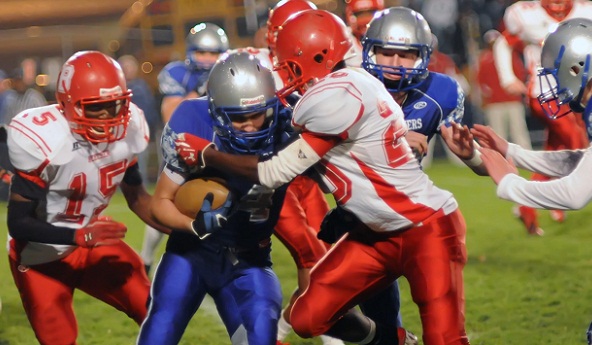
PHOTO: (Top) Beecher linebacker Tyrik Wicks (20) wraps up Saginaw Nouvel's Ryan Sullivan (4) as sophomore Mike Herd (15) also pursues during last weekend's Regional Final. (Middle) Flint Beecher coach Courtney Hawkins, who also played at Michigan State and in the NFL. (Click to see more from the Regional Final at HighSchoolSportsScene.com.)

Michigan’s Football Numbers Game – Corrected
September 1, 2017
Today’s blog was written by MHSAA Second Half Editor Geoff Kimmerly
The demise of Michigan high school football has been greatly exaggerated – or, at least, recently misreported by one of the U.S.’s most recognizable newspapers that noted as part of a larger story on football decline that Michigan has seen a “net loss of 57 teams in the past five years.”
It’s easy to understand how this error took place – especially when a reporter is not familiar with the football landscape in our state – but that doesn’t make this statement any less misleading, or harmful considering the story since has been picked up by multiple large news organizations. So let’s quickly clear up the misinterpreted information:
-
The data that led to this error came from an annual participation report released by the National Federation of State High School Associations (NFHS). Every spring, state associations (like the MHSAA) from every state and Washington, D.C., tally up how many of their member schools have a sport and how many athletes play it.
-
For 2016-17, the MHSAA submitted to the NFHS a total of 580 schools with 11-player football – that number actually includes all schools that reported having at least one football player, including primary and secondary schools in co-ops. And yes, that 580 is 57 fewer than the 637 11-player schools the MHSAA submitted for 2012-13.
-
But saying Michigan has lost 57 football programs misses out on something incredibly significant – the MHSAA also submitted 60 schools with 8-player football last year, up from 16 in 2012-13, making that net decrease in football schools over five years 13 – far fewer than 57.
And with a few more brush strokes, the picture of football in our state actually shows a healthy landscape:
-
The 640 schools in Michigan with at least one football player for 2016-17, 11 and 8-player combined, is actually eight more than we reported to the NFHS four years ago and 10 more than three years ago.
-
A better picture of Michigan’s football consistency is shown by how many varsity programs are taking the field. This fall, that number is 616 – 555 11-player varsities and 61 8-player – and we also had 616 for most of the 2016 season, 616 in 2015 and 615 in 2014.
-
We’ve had programs bring back varsity teams this year, and in one case a school has a team on its own for the first time. Benzonia Benzie Central and Suttons Bay were unable to field varsities in 2016, but Benzie Central is back playing 11-player and Suttons Bay is back with an 8-player team. Brimley, an 8-player school going back to 2010, also is fielding a team again after being unable to do so last year. Mount Clemens played only two varsity games in 2016 and forfeited a third, but has seven scheduled for this fall and lost close in its opener last week. And Bear Lake, previously a secondary school in a co-op program, now has a team all its own for the first time and is playing at the 8-player level.
-
Yes, there has been a decrease in Michigan high school football participation when it comes to the number of players – for reasons we discuss frequently, including more extracurricular/entertainment options than ever for students, more who are specializing in other sports and safety fears that often are misplaced. But we’ve also seen a three percent drop in enrollment at MHSAA member schools over the last five years. And despite that trend, Michigan again had the sixth-highest 11-player football participation in the nation in 2016-17 (and seventh-highest in 8-player) while ranking 10th nationally in number of residents of high school age.
-
So yes, while a nine percent drop in the number of football players over the last five years in Michigan clearly is troubling, and something we’re working with the Michigan High School Football Coaches Association to reverse, let’s also put those numbers in perspective. At medium-sized to bigger schools, it could mean a roster of 40 might have only 36 players. A roster of 20 at an 8-player school might go down to 18. Neither would signal the need to eliminate a football program.
-
And that move by so many schools to 8-player? It definitely started as a way for low-participation programs to keep football (and has worked for most of them). While that still may be the driving force as schools move from 11 to 8, others have made the switch because most of their former opponents did and joining them makes scheduling easier and travel shorter. Michigan has a multitude of small towns, and you’ll find most of these 8-player programs in pockets in the thumb, southwest or northern Lower Peninsula, or Upper Peninsula. And keep in mind, only Class D teams remain eligible for the 8-player playoffs – and only two of 61 teams playing 8-player this fall are larger than Class D and its enrollment limit of 203 students for 2017-18.
The story behind “a decrease of 57 schools” clearly is a little complex to explain and explain away, but it’s necessary to do so.
Yes, Michigan’s total number of football players is down a few percent. But the sport’s prominence and importance in our schools and communities remains high.