

Behind Scenes, St Mary's Goes to Goddard
September 27, 2016
By Keith Dunlap
Special for Second Half
As a coach and athletic director at Orchard Lake St. Mary’s over nearly three decades, George Porritt has been asked plenty of times to recall details from his football program’s storied past.
 That comes with coaching a program that annually has a roster full of highly-touted high school players coveted by college recruiters and has seen the best not only shine for prominent college programs but also NFL organizations (see Allen Robinson of Jacksonville).
“When was the last time a player did that?”
“What is the school record in this category?”
“How often has your team done this in a season?”
“When was the last time you lost to this opponent?”
Porritt’s answer is usually quick and consistent.
“Ask Robin Goddard,” Porritt typically says.
For the past 40 years, turning to Goddard has been a frequent option for anyone around St. Mary’s, and for that matter, other schools around the state.
It is why there will be lots of people in the prep sports community thinking of him when he has surgery on Thursday to break up kidney stones that have been bothering him during recent weeks.
Goddard each year puts together media guides with records and teams at St. Mary’s that go all the way back to the early 1900s. (See "Michigan's Football Past: A Must Read")
He can easily point out the fact that St. Mary’s won a state basketball championship in 1933, lost in the state basketball semifinals in 1919 and won its first state baseball championship in 1913. (Note: The MHSAA was not formed until Dec. 1924; previous championship tournaments were hosted by various entities around the state.)
“If he doesn’t have it in something, he finds it right away,” Porritt said. “He goes to the library and he tries to dig it up. He calls the other school and has done it for years. He keeps a great history of our school.”
Surely though, there have to be times when people raise their eyebrows at Goddard and wonder how he can possibly get accurate information from a century ago, right?
Actually, not really.
Not around St. Mary’s, anyway, even if it is hard to fathom for many others that high school sports in Michigan actually did exist before the start of World War I.
“I won’t even challenge him,” Porritt said. “I know he found it somewhere. He’ll tell other schools what their records are historically, and they don’t even know what theirs is. He has fun doing it and will go anywhere and find any way to find out the history of whatever he is looking into.”
Goddard’s importance to the school isn’t limited to being arguably the Encyclopedia Britannica of prep sports in the state of Michigan.
Also a facilities coordinator and valuable fundraiser, Goddard has spearheaded projects to put a track and lights at the football field, and was the architect of one of the most ambitious and out-of-box ideas ever seen at the school – the red artificial playing surface now on the football field.
 During Labor Day weekend in 2011, Goddard flew to Cheney, Wash., to meet with officials at Eastern Washington University, which at the time had the only red-colored artificial football field in the country.
Goddard picked the brains of the folks at Eastern Washington, came home and started a fundraising effort to try and secure $600,000 to bring a red-colored artificial surface to St. Mary’s.
By the following spring, the funds were raised and construction began on the field that was ready by the start of the 2012 season.
At the time, it was the third red-colored field in the country in addition to Eastern Washington and a high school field at Canyon High School in Texas.
Goddard also helped start the annual Polish Country Fair that takes place on the St. Mary’s campus every Memorial Day weekend, which is one of the most regularly-attended festivals in the Detroit area.
Len Karschnia, an administrator and assistant coach for the both the football and basketball teams at St. Mary’s, said when Goddard gets in touch with alums who have the means to donate back to the school, there usually is no hesitation because of their respect for Goddard.
“They always trust Robin to do that,” Karschnia said. “Everything he does (is) for the kids and the school, and that is why nobody is really reticent to give back to any projects that he runs because if he tells you on Tuesday he wants $500 to put up a banner in the gym, on Thursday the banner is up and done and there is a plaque on the wall saying thanks to whoever gave it to him.”
A staple at the school since he arrived in 1976, there obviously will be a lot of prayers and well-wishes around the state for a speedy recovery from surgery.
“He is a guy that whatever St. Mary’s needs, he’ll do it and he doesn’t need any fanfare for his good deeds,” Karschnia said. “It’s all for the kids, for George and for the school. That is really his value.”
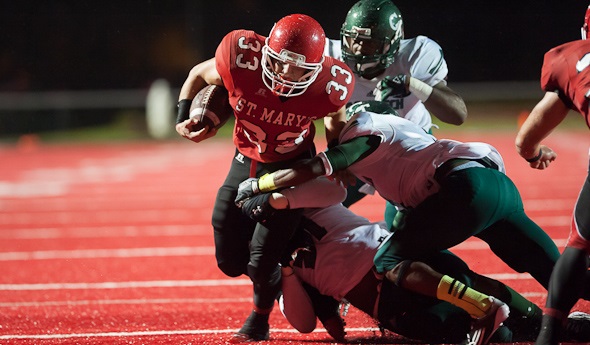
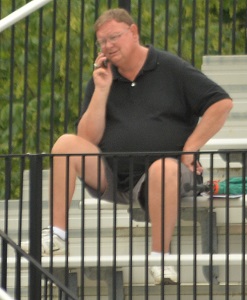
PHOTOS: (Top) Orchard Lake St. Mary's takes on Detroit Cass Tech on its home red turf in 2012. (Middle) Tucked away in the McLane Stadium bleachers, Robin Goddard watches the Eaglets' run to the 2015 Division 2 baseball championship. (Top photo by Terry McNamara.)
Drive for Detroit: Week 1 in Review
September 3, 2019
By Geoff Kimmerly
Second Half editor
Four of last season’s 10 MHSAA football champions began 2019 over the weekend 0-1. Ten teams that didn’t win a game last season stand 1-0 – and the two longest losing streaks in the state came to an end.

How's that for a new season and fresh start? And that's not even mentioning the storms that pushed many games to finish near or after midnight Thursday and roughly 40 to be completed later in the holiday weekend.
Below is our weekly review at some of the results that popped off the page most from every region of the state, with a little perspective on wins and losses that might mean even more as we get into late September and October.
"Drive for Detroit" is sponsored by MI Student Aid..
Bay & Thumb
HEADLINER Beaverton 16, Breckenridge 6 The Beavers are coming off two straight eight-win seasons and just missed catching Breckenridge on opening night last year, falling 20-19. This time they outpaced the Huskies, last season’s Division 8 runners-up, to take a 2-1 lead in their recent opening-night series. Click for more from the Midland Daily News and see highlights below from MI Sports Now.
Beaverton tops Breckenridge by 10 https://t.co/Xp7ZQ7nKtu pic.twitter.com/rEuoFVQb9M
— MISportsNow (@MISportsNow) August 30, 2019
Watch list Port Huron 33, Flint Carman-Ainsworth 6 Although Carman-Ainsworth is coming off a down season, expectations are always high – and Port Huron’s should be now too after avenging last season’s 38-22 defeat and as the Big Reds seek their first playoff berth since 2014.
Remember this one Montrose 16, Cass City 14 These two both could be on the way to big things; after last year’s 48-22 Montrose win, the Rams went on a Division 6 Semifinal run and Cass City won its league.
More shoutouts Freeland 27, Marshall 26 (OT) A blocked extra point and then a fumbled extra point attempt snap were part of a wild overtime that saw the Falcons defeat the Redhawks by three points or fewer for the second straight season. Davison 54, Fenton 27 The Cardinals came out best in a matchup of likely league contenders, scoring 50+ points against a Tigers program that hadn’t given up that many since 2016.
Greater Detroit
HEADLINER Detroit Catholic Central 24, Detroit Martin Luther King 22 These two met for the first time since the 2001 playoffs, and the result was the most exhilarating of an exceptional weekend of games at the Xenith Prep Kickoff Classic at Wayne State. DCC didn’t score during the second half but held off a potential King scoring drive late in the fourth quarter to edge the reigning Division 3 champion. Click for more from MLive-Detroit and see below for highlights from State Champs Sports Network.
VIDEO: Check out the highlights of the Detroit Catholic Central (@DCCfootball) vs. Detroit King (@DetKingFootball) football game from the Xenith Prep Kickoff Classic (@detpkc). @DETROITCCAD @DCCShamrocks.
Presented by @LawrenceTechU, @MHSAA & @hungryhowies pic.twitter.com/y1GiRtoZph— STATE CHAMPS! (@statechampsnet) September 3, 2019
Watch list Southfield Arts & Technology 28, Clarkston 14 These two will meet again in league play in Week 6, and it might be the statewide game of that week after the Warriors began their rebound from two straight sub-.500 seasons with a massive win over the reigning Division 1 runner-up.
Remember this one Bloomfield Hills Brother Rice 7, Utica Eisenhower 0 It’s “six wins and in” the playoffs for one more season, and with these teams representing two of the strongest leagues statewide – Brother Rice the Detroit Catholic League Central and Eisenhower the Macomb Area Conference Red – every win counts that much more.
More shoutouts Clinton Township Chippewa Valley 35, Saline 21 Reigning Division 1 champion Chippewa Valley graduated a ton on offense but found enough against another 2018 semifinalist in Saline. Lake Orion 17, Lapeer 7 The Dragons are 1-0 for the first time since 2013 after handing the Lightning its first regular-season loss since Week 8 of 2017.
Mid-Michigan
HEADLINER Pewamo-Westphalia 14, Reading 0 The Pirates handed reigning Division 8 champion Reading its first defeat since the end of 2017, but more impressively P-W locked down an offense that a year ago posted the 10th-most points in MHSAA 11-player history. The Pirates haven’t lost a regular-season game since their 2017 opener. Click for more from the Hillsdale Daily News.
Watch list Lansing Eastern 35, Owosso 0 One win meant a million for the Quakers, who broke a 38-game losing streak – and with one more victory would equal their best finish since 2010.
Remember this one New Lothrop 54, Lake City 7 Only a game of the P-W/Reading magnitude could bump this rematch from last season’s Division 7 Semifinals out of the headlining spot, as the reigning champion Hornets again put up 50+ points on the Trojans after winning last November 51-22.
More shoutouts DeWitt 31, Traverse City Central 26 The Panthers traveled to Thirlby Field and hung on for a nice win over an annual playoff qualifier. Central Montcalm 22, Morley Stanwood 20 After a winless 2018, Central Montcalm broke a 13-game losing streak with its first victory over Morley Stanwood since 2014.
Northern Lower Peninsula
HEADLINER Maple City Glen Lake 26, Millington 7 The Lakers’ nonleague schedule is loaded, and they almost couldn’t have hoped for better against a Millington team coming off its 15th straight playoff season. Glen Lake enjoyed three touchdown passes from Reece Hazelton in scoring all of its points during the first half. Click for more from the Traverse City Record-Eagle.
Watch list Evart 20, Frankfort 3 The Wildcats have made the playoffs once over the last five seasons and won a combined six games over the last two – but if opening night is an indication, they could match all of that this fall after downing a Frankfort team that’s made the playoffs five straight seasons and beat Evart in their last meeting 30-0 to open the 2016 playoffs.
Remember this one Grayling 22, Roscommon 6 The Vikings have made the playoffs seven times this decade, but finished only 3-6 a year ago – while Roscommon came into this season off a league title and 10-2 finish to 2018.
More shoutouts Alcona 16, Tawas 14 The Tigers went from two straight nine-win seasons to one victory in 2018, but the bounce-back has begun with this avenging of a 48-24 last-season loss. Kingsley 36, McBain 6 These teams combined to go 18-5 a year ago, and this result matched the second-best by the Stags’ defense from 2018.
Southeast & Border
HEADLINER Blissfield 33, Ottawa Lake Whiteford 14 The Royals broke a seven-game opening-night losing streak against Whiteford, in the process handing the Bobcats their first regular-season defeat since Week 9 of 2015. Whiteford also hadn’t given up 30 points in a game since the 2016 Division 8 Final. Click for more from the Toledo Blade and see highlights below from BCSN.
#ICYMI- Whiteford kicked off their season opener last night against Blissfield! The Bobcats put up a tough fight, but fell short 33-14. pic.twitter.com/x2l8ykk4AH
— BCSN (@BCSNsports) August 30, 2019
Watch list Erie Mason 58, Petersburg Summerfield 40 After four straight seasons of finishing 1-8, Erie Mason is 1-0 for the first time since 2003, the last time the Eagles made the playoffs.
Remember this one Jackson Lumen Christi 14, Kalamazoo United 12 The Titans ran their state-best winning streak to 24, but hardly with ease against a United team with some key new faces.
More shoutouts Homer 18, Michigan Center 0 The Trojans got off to the right start coming off their first sub-.500 season since 2009 by beating the reigning Cascades Conference runner-up. Ann Arbor Huron 63, Ecorse 14 The River Rats won for the first time in 40 games, putting up 63 points after scoring 98 over the entirety of 2018.
Southwest Corridor
HEADLINER Berrien Springs 28, Grand Rapids West Catholic 3 The Shamrocks are riding a string of five straight playoff seasons into the fall, but it’s hard to argue they’ve had a better start during this run. West Catholic has made the playoffs 16 straight seasons and is coming off a 2018 that saw respectable defeats to two eventual MHSAA champions. Click for more from the St. Joseph Herald-Palladium.
Watch list Paw Paw 42, Three Rivers 0 Edwardsburg tends to own the Wolverine Conference, and Three Rivers has been its biggest challenger the last few seasons – but that role could fall to Paw Paw coming off this big win and an 8-3 finish last year that also included a playoff victory over Three Rivers.
Remember this one Mendon 14, Decatur 7 Two of the best in the Southwest 10 Conference and also at least regionally in Division 8 saw each other right away with the Hornets running their recent winning streak over the Raiders to three straight.
More shoutouts St. Joseph 32, Battle Creek Central 19 The Bears avenged last season’s 34-27 loss to the Bearcats, a meeting that led things off for two eventual playoff qualifiers. Coldwater 47, Haslett 30 The Cardinals also evened the score against their opening night opponent after falling to Haslett 28-7 a year ago and going on to miss the playoffs for the first time since 2012.
Upper Peninsula
HEADLINER Iron Mountain 17, Negaunee 14 These teams have proven to be just about even over two straight openers, with the Mountaineers now winning both by three points. Last year the same result previewed an 8-3 season for Iron Mountain and a 5-4 by the Miners, who are looking to get back to the playoffs for the first time since 2016. Click for more from the Iron Mountain Daily News.
Watch List Lake Linden-Hubbell 32, Norway 14 The Lakes are coming off their first back-to-back sub-.500 seasons since the early 1970s, but they’re hoping that breaking a three-game losing streak to Norway is the start of a turnaround.
Remember this one Bark River-Harris 56, Gwinn 50 (OT) The Broncos are another team seeking a comeback after falling to 2-7 in 2018, and avenging last season’s 36-20 loss to Gwinn may have them on the way.
More shoutouts Sault Ste. Marie 22, Cheboygan 16 The Blue Devils went 5-4 last season while averaging just 15 points per game, and this week’s 22 would’ve been their second-highest total last fall. West Iron County 32, Munising 6 Beating Munising on opening night has been good to the Wykons, who made the playoffs all four previous seasons this decade after they won that matchup. West Iron missed the playoffs in 2015 after falling to the Mustangs in Week 1.
West Michigan
HEADLINER Muskegon 41, Warren De La Salle Collegiate 7 After closing last season with a tough defeat in the Division 3 Final, the Big Reds opened this fall with a second straight win over two-time reigning Division 2 champion De La Salle. During the first half alone, Muskegon quarterback Cameron Martinez ran 13 times for 109 yards and three scores. Click for more from the Muskegon Chronicle.
Check out the highlights of the Muskegon (@OnMuskegon) vs. De La Salle football game from tonight at the Xenith Prep Kickoff Classic (@detpkc). Brought to you by @LawrenceTechU, @MHSAA & @hungryhowies pic.twitter.com/BSm2ZDHFoZ
— STATE CHAMPS! (@statechampsnet) August 31, 2019
Watch List Grand Rapids Catholic Central 17, River Rouge 14 GRCC is coming off a third straight trip to at least the Division 4 Semifinals and is back in the swing after winning this one on a field goal with 2:15 to play.
Remember this one Hart 48, Holton 40 (2OT) Hart hasn’t had a winning season since 1997 and didn’t have a varsity at all in 2015, but started this fall with this victory over a 2018 Division 8 semifinalist.
More shoutouts Montague 42, Reed City 0 Last season’s Division 6 runner-up avenged a 34-13 loss to the Coyotes while handing them only their second regular-season defeat over the last five years. Zeeland West 28, East Grand Rapids 21 Surprisingly, this was the first meeting between these perennial Division 3 powers – so although they’d never met before, it’s not hard to anticipate them possibly meeting again in the playoffs.
8-Player
HEADLINER Brimley 24, Rapid River 12 Simply put, this was the Bay’s biggest win during a decade of 8-player football. Rapid River is the reigning 8-Player Division 2 champion and had beaten Brimley 80-55 in last year’s regular-season finale. Click for more from the Escanaba Daily Press.
Watch List Pickford 48, Crystal Falls Forest Park 16 A junior-heavy Pickford team finished 8-Player Division 1 runner-up last season and opened its return by nearly doubling up on last season’s 18-point win over the always-powerful Trojans.
Remember this one Climax-Scotts 16, Wyoming Tri-unity Christian 12 The Panthers’ 8-player debut was as good as expected, and they quickly will have more chances to show what they can do with Lawrence, Bellevue and Camden-Frontier coming up over the next three weeks.
More shoutouts Powers North Central 66, Cedarville 12 The Jets lasted only a week in last season’s Division 2 playoffs, but opened this fall with a win over a 2018 semifinalist. Martin 20, Bellevue 12 The Clippers are another new 8-player team and coming off a playoff season in 11, and they should be excited after this debut against one of the state’s best in 8 over the last two seasons.
Second Half’s weekly “Drive for Detroit” previews are powered by MI Student Aid, a part of the Office of Postsecondary Financial Planning located within the Michigan Department of Treasury. MI Student Aid encourages students to pursue postsecondary education by providing access to student financial resources and information. MI Student Aid administers the state’s 529 college savings programs (MET/MESP), as well as scholarship and grant programs that help make college Accessible, Affordable and Attainable for you. Connect with MI Student Aid at www.michigan.gov/mistudentaid and find more information on Facebook and Twitter@mistudentaid.
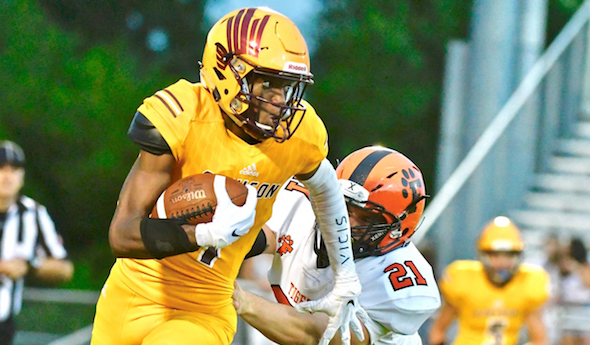
PHOTO: Davison put 54 points on the scoreboard to win its season opener against Fenton. (Photo by Terry Lyons.)