


Best Practices
June 28, 2016
Two-thirds of concussions reported in Michigan high school football last fall occurred in games. Even though there are at least five times more hours of exposure during practices than games, there are half as many concussions during practice, according to the mandated concussion reporting requirement of the Michigan High School Athletic Association that is unmatched in the country in terms of its depth and breadth for a statewide requirement.
Michigan was among the handful of states to restrict contact in practice, in 2014, a full season prior to recommendations from the National Federation of State High School Associations and later action by most other statewide associations.
Some of those statewide organizations continue to operate without limitation on contact in football practices, while their counterpart organizations in other states have gone so far as to limit contact to a certain number of minutes in a day and/or week.
Entering mostly uncharted waters for high school football in early 2014, an MHSAA task force recommended that the number of practices be limited where collisions between players could occur – no more than one per day during preseason, no more than two per week after the first game.
This change was embraced by this state’s football coaches association and adopted by the MHSAA Representative Council. All parties liked the ease of administration of this policy, and all distrusted the idea of limiting the number of minutes of contact during practices.
If there is a 30-minute limit on contact in a day or a 90-minute limit on contact in a week, is it the same 30-minute or 90-minute period for all players, even if many are not involved in one or more of the contact drills? Or does the limit apply to each player individually; and if so, how is that tracked, and by whom?
These and other questions made coaches and administrators question how effective a limit on minutes might really be. Nevertheless, a 90-minute per week limit during regular season has been made an MHSAA recommendation for the 2016 season. This will provide an opportunity to address and possibly answer some of the questions that have been raised.
The MHSAA will survey schools this fall about their practice plans and the actual time spent in contact drills by players, assessing how that differs according to offense, defense, player position and grade in school, and determining best practices for how to track player contact minutes.
When Michigan acted in 2014 to limit contact in practice, it was one of the first states to do so. As Michigan takes additional steps to limit contact in practice, it will be one of the first states to do so after researching the best ways to actually do it.
A Game for Every Fan: District Finals
November 6, 2014
By Geoff Kimmerly
Second Half editor
One week of MHSAA football playoffs is behind us, and all nine champions from 2013 are still alive.
Maybe that's not too shocking, considering they were the elite only a short year ago. But don't be too surprised if that number is cut down by at least a few when Saturday night is done.
All nine of those reigning champions remain undefeated heading into Friday and Saturday's District Finals. But three are playing opponents also undefeated through 10 weeks.
All three matchups are among those highlighted below as we look to this week's 11-player District Finals and 8-player Regional Finals. All are Friday unless noted.
DIVISION 1
Lapeer (10-0) at Clarkston (10-0)
The Wolves have fended off a few impressive challenges in building their winning streak to 23 straight including last season's run to their first MHSAA title. Quarterback D.J. Zezula has taken on and thrived in a starring role as Clarkston has earned close wins over Macomb Dakota and Farmington Hills Harrison and double-digit victories over everyone else. But Lapeer is as daunting an unknown as they come in this tournament; the Lightning, in its first season after the combination of Lapeer East and West, also has been challenged only twice but hung tough in its playoff debut last week with a 23-15 win over Romeo.
Others that caught my eye: Hudsonville (6-4) at Rockford (8-2), Detroit Cass Tech (10-0) at Dearborn Fordson (10-0).
DIVISION 2
Muskegon Mona Shores (9-1) at Midland Dow (10-0)
On a night featuring a decent share of 10-0 vs. 10-0 District Finals, this still is among premier games. Dow must defend Midland Community Stadium against the playmaking power of Mona Shores quarterback Tyree Jackson, who has led his offense to 42 or more points five weeks running while facing the likes of Muskegon and Caledonia among others. The Chargers could be up to the task, having given up no more than 21 points in a game this fall in earning this opportunity to tie its record for wins.
Others that caught my eye: Farmington Hills Harrison (8-2) at Walled Lake Western (9-1), Southfield (7-3) at Oak Park (8-2).
DIVISION 3
Stevensville Lakeshore (8-2) at Zeeland West (10-0)
Aside from an odd opening-night score (2-0 over Battle Creek Central), Lakeshore has rather quietly won eight games for the third straight season. But the Lancers could make a major splash by knocking off the reigning MHSAA champion. If the score stays close, it could up Lakeshore's chances significantly; the Lancers are 5-1 this fall in games decided by 10 or fewer points. West has had only one opponent get closer than 27 points, and none come within 10.
Others that caught my eye: Cedar Springs (9-1) at Muskegon (9-1) on Saturday, Grand Rapids Christian (6-4) at Lowell (9-1).
DIVISION 4
Saginaw Swan Valley (10-0) at Lansing Sexton (10-0)
This could be THE game of this weekend, with the winner a favorite to at least reach Ford Field – if not win it all. These two also met in a Regional Final last fall, with Sexton winning 26-21. Vikings running back Alex Grace has at least 212 yards and two rushing touchdowns in eight straight games and is up to third on the MHSAA career rushing yards list with 7,353. He had 242 yards and two touchdowns in the 2013 loss to the Big Reds, who again are sound defensively and capable on offense of holding onto the ball as well.
Others that caught my eye: Vicksburg (8-2) at Edwardsburg (9-1), Hudsonville Unity Christian (6-4) at Grand Rapids South Christian (8-2).
DIVISION 5
Almont (10-0) at Marine City (10-0)
Despite both being successful in the postseason over the last decade, these two have eluded each other with Marine City playing in Division 4. East China Stadium should be rocking with the Mariners representing the best from the Macomb Area Conference Gold and as the reigning Division 4 champion and the Raiders the champs in the Blue Water Area Conference. Almont has set a team record for scoring while averaging 53.4 points per game, and has given up only 49 with five shutouts including 65-0 over Clawson last week.
Others that caught my eye: Clare (8-2) at Freeland (9-1), Reed City (8-2) at Remus Chippewa Hills (8-2).
DIVISION 6
Madison Heights Madison (8-2) at Flint Beecher (10-0)
The winner of this game not only moves on to the Regional – it likely will be considered a favorite by at least some to end Ithaca’s nation-best 11-player winning streak of 66 games. That’s how much both of these teams have been regarded from the start of this fall, and neither has disappointed. Beecher has set a team record for wins, and Madison’s losses were to Division 2 playoff team Walled Lake Western and Division 3 qualifier Warren Woods-Tower.
Others that caught my eye: Clinton (10-0) at Monroe St. Mary Catholic Central (9-1), Hillsdale (8-2) at Jackson Lumen Christi (10-0).
DIVISION 7
Iron River West Iron County (9-1) at Ishpeming (9-0)
The Hematites have turned back West Iron once during their 30-game winning streak, in last season’s District Final 34-0. And the shutouts haven’t ended, with Ishpeming blanking four of its last five opponents. But the Wykons have a chance to show how much they’ve learned since that loss last season – their only loss this fall was 8-6 to playoff team Bark River-Harris, and they looked ready enough in blanking Iron Mountain 40-0 a week ago. That said, Ishpeming also shut out Iron Mountain, 36-0 on opening night.
Others that caught my eye: Traverse City St. Francis (8-2) at Suttons Bay (9-1), Saginaw Michigan Lutheran Seminary (9-1) at Whittemore-Prescott (10-0).
DIVISION 8
Fowler (10-0) at Muskegon Catholic Central (10-0)
These records are identical, but a Fowler win would be considered one of the recent best of that program’s storied history. MCC’s 22-game winning streak also includes a 42-0 District Final win over the Eagles last fall. Fowler has a tough runner in Austin Cook, the leading rusher in the Lansing area with more than 1,700 yards. He and his blockers might have the biggest task of an upset effort.
Others that caught my eye: Waterford Our Lady (9-1) at Harbor Beach (10-0) on Saturday, Johannesburg-Lewiston (9-1) at Beal City (8-2).
8-PLAYER
Cedarville (9-1) at Rapid River (10-0)
One of these years will be Cedarville’s year – the Trojans are 34-6 in four seasons of 8-player football – and they seemed to send a signal that this could be the one with a 39-0 win over Bellaire last week. Rapid River has always been in the way – the reigning MHSAA runner-up Rockets have won three straight over the Trojans including 20-19 in Week 6 and are 22-1 over the last two seasons.
Others Regional Finals: Kingston (7-3) at Deckerville (8-2), Morrice (6-4) at Peck (10-0), Lawrence (10-0) at Battle Creek St. Philip (9-1).
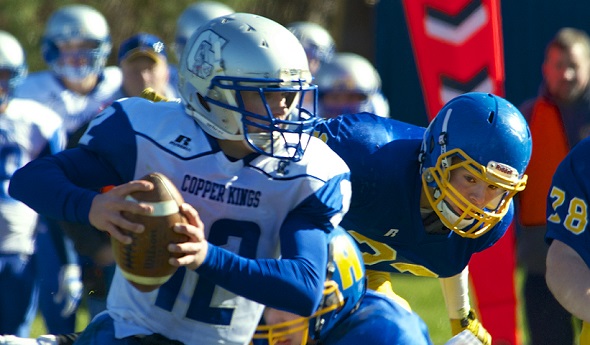
PHOTO: Calumet traveled to Harrison last week and won 30-21 to earn this week’s District Final matchup with Menominee. (Click to see more from HighSchoolSportsScene.com).