


Best Practices
June 28, 2016
Two-thirds of concussions reported in Michigan high school football last fall occurred in games. Even though there are at least five times more hours of exposure during practices than games, there are half as many concussions during practice, according to the mandated concussion reporting requirement of the Michigan High School Athletic Association that is unmatched in the country in terms of its depth and breadth for a statewide requirement.
Michigan was among the handful of states to restrict contact in practice, in 2014, a full season prior to recommendations from the National Federation of State High School Associations and later action by most other statewide associations.
Some of those statewide organizations continue to operate without limitation on contact in football practices, while their counterpart organizations in other states have gone so far as to limit contact to a certain number of minutes in a day and/or week.
Entering mostly uncharted waters for high school football in early 2014, an MHSAA task force recommended that the number of practices be limited where collisions between players could occur – no more than one per day during preseason, no more than two per week after the first game.
This change was embraced by this state’s football coaches association and adopted by the MHSAA Representative Council. All parties liked the ease of administration of this policy, and all distrusted the idea of limiting the number of minutes of contact during practices.
If there is a 30-minute limit on contact in a day or a 90-minute limit on contact in a week, is it the same 30-minute or 90-minute period for all players, even if many are not involved in one or more of the contact drills? Or does the limit apply to each player individually; and if so, how is that tracked, and by whom?
These and other questions made coaches and administrators question how effective a limit on minutes might really be. Nevertheless, a 90-minute per week limit during regular season has been made an MHSAA recommendation for the 2016 season. This will provide an opportunity to address and possibly answer some of the questions that have been raised.
The MHSAA will survey schools this fall about their practice plans and the actual time spent in contact drills by players, assessing how that differs according to offense, defense, player position and grade in school, and determining best practices for how to track player contact minutes.
When Michigan acted in 2014 to limit contact in practice, it was one of the first states to do so. As Michigan takes additional steps to limit contact in practice, it will be one of the first states to do so after researching the best ways to actually do it.
Gach Brings Major Spotlight to Groves Football, Major Goals Into Final Season
By
Keith Dunlap
Special for MHSAA.com
September 6, 2024
It’s not like Birmingham Groves head coach Brendan Flaherty hadn’t had players in the past who received a lot of recruiting attention, given several Division I college talents such as Jaden and Jaren Mangham and DeOn’tae Pannell have come through the program under his tenure.
 But make no mistake, Flaherty hadn’t coached anyone who has received as much recruiting attention as Avery Gach.
Before committing to Michigan over the summer, Gach held scholarship offers from 40 schools, and we’re not talking about smaller or upstart programs, either.
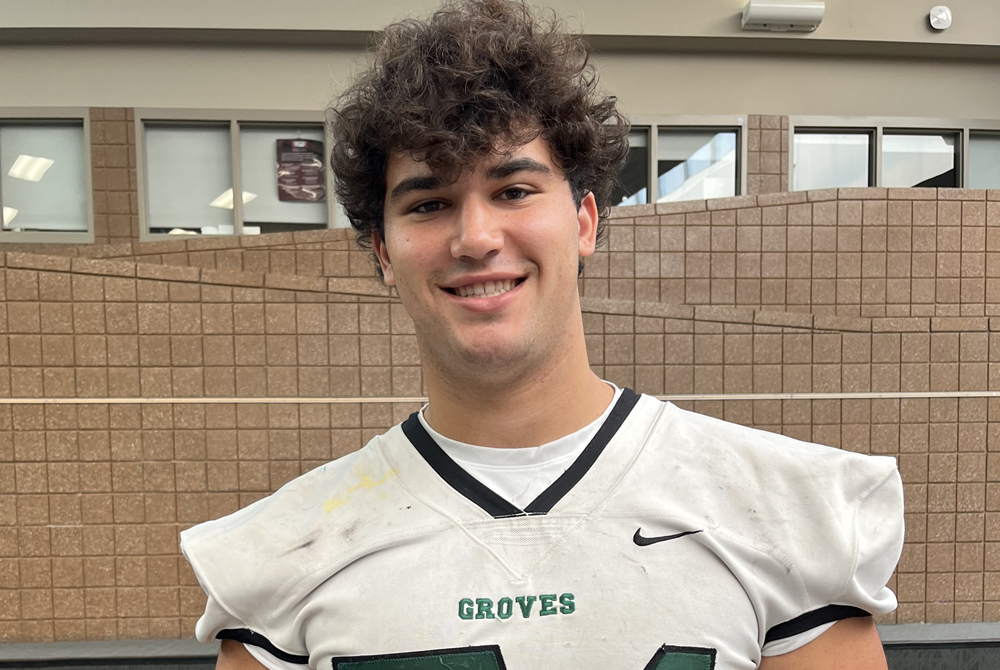
Alabama, Ohio State, Georgia and Florida State were among the programs to offer Gach, a hulking 6-foot-5, 290-pound senior lineman.
“He’s a unicorn,” Flaherty said. “The attention it has brought the school and the limelight it has shined on us. I haven’t had anybody like this in 24 years. We’ve had Big Ten players before. But he obviously takes it to another level being a national guy. It’s well-deserved, and he’s done a great job handling it.”
Indeed, this fall will be the last chance for Groves to experience a player who might not come around again for a while once he signs and enrolls early at Michigan, as he plans to do.
Gach always has towered over everyone — he said he was 6-3 as an eighth-grader — and has done that on the football field since becoming a rarity at Groves by making the varsity as a freshman.
After getting some experience during his freshman year, Gach really started to reach another level.
“After my ninth-grade season, I knew this was the sport I wanted to do,” said Gach, who also played basketball and baseball growing up. “I just hit the weight room. That helped me a ton.”
It wasn’t just weights and getting stronger, but flexibility and agility training as well that helped him become more than just someone who was bigger than everybody.
Gach also got to work mastering technical aspects of being a lineman.
“Just having heavy hands, containing the bull rush and keeping my core tight,” Gach said.
From there, the scholarship offers and attention started pouring in.
Gach didn’t allow a sack his sophomore and junior years, so it’s a good bet opposing defensive linemen know what they’re up against this fall.
The wrinkle this year, though, is that opposing offensive linemen might be up against the same challenge. Gach is going to spend a significant amount of time at defensive tackle for the Falcons, likely commanding constant double and triple-teams.
“I’m going to play it a lot this year,” he said. “I’m going both ways. I’m excited. I’m going to make plays out there. They’re two separate positions, but you have to be aggressive at both.”
Flaherty, for one, firmly believes Gach can be just as much of a factor on the defensive side of the ball as he has been on offense.
“His mind is wired that he is an offensive lineman,” Flaherty said. “But if you rewired it a little bit and said he was a defensive lineman, he would be a force. He just plays with such a great energy, tenacity and intensity. He’s going to do a lot of great stuff on defense.”
Gach also played baseball for Groves his first two years of high school but decided to give that sport up to throw shot put for the track team this past spring while preparing for the football season.
He’s fully ready and has ambitions that are similarly sizable for a Groves program that has never reached the MHSAA Finals.
“The expectation this season is to win a state championship,” Gach said.
It might seem like an ambitious goal for a program that has never done so. But then again, there also never been a player in program history quite like Gach, as people should once again see on the field this fall.
 Keith Dunlap has served in Detroit-area sports media for more than two decades, including as a sportswriter at the Oakland Press from 2001-16 primarily covering high school sports but also college and professional teams. His bylines also have appeared in USA Today, the Washington Post, the Detroit Free Press, the Houston Chronicle and the Boston Globe. He served as the administrator for the Oakland Activities Association’s website from 2017-2020. Contact him at [email protected] with story ideas for Oakland, Macomb and Wayne counties.
PHOTO Groves’ Avery Gach stands in for a photo during Oakland Activities Association media day this preseason. (Photo by Keith Dunlap.)