


Best Practices
June 28, 2016
Two-thirds of concussions reported in Michigan high school football last fall occurred in games. Even though there are at least five times more hours of exposure during practices than games, there are half as many concussions during practice, according to the mandated concussion reporting requirement of the Michigan High School Athletic Association that is unmatched in the country in terms of its depth and breadth for a statewide requirement.
Michigan was among the handful of states to restrict contact in practice, in 2014, a full season prior to recommendations from the National Federation of State High School Associations and later action by most other statewide associations.
Some of those statewide organizations continue to operate without limitation on contact in football practices, while their counterpart organizations in other states have gone so far as to limit contact to a certain number of minutes in a day and/or week.
Entering mostly uncharted waters for high school football in early 2014, an MHSAA task force recommended that the number of practices be limited where collisions between players could occur – no more than one per day during preseason, no more than two per week after the first game.
This change was embraced by this state’s football coaches association and adopted by the MHSAA Representative Council. All parties liked the ease of administration of this policy, and all distrusted the idea of limiting the number of minutes of contact during practices.
If there is a 30-minute limit on contact in a day or a 90-minute limit on contact in a week, is it the same 30-minute or 90-minute period for all players, even if many are not involved in one or more of the contact drills? Or does the limit apply to each player individually; and if so, how is that tracked, and by whom?
These and other questions made coaches and administrators question how effective a limit on minutes might really be. Nevertheless, a 90-minute per week limit during regular season has been made an MHSAA recommendation for the 2016 season. This will provide an opportunity to address and possibly answer some of the questions that have been raised.
The MHSAA will survey schools this fall about their practice plans and the actual time spent in contact drills by players, assessing how that differs according to offense, defense, player position and grade in school, and determining best practices for how to track player contact minutes.
When Michigan acted in 2014 to limit contact in practice, it was one of the first states to do so. As Michigan takes additional steps to limit contact in practice, it will be one of the first states to do so after researching the best ways to actually do it.
Mann Makes Great on High Expectations
By
Tom Markowski
Special for Second Half
April 20, 2017
BEVERLY HILLS – Entering high school, Steve Mann faced high expectations.
 His mother and father both experienced much success as student-athletes at Detroit Country Day, and his sister, Brittany, was one of the top track athletes to compete at and graduate from the school.
But while it's still too early to tell, Steve might end up the best of the Mann bunch.
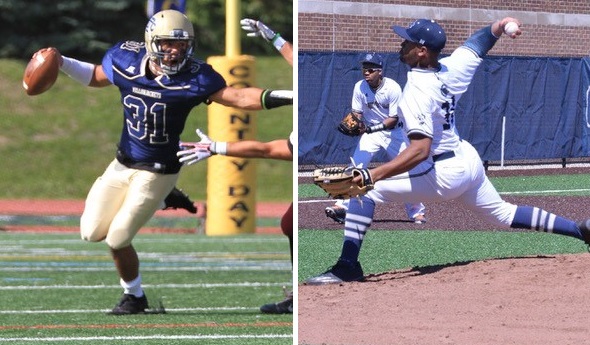
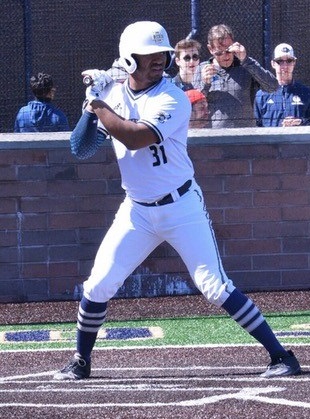
Steve, 18, has played varsity football and baseball for four seasons each at Country Day, earning all-state honors in football this past fall and baseball as a junior. Also an outstanding student, he has signed to continue his academic and baseball careers at Duke University, where he’ll end up unless he’s drafted by a Major League Baseball team this summer and offered a deal he can’t refuse – it’s possible he’ll be taken during the first five rounds.
Country Day varsity baseball coach Steve Lepkowski – a 1993 graduate of the school and former football assistant as well before taking over the baseball program in 2015 – said he’s never coached an athlete like Mann.
“Steve is going to be successful at whatever he does,” Lepkowski said. “He’s a four-year captain here. That’s as unique as you can get. We vote for that. And every year we re-vote, and (each) time we re-voted him in.”
Last season, Mann hit .396 with 25 RBI, 24 stolen bases and 27 walks. Through seven games this season, he’s hitting .536 with three home runs, 18 RBI, nine stolen bases and nine walks. He also is 3-0 pitching with a 1.65 ERA.
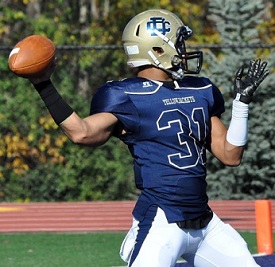
In football, Mann played defensive back, quarterback and receiver. He’s 6-foot tall, and his weight has fluctuated depending on what sport he is playing. For football, his playing weight was 195 pounds. For baseball he’s up to 210. Mann is a centerfielder who, out of necessity, also pitches for Country Day. He’s expected to be an outfielder at the next level.
With his Duke signing in November, Mann left a football future behind. But he has known for a while where he wanted to be next. Scholarship offers from a more prestigious baseball conference, the Southeastern Conference, fed Mann’s appetite. But he had his sights set on Duke (which plays in the Atlantic Coast Conference) early on, so when the scholarship offer came, that was the end of his recruiting process.
 “The scouts ask me, why Duke? Why not the SEC?" Lepkowski said. "Well, I said, Steve cares about academics. Duke has been number one with him all along. As a sophomore, I asked him, where do you want to go? It was Duke. So I talked with Duke. I know of the coaches there. And I told them I have a player here that wants to go to your school, and they asked who. I told them Steve Mann. They said, Steve Mann? He wants to come here? That was it. I call him the Shane Battier of baseball.”
If an explanation is needed, Battier helped lead Duke to an NCAA basketball championship after being at the forefront of Country Day’s Class B titles in 1995, 1996 and 1997. Battier was named Mr. Basketball by the Basketball Coaches Association of Michigan as a senior, and Mann is a leading candidate for the Mr. Baseball Award this spring.
Like Battier, Mann also is an outstanding student. He carries a 3.94 grade-point average, taking classes including honors English and advanced placement mathematics and Spanish.
And as for mentors, Mann has to look no further than his living room couch. His father, Steve, also played football, basketball and ran track at Country Day. He caught the winning touchdown pass in the 1986 Class C title game against Muskegon Catholic Central (Final score: 18-14). He went on to play football at University of Wyoming.
His mother, Kira (Lewis), played basketball, lacrosse and volleyball at Country Day before continuing her education at Penn.
Then there’s his sister, Brittany. A 2012 Country Day graduate, Brittany was the Lower Peninsula Division 2 discus and shot put champion as a junior and senior. Country Day won the team title her junior season. Brittany went on to compete at Oregon before graduating last year. She’s enrolled at Southern California and in pursuit of her master’s in communications.
At Oregon, Brittany set the school record in the shot put (57 feet, 4¾ inches) and helped lead her school to its first NCAA team title (2015) in 30 years. She was a four-time All-American.
“I had some big shoes to fill when I came here,” Steve Mann said of Country Day. “Since high school started, even in eighth grade, I knew baseball was going to be it. Before eighth grade I focused on being an athlete. With Brittany coming through Country Day, it was easy to see what I needed to do (to be successful). It was kind of like a competition. I want to be like you, but I want to be better.”
Individually, Mann and his sister are pretty much on par. But there’s that elusive team title he has yet to help win, though he has come close.
County Day lost in the Division 4 Football Final this past November, and last spring the Yellowjackets reached the Division 2 Quarterfinals in baseball before they were eliminated by Dearborn Divine Child, 4-3.
Mann has one more shot.
“I tell myself, I have to win a state championship,” he said. “We’re good enough to win it.”
Mann has always been around sports, even when he was too young to realize it. The year he was born was the year his father became an assistant football coach at Country Day. Whether he was the water boy, ball boy or just tagging along, Steve grew up watching sports.
 “I was always with my dad,” he said. “When I was 5, 6 years old, just being out there was great. My dad has taken me through this journey. It was a step-by-step process.
“Another big factor for me was Brittany going on her recruiting visits.”
When he was in the eighth grade, Steve Mann had the opportunity to meet Olympian Devin Allen through his sister. In 2016, Allen became the first man since 1956 to win the 110-meter hurdles at both the NCAA Outdoor Championships and U.S. Olympic Trials. Allen also played receiver on Oregon’s football team.
“I was star-struck,” Mann said. “He was so humble. How could you not want that for yourself?”
Mann is unassuming. Bragging is not a trait his household condones. Great athletes don’t have to tell you how good they are. Their actions do the talking.
His parents deserve much of the credit for this. A part of Mann’s training was to compete against athletes two and three years older to see, for one, how they train and, two, to see how much Mann needed to improve athletically to become like them.
“There were a lot of expectations,” his father said. “He is very self-driven, to live up to both the Mann name at Country Day and to create his own path. I’ve tried to teach him what it’s like to play at the next level.”
As an example, Steve Mann had his son train in the baseball offseason with Major League players who were home away from the game. This experience was not so much about throwing or hitting a baseball. It was about being around those who made it to see how they trained, what foods they ate and the like.
“I did a similar thing with him when he was in middle school,” Mann said of his son. “I’d have him train with the guys in high school, like a Jonas Gray (currently an NFL free agent) and a Bennie Fowler (Denver Broncos). I do that with my younger son, too.”
The Manns' third child is Brandon, who is 13 years old and about to complete the seventh grade. And, yes, Brandon Mann also plays baseball and football, and, yes, his is quite good at both.
 Tom Markowski is a columnist and directs website coverage for the State Champs! Sports Network. He previously covered primarily high school sports for the The Detroit News from 1984-2014, focusing on the Detroit area and contributing to statewide coverage of football and basketball. Contact him at [email protected] with story ideas for Oakland, Macomb and Wayne counties.
PHOTOS: (Top) Steve Mann starred as a multi-position football player during the fall and also pitches and plays outfield during baseball season. (Middle) Mann, here at the plate, could be drafted during the top five rounds in June. (Below) Mann prepares to unload a pass last fall. (Baseball photos by D’Andrea Parnell. Football photos by Scott Bertschy.)