


Best Practices
April 10, 2012
For decades, football has had the greatest participation among high school sports. In recent years it’s become the greatest spectator sport as well. Today, MHSAA Football Playoff revenue exceeds that of Boys and Girls Basketball Tournaments combined. And if I ever want to generate comments to a blog, all I have to do is mention football.
I can write either the most inspired or inane words about most topics, and not generate a comment. But mention “football,” and opinions come fast and usually furious.
So it was with my eyes wide open that I challenged some “sacred cows” in my posting of March 20, questioned some of the standard operating procedures of high school football practice, and predicted that we will soon be making some changes in the sport I played through four years of college and coached in high school and to which I owe more of my character development than any other sport. I knew some readers would call me out of date and out of touch, knowing nothing of my past or my passion.
I knew some readers would challenge any comparison made with college and professional players, asserting that older players need fewer practices with less contact because they already have the skills and techniques of blocking and tackling. However, they miss the fact that it is the younger and still growing body that needs more care and caution, not less. Less hitting, not more. More heat and humidity acclimatization, not less.
I knew some readers would complain about diminishing time to develop young players, overlooking the proliferation of camps, clinics, combines, 7-on-7 leagues and the like which have improved skills and conditioning for many athletes prior to the official start of practice. If that were not true or if we would dial down the out-of-season demands, then I might not join the amassing advocates for reduced in-season practice demands. But sadly, it is true; coaches already have these kids year-round.
On the same day that I posted predictions of changes for football practice policies in Michigan, including more days before pads and fewer days with double sessions, the Georgia High School Association adopted policies that did just that, requiring five days of practice before the first with full pads and prohibiting two-a-day practices on consecutive days.
Such changes reflect the growing body of evidence regarding “best practices” for high school football, including the recommendations of the American Academy of Pediatrics, the Centers for Disease Control and Prevention, and the National Federation of State High School Associations. This train has left the station; and Michigan should be an early stop, an early adopter of practice policies modifications. We put our players, coaches and selves in peril if we ignore the evidence.
I’m embarrassed to say that for too long I avoided this topic because I knew it would bring ridicule. Then recently, a young but experienced head football coach told me that these are the kinds of changes that football needs. Needs to keep the game attractive to kids; and needs to keep the game safe for kids.
Menominee Follows Winning Formula
October 29, 2015
By Dennis Grall
Special for Second Half
MENOMINEE – Explaining the continued success of football at Menominee High School is not difficult.
"Football is just work. The kids are willing to work," fourth-year coach Joe Noha said of a simple explanation of a premier program for decades.
 The Maroons (9-0) host Grayling (6-3) Friday at venerable Walton Blesch Stadium in a Division 5 opener. Noha, a former Menomninee player and assistant coach under legendary head coach Ken Hofer, is 45-4 since taking over the program.
Menominee was Division 5 runner-up under Noha in 2013 and reached the MHSAA Semifinals the other two seasons. Under Hofer, with Noha as the top assistant, the Maroons won Division 5 titles in 2006 and 2007 and Class BB in 1998.
There is more to this amazing success than simply hard work, something every successful program can also claim.
"We try to put our guys in the best position to have success," Noha said. "We can do a lot of different things."
Again, all successful teams can make that claim.
The Maroons also can point to stability in the coaching staff. Hofer, who retired after the 2011 season, is the all-time leader in victories among Upper Peninsula coaches with a 313-141-2 record. Noha, who graduated from Menominee in 1983 and then played football at Saginaw Valley State University, joined Hofer's staff in 1994.
Assistants like Ron "Satch" Englund, Jamie Schomer, Dave Mathieu, Nathan Linsmeier, Lucas Chouinard, Tyler Uecke, Bill Schwanz and Mark Klapp have also been part of the program for many years, providing stability to that success. Many of them also played for Hofer.
"After every practice we evaluate and look at ways to get better," said Noha, mentioning something else that of course is done across the sports universe.
Noha noted successful operations, referring to Fortune 500 companies, as he said, "everyone has core values. We put kids first, teach them hard work and responsibility (and discipline). Our teaching staff, our community; it is all part of what we do. We always have a support staff to lean on. Our kids know that. They know what the Menominee standard looks like."
He also pointed out, "There is a lot of pride there. We talk about giving back to what was given to you."
 Noha also notes a "family mantra" in Menominee. "There is definitely family here, there is definitely community support here, the school supports us. There is not a lot of turnover here. We stick together, we work well together. A lot of people maintain the standard.
"A lot of people have a vested interest."
Again, nothing different from other successful programs.
But here's what is different: The Menominee Maroons do all of those things, and most importantly, perhaps, is it has been like that for nearly half a century.
One other explanation could also be how the Maroons operate on the gridiron. They are one of the very few remaining teams who use a single-wing offense, which makes it difficult for potential playoff opponents to prepare for since it is tough to emulate in practice.
Familiar Upper Peninsula opponents such as Escanaba, Kingsford, Gladstone and Marquette get to see the single-wing every year, as well as at the freshmen and jayvee levels. Grand Rapids West Catholic, which beat the Maroons in the 2013 title game and the 2012 semis, also has a good idea of the single-wing intricacies.
"West Catholic has beaten us because they were better," admitted Noha. "Trying to replicate it in practice is very difficult. You have to execute. It comes down to putting kids in good spots."
The Maroons have obviously modified the single-wing through the years, from fullback spinners to jump passes to bubble screens and fly patterns for receivers. "We can spread it out and we can pound it, but the single-wing concepts are still there,” Noha added.
"Everybody puts their tweaks on everything. If you are defending us, you better know the top three plays in our formations. Everyone's film is your DNA, your template. It is not brain surgery by any means."
It still comes down to other areas. "You have to have the kids, the coaches, and the kids have to be resilient," Noha said. "You can have any system you want."
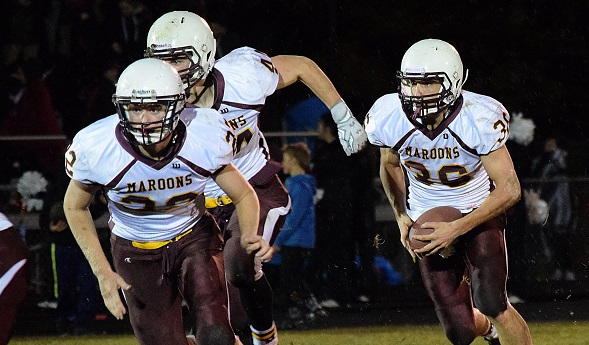
Talent also comes in handy, and the Maroons again are blessed in that department. Led by quarterback/running back Nathan Nowack, the Maroons fill six defensive positions and five offensive positions on the Great Northern Conference all-star team this fall.
Nowack, who scored seven touchdowns against Gladstone this year, is the GNC's offensive player of the year, and lineman Adam Beyersdorf is the GNC's defensive player of the year.
Noha said changes have been made throughout the 35 years he has been associated with the program, some mandated by the MHSAA such as the reduction of contact in practice and the emphasis on concussions.
"The practices and the schemes stay the same. We look at nutrition more and we don't hit nearly as much as we used to," said Noha, who also indicated weight training has been emphasized much more since he was a player.
 "The kids are bigger, stronger, faster and more physically fit. The game is faster, the kids are more skilled and get out in space more," Noha said.
While the Maroons usually boast good size in the line, Noha said the Maroons look more at body composition and how it best suits the players and positions. Many of the players go around the 180-190 pound area and are well-conditioned, solid athletes, he said.
Noha noted the first three playoff games are usually held outdoors, and then the Maroons usually play in the Superior Dome at Northern Michigan University and then hit Ford Field if they reach the title game. He said heavier kids may wilt under the indoor conditions. "We want kids that can run and move," he said.
Menominee's future may look even brighter. After not having a freshmen football team the past four years, Noha said that level will resume in 2016 as 30 freshmen players are anticipated. There were 22 freshmen on the 2015 junior varsity team.
Football is played to be fun for the Maroons, and it is always more fun when you can enjoy success like the Maroons experience. What it all comes down to in Menominee, Noha said, is "the scoreboard never defines us. We try to use football to get us to a better place."
 Denny Grall retired in 2012 after 39 years at the Escanaba Daily Press and four at the Green Bay Press-Gazette, plus 15 months for WLST radio in Escanaba; he served as the Daily Press sports editor from 1970-80 and again from 1984-2012. Grall was inducted into the Upper Peninsula Sports Hall of Fame in 2002 and serves as its executive secretary. E-mail him at [email protected] with story ideas for the Upper Peninsula.
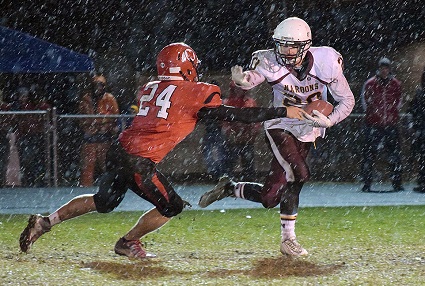
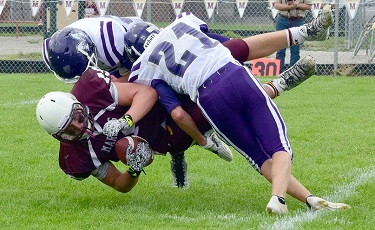
PHOTOS: (Top) Senior Nathan Nowack (36) follows two of his blockers during this season's game against Marquette. (Middle) Hunter Hass works to avoid a Marquette defender on a rainy night. (Below) A Menominee ball-carrier holds onto the ball as two Marinette, Wis., players tackle him. (Photos courtesy of Val Ihde.)