


Best Practices
April 10, 2012
For decades, football has had the greatest participation among high school sports. In recent years it’s become the greatest spectator sport as well. Today, MHSAA Football Playoff revenue exceeds that of Boys and Girls Basketball Tournaments combined. And if I ever want to generate comments to a blog, all I have to do is mention football.
I can write either the most inspired or inane words about most topics, and not generate a comment. But mention “football,” and opinions come fast and usually furious.
So it was with my eyes wide open that I challenged some “sacred cows” in my posting of March 20, questioned some of the standard operating procedures of high school football practice, and predicted that we will soon be making some changes in the sport I played through four years of college and coached in high school and to which I owe more of my character development than any other sport. I knew some readers would call me out of date and out of touch, knowing nothing of my past or my passion.
I knew some readers would challenge any comparison made with college and professional players, asserting that older players need fewer practices with less contact because they already have the skills and techniques of blocking and tackling. However, they miss the fact that it is the younger and still growing body that needs more care and caution, not less. Less hitting, not more. More heat and humidity acclimatization, not less.
I knew some readers would complain about diminishing time to develop young players, overlooking the proliferation of camps, clinics, combines, 7-on-7 leagues and the like which have improved skills and conditioning for many athletes prior to the official start of practice. If that were not true or if we would dial down the out-of-season demands, then I might not join the amassing advocates for reduced in-season practice demands. But sadly, it is true; coaches already have these kids year-round.
On the same day that I posted predictions of changes for football practice policies in Michigan, including more days before pads and fewer days with double sessions, the Georgia High School Association adopted policies that did just that, requiring five days of practice before the first with full pads and prohibiting two-a-day practices on consecutive days.
Such changes reflect the growing body of evidence regarding “best practices” for high school football, including the recommendations of the American Academy of Pediatrics, the Centers for Disease Control and Prevention, and the National Federation of State High School Associations. This train has left the station; and Michigan should be an early stop, an early adopter of practice policies modifications. We put our players, coaches and selves in peril if we ignore the evidence.
I’m embarrassed to say that for too long I avoided this topic because I knew it would bring ridicule. Then recently, a young but experienced head football coach told me that these are the kinds of changes that football needs. Needs to keep the game attractive to kids; and needs to keep the game safe for kids.
Ithaca Focuses Again on Number 1
August 17, 2015
By Geoff Kimmerly
Second Half editor
ITHACA – Leaders talked Thursday about getting back to Ford Field after finishing 2014 with a loss.
The coach discussed the value of experience and how seniors are key to a successful season.
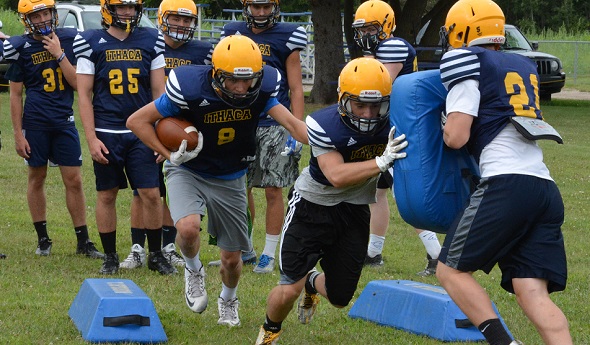
 Players started their first workout on their home practice field by stretching and working on special teams. When they were thirsty, they drank water. They wore helmets, shoulder pads, shorts and shoes.
Ithaca might’ve had the nation’s longest active 11-player football winning streak snapped last season – but during this afternoon, nothing seemed much different than for about 600 other teams in Michigan looking to begin this fall 1-0.
“That’s the first question everybody asked me last season. But it’s over now, and we’ve just got to focus on this season,” said senior Jake Smith, the returning quarterback, of the five-season run. “There’s not as much pressure anymore. We don’t have to carry on a streak. But we want to start a new one.”
And that's where this practice and any by the Yellowjackets likely will differ from most in Michigan this fall.
The practice field was filled with veterans, with nine starters back on offense and 13 who started at least one game on defense during last season's run to the Division 6 championship game, which ended in a 22-12 streak-breaking loss to Monroe St. Mary Catholic Central.
Those are some key numbers to immediately digest, but numbers became part of the swirl around Ithaca’s incredible run of the last five seasons.
First up was 44 – the number of games Ithaca won in a row to pass Cheboygan for the MHSAA’s longest streak that came all during the playoff era, which began in 1975.
Then came 57 – the number of games Ithaca had won consecutively when it took over sole possession as the nation’s most consistent winner thanks to a loss by Regina High School in Iowa City, Iowa, last August.
There was 72 – the number of consecutive wins by Hudson from Sept. 1968-Nov. 1975 that remains the MHSAA record, although, it is noted, that streak included only one playoff win before Hudson fell in the inaugural Class C Final to see its run end.
Finally, the end came at 69 – the number of games Ithaca won from opening night in 2010 until falling in to Monroe St. Mary on Nov. 28.
And now there’s only 1 – the number of wins in a row Ithaca will play for when it opens against Clare on Aug. 28, and the ranking in its division the Yellowjackets will strive for again after winning four of the last five Division 6 titles.
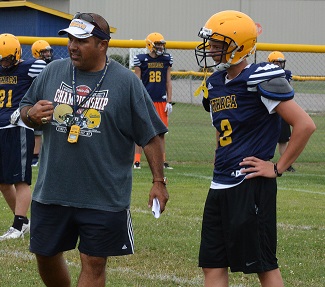 “I hate to think of it as a start over,” Ithaca coach Terry Hessbrook said as his team started its first practice at home after three days of camp in Hawks, near Rogers City. “There’s lots of experience out here, and it’s been a nice few days. I haven’t had to raise my voice because they know what the goal is, and they know what the process is that you’ve got to go through to get to it. And it’s quite a climb – you don’t get to start where you finish (the year before).
“(But) you finish on such a high, even if you lose.”
Rewind to last season’s loss, if only for a minute.
Monroe St. Mary relied in part on a senior quarterback in Bryce Windham and a 1,000-yard rusher in senior running back John Lako. Ithaca, meanwhile, returned to Ford Field with only six seniors and only a few who played significant roles – and really, were a surprise after conquering a road that included No. 8 Millington, No. 10 Madison Heights Madison and No. 5 Boyne City, the final two wins decided by senior-like clutch play in the fourth quarter.
Ithaca and Monroe St. Mary literally traded scores in the Final, although Ithaca never led. Smith ran for a 3-yard score with 33 seconds left in the third quarter to pull the Yellowjackets to within three points at 15-12. But neither team scored again until St. Mary added a touchdown with 1:41 to play.
And yet, the welcome at home that night had Ithaca feeling like it was a champion still.
“We had more people show up when we returned than maybe when we won the third or fourth (title),” said Hessbrook, who starred as a running back at Ithaca from 1982-84 and took over as head coach before the 2004 season. “The community kind’ve stood in unison and said, ‘That was pretty cool that we just got to go on that ride.’
“I get chills just talking about it.”
There could be more to come.
Smith, who has had college football conversations with Harvard and Yale among others, threw for 2,134 yards and 27 touchdowns last season and ran for 1,391 more yards and 20 scores. His top three receivers last season all were juniors; Spence DeMull is recovering from an injury, but caught 66 passes for 1,193 yards and 16 TDs. Senior Jace Demenov, the team’s leading tackler the last two seasons, is moving from offensive line to a tight end/receiver combo and is among a few who should emerge as reliable targets. Nose tackle Jonah Loomis was the team’s second-leading tackler last season and also is a senior this fall.
Eight of this season’s seniors were on the varsity as sophomores, so they’ve played 28 games – including 10 during the playoffs. Still, Ithaca is coming off a loss … not something it’s been used to of late.
 “(Local people) ask who is coming back, and we just say everybody,” Demenov said. “In years past, people knew who was coming back and what it was going to be like. People are asking this year who do we have, are we going to be good.
“It’s a game that we lost, an important game for us. We all worked for it, and to have an ending like that really bugged us. It was fun saying we had the longest streak in the nation, but the pressure’s not off. We’re coming back stronger than ever.”
As one might expect, history says Ithaca should remain elite. Hudson went 9-0 in 1976 coming off its streak-ending loss in the 1975 Final. Cheboygan won 10 of its next 11 starting at the end of 1982 and finished 1983 at 8-1. Farmington Hills Harrison came off the end of its 36-game winning streak from 1999-2002 by finishing the latter 8-3 and going 11-2 in 2003, and Fowler won the 1998 Class D title with a 10-3 record after seeing its 33-game win streak end in a 1997 Regional Final.
Still, there isn’t a script Hessbrook can refer to in this situation since so few have been in such a spot. He said it’s up to these seniors to leave their mark – be it playing 10 games, or 12, or getting all the way back to Ford Field.
Winning 14 in a row wouldn’t be 70 or 71 – but more than good enough, even if it comes with fewer people watching Ithaca’s every move.
“I think they should follow us,” Smith said. “We slipped up one game. We’re still a great team that’s going to go out there and put on a show for the fans.
“Anybody that follows us this year is not going to be disappointed.”
 Geoff Kimmerly joined the MHSAA as its Media & Content Coordinator in Sept. 2011 after 12 years as Prep Sports Editor of the Lansing State Journal. He has served as Editor of Second Half since its creation in Jan. 2012. Contact him at [email protected] with story ideas for the Barry, Eaton, Ingham, Livingston, Ionia, Clinton, Shiawassee, Gratiot, Isabella, Clare and Montcalm counties.
PHOTOS: (Top) Ithaca players work on a blocking drill during Thursday's practice. (Middle) Coach Terry Hessbrook, left, explains how to field a kick to one of his special teamers. (Below) Jake Smith, carrying the ball, follows blocker Grant Gimmey.