


Best Practices
April 10, 2012
For decades, football has had the greatest participation among high school sports. In recent years it’s become the greatest spectator sport as well. Today, MHSAA Football Playoff revenue exceeds that of Boys and Girls Basketball Tournaments combined. And if I ever want to generate comments to a blog, all I have to do is mention football.
I can write either the most inspired or inane words about most topics, and not generate a comment. But mention “football,” and opinions come fast and usually furious.
So it was with my eyes wide open that I challenged some “sacred cows” in my posting of March 20, questioned some of the standard operating procedures of high school football practice, and predicted that we will soon be making some changes in the sport I played through four years of college and coached in high school and to which I owe more of my character development than any other sport. I knew some readers would call me out of date and out of touch, knowing nothing of my past or my passion.
I knew some readers would challenge any comparison made with college and professional players, asserting that older players need fewer practices with less contact because they already have the skills and techniques of blocking and tackling. However, they miss the fact that it is the younger and still growing body that needs more care and caution, not less. Less hitting, not more. More heat and humidity acclimatization, not less.
I knew some readers would complain about diminishing time to develop young players, overlooking the proliferation of camps, clinics, combines, 7-on-7 leagues and the like which have improved skills and conditioning for many athletes prior to the official start of practice. If that were not true or if we would dial down the out-of-season demands, then I might not join the amassing advocates for reduced in-season practice demands. But sadly, it is true; coaches already have these kids year-round.
On the same day that I posted predictions of changes for football practice policies in Michigan, including more days before pads and fewer days with double sessions, the Georgia High School Association adopted policies that did just that, requiring five days of practice before the first with full pads and prohibiting two-a-day practices on consecutive days.
Such changes reflect the growing body of evidence regarding “best practices” for high school football, including the recommendations of the American Academy of Pediatrics, the Centers for Disease Control and Prevention, and the National Federation of State High School Associations. This train has left the station; and Michigan should be an early stop, an early adopter of practice policies modifications. We put our players, coaches and selves in peril if we ignore the evidence.
I’m embarrassed to say that for too long I avoided this topic because I knew it would bring ridicule. Then recently, a young but experienced head football coach told me that these are the kinds of changes that football needs. Needs to keep the game attractive to kids; and needs to keep the game safe for kids.
1st & Goal: Week 8 Preview
October 15, 2020
By Geoff Kimmerly
Second Half editor
The midpoint of every other regular season is crunch time during this abbreviated fall of 2020.
Teams across Michigan will play their fifth games this weekend – but a week from Saturday, all of this year’s league championships and playoff profile boosting will be complete.
Every game has meant even more, and below are a number of games this weekend that could end up meaning the most.
Find the schedule and then results this weekend as they’re reported via the MHSAA Score Center. This week’s broadcast schedule includes 53 varsity football games on MHSAA.tv; click the link for listings
Bay & Thumb
Hemlock (4-0) at Millington (4-0)
This will decide the Tri-Valley Conference West I championship, with Hemlock seeking its first league title since 2012 and Millington its first since 2014. To finish first, the Huskies will need to break a recent three-game losing streak against the Cardinals, who won last year’s matchup 15-6. Millington’s defense might be the key this time; it has given up just 34 points over its other three league matchups.
Keep an eye on these: FRIDAY Marine City (4-0) at Marysville (4-0), North Branch (4-0) at Imlay City (3-1), Bad Axe (3-1) at Elkton-Pigeon-Bay Port Laker (3-1), Fenton (4-0) at Swartz Creek (3-1).
Greater Detroit
Detroit Cass Tech (4-0) vs. Detroit Martin Luther King (3-1) at Detroit Collegiate Prep, Saturday
They opened this season with their closest result since 2015, Cass Tech winning 34-26, and now meet again in the Detroit Public School League 1-2 championship game. Both cruised through their league schedules, both giving up only seven points over their other three games this fall.
Keep an eye on these: FRIDAY Detroit U-D Jesuit (2-1) at Detroit Catholic Central (4-0), Garden City (3-1) at Dearborn Heights Crestwood (4-0), Detroit Central (4-0) vs. Detroit Southeastern (4-0) at Detroit Collegiate Prep. SATURDAY Clarkston Everest Collegiate (4-0) at Royal Oak Shrine (4-0).
Mid-Michigan
McBain (4-0) at Beal City (4-0)
The Aggies were well on their way to a perfect run through the Highland Conference last season when third-place McBain stunned with a 27-0 win in the league finale – which sent Beal into a shared championship with Houghton Lake instead. McBain and Beal City are meeting in the league finale again, with the winner taking the championship outright.
Keep an eye on these: FRIDAY Pewamo-Westphalia (4-0) at Fowler (4-0), Harrison (3-1) at Clare (4-0), Durand (4-0) at New Lothrop (4-0), Williamston (4-0) at Olivet (4-0).
Northern Lower Peninsula
Sault Ste. Marie (3-1) at Kingsley (4-0)
The Blue Devils have launched an impressive chase of reigning champion Kingsley in their first season as part of the Northern Michigan Football Conference, as both are the only teams still unbeaten in Legends division play. Both have wins over Traverse City St. Francis, but Sault Ste. Marie’s victory over Marquette in Week 5 may turn out to have been even more important prep for the powerful Stags.
Keep an eye on these FRIDAY East Jordan (3-1) at Johannesburg-Lewiston (4-0), Manistee (3-1) at Ludington (3-1), Cadillac (3-1) at Traverse City West (3-1). SATURDAY Ogemaw Heights (3-1) at Traverse City St. Francis (2-2).
Southeast & Border
Erie Mason (4-0) at Sand Creek (4-0)
The Eagles, first-year members of the Tri-County Conference, are in a league title conversation for the first time since winning the Lenawee County Athletic Association in 2003. They also can tie their winningest finish since 2003 with a victory this week or next, having won a combined eight games over the last seven seasons before this fall. Sand Creek is used to more success, but still is hoping to clinch its first league championship since 2011. Both have scored at least 46 points in every game this fall.
Keep an eye on these: FRIDAY Homer (4-0) at Reading (3-1), Monroe (3-1) at Temperance Bedford (3-1), Ida (2-2) at Blissfield (4-0), Michigan Center (1-1) at Manchester (2-2).
Southwest Corridor
Lawton (4-0) at Schoolcraft (3-1)
In 2019, Lawton won the Southwestern Athletic Conference Valley title, and Schoolcraft the SAC Lakeshore championship. This fall, Schoolcraft moved into the Valley, and Lawton this weekend no doubt is rolling up the welcome mat – recalling as well how the Eagles defeated the Blue Devils 47-10 in last season’s Division 7 District Final.
Keep an eye on these FRIDAY Constantine (3-1) at Kalamazoo United (4-0), Battle Creek Lakeview (4-0) at Stevensville Lakeshore (3-1), Cassopolis (2-2) at Mendon (3-1), Watervliet (2-2) at Coloma (3-1).
Upper Peninsula
Escanaba (0-1) at Marquette (3-1)
Arguably the Upper Peninsula’s most famed rivalry will add one of its more interesting chapters, as Marquette has clinched a share of the Great Northern Conference championship while Escanaba is finally getting an opportunity to play its first game this fall. This could go a few ways. The Eskymos could show some rust against their game-sharpened rivals. They also could unleash a month’s worth of wanting to get back on the field now that they’ve finally gotten the chance.
Keep an eye on these FRIDAY Gladstone (2-1) at Menominee (2-2), West Iron County (4-0) at Gwinn (2-2), Negaunee (3-1) at Houghton (1-1), Calumet (1-2) at Hancock (1-2).
West Michigan
Whitehall (4-0) at Montague (4-0)
Tonight’s winner will clinch a share of the West Michigan Conference title, and Montague is a frequent part of the championship conversation. Whitehall is seeking its first WMC title since 1999, but has had a big role is making this one of the most competitive leagues in the state as well with five playoff appearances over the last six seasons. This matchup could be a test of defensive wills – the Vikings have allowed only three points this season, and Montague has given up a mere 12.
Keep an eye on these: FRIDAY Zeeland West (4-0) at Muskegon (3-1), Allendale (3-1) at Grand Rapids West Catholic (3-1), Hamilton (2-2) at Hudsonville Unity Christian (4-0), Ada Forest Hills Eastern (3-1) at Grand Rapids Catholic Central (4-0).
8-Player
Kinde-North Huron (4-0) at Peck (3-1)
This showdown will decide at least a share of the North Central Thumb League Stripes championship, with North Huron able to clinch outright what would be its second title in four seasons. The Warriors have won six straight times over Peck, including in last season’s playoff opener – although the team’s regular-season meeting was decided by just eight points.
Keep an eye on these: FRIDAY Munising (4-0) at Cedarville (3-1), Deckerville (3-1) at Genesee (3-1), Pickford (4-0) at Rapid River (3-1). SATURDAY Merrill (4-0) at Portland St. Patrick (4-0).
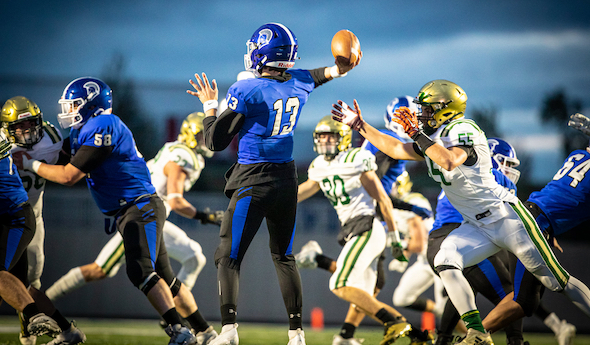
PHOTO: Muskegon Catholic Central is another undefeated team this fall; here the defense surrounds Sparta’s quarterback during the Oct. 2 victory. (Photo by Tim Reilly.)