


Best Practices
April 10, 2012
For decades, football has had the greatest participation among high school sports. In recent years it’s become the greatest spectator sport as well. Today, MHSAA Football Playoff revenue exceeds that of Boys and Girls Basketball Tournaments combined. And if I ever want to generate comments to a blog, all I have to do is mention football.
I can write either the most inspired or inane words about most topics, and not generate a comment. But mention “football,” and opinions come fast and usually furious.
So it was with my eyes wide open that I challenged some “sacred cows” in my posting of March 20, questioned some of the standard operating procedures of high school football practice, and predicted that we will soon be making some changes in the sport I played through four years of college and coached in high school and to which I owe more of my character development than any other sport. I knew some readers would call me out of date and out of touch, knowing nothing of my past or my passion.
I knew some readers would challenge any comparison made with college and professional players, asserting that older players need fewer practices with less contact because they already have the skills and techniques of blocking and tackling. However, they miss the fact that it is the younger and still growing body that needs more care and caution, not less. Less hitting, not more. More heat and humidity acclimatization, not less.
I knew some readers would complain about diminishing time to develop young players, overlooking the proliferation of camps, clinics, combines, 7-on-7 leagues and the like which have improved skills and conditioning for many athletes prior to the official start of practice. If that were not true or if we would dial down the out-of-season demands, then I might not join the amassing advocates for reduced in-season practice demands. But sadly, it is true; coaches already have these kids year-round.
On the same day that I posted predictions of changes for football practice policies in Michigan, including more days before pads and fewer days with double sessions, the Georgia High School Association adopted policies that did just that, requiring five days of practice before the first with full pads and prohibiting two-a-day practices on consecutive days.
Such changes reflect the growing body of evidence regarding “best practices” for high school football, including the recommendations of the American Academy of Pediatrics, the Centers for Disease Control and Prevention, and the National Federation of State High School Associations. This train has left the station; and Michigan should be an early stop, an early adopter of practice policies modifications. We put our players, coaches and selves in peril if we ignore the evidence.
I’m embarrassed to say that for too long I avoided this topic because I knew it would bring ridicule. Then recently, a young but experienced head football coach told me that these are the kinds of changes that football needs. Needs to keep the game attractive to kids; and needs to keep the game safe for kids.
MMA Helps 3-Sporter Shine at BCC
May 3, 2019
By Doug Donnelly
Special for Second Half
BROOKLYN – When Khol Partridge gets some time away from the football field, basketball court and baseball diamond, he knows exactly where he’s going – to relax with some Mixed Martial Arts.
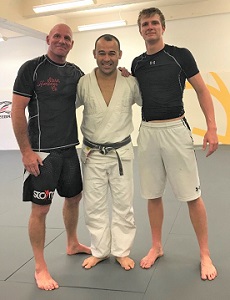
 Partridge is winding down his days as a three-sport athlete at Brooklyn Columbia Central, a Class B school in southeast Michigan’s Irish Hills area. His father Rodney owns Pure Combat, a gym in Cement City that challenges Khol as an athlete, both mentally and physically, in a different way than high school sports do. But, combined, Khol said, it’s made him a stronger athlete and more of a leader.
“In the summertime, I’m in the gym every day,” Partridge said. “It makes you such a better athlete. It improves your attitude, your mindset, your balance, everything about being an athlete.”
Partridge mainly does the Jiu Jitsu form of MMA, not the type that puts him into a ring with another striker, or fighter. But, it’s still intense.
“My dad puts me through all kinds of crazy workouts,” he said. “You get yourself into tough spots in MMA and it makes you have to find a way out of it. That’s one way it helps you in other sports.”
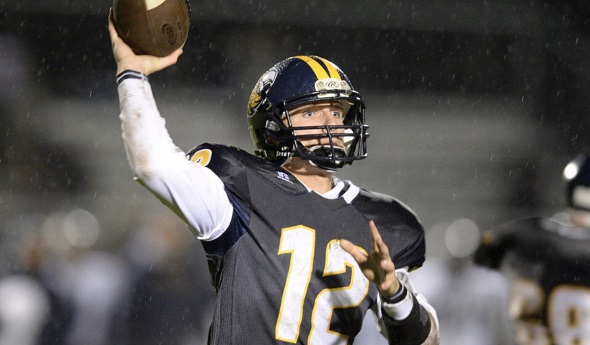
Partridge has been in more than a few tight spots for the Golden Eagles over the last few seasons but has usually found a way to success. The CC football team has gone 23-9 over the last three seasons, making three consecutive playoff appearances. He led the Lenawee County Athletic Association this past season by completing 154-of-257 passes for 2,317 yards and 26 touchdowns. He threw just four interceptions all season. He also ran for 511 yards and nine touchdowns.
CC football coach Josh Kubiak called Partridge an “amazing athlete” and “amazing individual.”
“I could go on about Khol for a long time and tell you about all his stats and achievements,” Kubiak wrote in an e-mail. “In my opinion the best quality Khol has is his leadership skills. I remember back to when he was a freshman on our playoff team. He was the last player on the field after our loss hugging seniors and then came up to me and said, ‘We will be back.’”
The Golden Eagles won their first league football title since 1982 with Partridge at quarterback this past season. He finished with 4,800 career passing yards and a number of CC football records.
 “He has the special talent to get other student athletes to follow him, and he gets the best out of them,” Kubiak said. “He always finds the positive out of the worst situations.”
It’s no surprise that Partridge chose the quarterback position – or, rather, it chose him.
“I was a quarterback since I was really little. I don’t know, maybe it was just because I wanted to be a leader. I’ve always had that mindset. I wanted to be the smartest player on the field, to know what everyone else was doing. My dad always taught me to be a leader, to be the best leader I could be.
“My biggest goal has always been just to be a leader. Leadership is a full-time job. You just have to step up at important times, to be an inspiration to others in the huddle or know when to get after someone and when to just give them a high-five and say, ‘It’s all right. Keep your head up.’”
Partridge got a few looks from colleges and was close to trying to walk on at a Division I school out west. Ultimately, he decided to stay a little closer to home and committed to Ohio’s University of Findlay, a perennial football powerhouse in Division II.
“I got a lot of looks, but nothing seemed to pan out. Then, the Findlay coach hit me up on Twitter,” Partridge said. “They contacted me, so saw tape and I went to visit. They have a great campus. I even did some research, and I know there is a Mixed Martial Arts gym not far from campus.”
In basketball, Partridge was the team’s top scorer in 2018-19, made 48 3-pointers and finished his career with more than 750 points over parts of four seasons. In baseball, he’s one of the team leaders in hitting and is enjoying another season of success.
“I fell in love with football early on in life,” he said. “I always played baseball, too. Me and my buddy, Chase Tompkins, we’ve always played baseball together. I didn’t start playing basketball until later, probably seventh grade.
“If it’s football season, then football is my favorite sport. If it’s baseball season, then baseball is my favorite sport.”
In baseball, Partridge is a middle infielder. When Tompkins pitches, Partridge plays shortstop; otherwise he plays second base.
“We are a really good double-play combination,” he said. “I think last year we turned like 20 double plays together. It’s crazy. We’ve played together a long time. We’ve kind of always been that duo.”
This season, Partridge’s goal is to hit .500.
“The season is going great,” he said. “I’m hitting fairly well, not as well as I want to be hitting, but I’m working hard. Baseball is so mental. You have to be mentally right to play the game.”
Partridge is quick to credit his parents, Rodney and Terri, for his success.
“My dad has been the biggest influence in my life,” he said. “He’s always been someone to look up to. And my mom is the best ever. She keeps my head in line. I’m so blessed to have two parents I can look up to.”
Khol Partridge is excited for the next chapter in life, although he still has some work to do this spring with the CC baseball team. He’s entertaining the idea of trying to walk-on with the Findlay baseball team.
“I definitely think I can,” he said. “Sports are a big part of my life. They always have been. Sports teaches you so much about different aspects in life.”
 Doug Donnelly has served as a sports and news reporter and city editor over 25 years, writing for the Daily Chief-Union in Upper Sandusky, Ohio from 1992-1995, the Monroe Evening News from 1995-2012 and the Adrian Daily Telegram since 2013. He's also written a book on high school basketball in Monroe County and compiles record books for various schools in southeast Michigan. E-mail him at [email protected] with story ideas for Jackson, Washtenaw, Hillsdale, Lenawee and Monroe counties.
PHOTOS: (Top) Columbia Central’s Khol Partridge unleashes a pass this past fall. (Middle) Partridge, far right, with father Rodney (far left) and renowned Brazilian Jiu-Jitsu competitor Marcelo Garcia. (Photos courtesy of the Partridge family.)