

Big Stop Locks Up Chippewa Valley Title
November 24, 2018
By Tom Kendra
Special for Second Half
DETROIT – Ironically, it was Clinton Township Chippewa Valley’s defense which stole the show Saturday at Ford Field.
With just 23 seconds to play in the Division 1 Final, Clarkston scored to pull within one point of the Big Reds. Wolves coach Kurt Richardson, himself known statewide for defensive genius over 32 seasons leading the program, rolled the dice and went for a go-ahead 2-point conversion.
After a timeout, fullback Jake Billette took a direct snap and went left, then handed off to receiver Josh Luther running right, who was looking to either run or pass for the conversion.
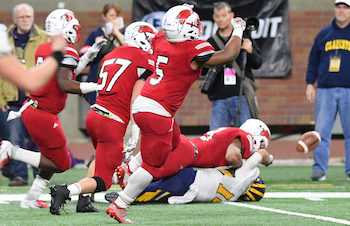
But Chippewa Valley senior defensive lineman Michael Garwood read the play perfectly, stayed home on the reverse and then bull-rushed Luther for a four-yard loss, preserving the Big Reds’ 31-30 victory and first MHSAA football championship since winning Division 2 in 2001.
“A lot of people talk about our offense, but that was a huge defensive play right there, obviously,” said 10th-year Chippewa Valley coach Scott Merchant, whose team finished 14-0 and was known for its offense. “Michael Garwood, our defensive end, stayed home on the backside and really blew up that play.”
Garwood’s tackle for loss ended a valiant comeback for Clarkston, which was looking for its second consecutive Division 1 title and fourth in six years.
The Big Reds stunned the Wolves with two TDs in the first 6 minutes to take a quick 14-0 lead, and still led by that same margin, 24-10, at halftime.
The second half was a different story as Clarkston scored three touchdowns to just one for Chippewa Valley, but the failed two-point conversion attempt proved to be the difference.
“We’ve been aggressive forever here, and that’s the way we play football,” said Richardson, a 1971 Clarkston graduate who has turned his alma mater into a state powerhouse, explaining his end-of-game gamble. “We called a timeout, and we were all in on it. They defended it well, so what can I say? It was just a great high school football game.”
The Big Reds, champions of the Macomb Area Conference Red, were able to move the ball consistently against the vaunted Clarkston defense because of crafty senior quarterback Tommy Schuster and a bevy of dangerous weapons including Martice Bunting, Andrew Chenault and David Ellis.
Schuster, a 6-0, 195-pound senior, was a perfect 13-for-13 through the air for 205 yards and two touchdowns. He set the MHSAA Finals record for passing accuracy for players who have attempted at least 12 passes in one championship game, breaking the record of .846 set in 2011.
Schuster, who had a 36-yard scoring strike to senior Bunting in the first quarter and then a 25-yard scoring pass to Bunting late in the third which proved to be the game-winner, said all of the pregame talk about Clarkston’s defense motivated him and his offensive teammates.
 “We definitely took it as a challenge,” said Schuster, a three-year starter who threw for 1,858 yards with 26 touchdown passes and only one interception this season. “Our gameplan was to come out strong and punch them in the mouth, get their attention, and then keep it up.”
Clarkston’s final drive began at its own 22-yard line with 2:28 remaining and the Wolves trailing, 31-24.
Senior quarterback Jake Jensen, outstanding himself with a game-high 121 rushing yards and 10-of-15 passing for 110 yards through the air, engineered a 10-play, 78-yard drive which culminated with a seven-yard touchdown pass to Matt Miller with 23 seconds left on the clock.
That set the stage for Richardson’s gamble on the conversion and the title-saving tackle by Garwood.
Clarkston actually finished with the edge in total yards, 347-320, including a 213-115 edge on the ground. The difference turned out to be Schuster’s perfect day through the air, as he averaged 16 yards per pass, and also one big special teams play.
After the Wolves closed to within 17-10 on a three-yard scoring run from senior Jacob Honstetter just 41 seconds before halftime, Chippewa Valley speedster David Ellis answered right back.
Ellis, who has committed to Indiana University, took the ensuing kickoff at his own 6-yard line and turned on the jets, sprinting 94 yards along the Clarkston sideline to up the lead to 24-10 at the break.
“I just wanted to make something happen,” explained Ellis, who has 4.4-second speed in the 40-yard dash. “I saw a hole to the left and just ran as fast as I could.
“Clarkston was one of the best defenses that we faced, but we just have too many players. You can stop one, but then there’s five or six others to worry about.”
Ellis added three receptions for 58 yards, and Bunting had three catches for 66 yards. Chenault was the leading rusher with 12 carries for 67 yards. Chippewa Valley’s defense was led by Ja’Von Kimpson with an interception, Myles Harris with eight tackles, Jonathan Zak with six and Garwood with five.
Billette had 11 carries for 70 yards and a touchdown for Clarkston. Luther had four receptions and Conor Donahue and Miller had three catches apiece. Max Nicklin, Aaron Berti, Brendan Barker, Zach Reid and Luther all made six tackles.
The game was the polar opposite of last year’s Division 1 Final, where Clarkston beat West Bloomfield by the baseball-like score of 3-2. That five-point affair was the second-lowest scoring game in Finals history, and Clarkston tied the record for most punts in the Finals with eight.
Just 2:26 into Saturday’s game, the Big Reds eclipsed last year’s total points on a three-yard run by Chenault, capping a six-play, 76-yard drive.
Saturday also was vastly different from Clarkston’s previous four playoff games, where the Wolves allowed a total of 16 points.
Chippewa Valley scored its 17th point early in the second quarter on a 36-yard field goal by Niko Kepi.
By then, both coaches knew it was going to be a whole different type of ballgame.
“This is a huge day for all of us, our football program and our community,” said Merchant. “I am thankful to all of these players for taking me on this ride. This is a special, very humble group of kids that always give credit to other people.”
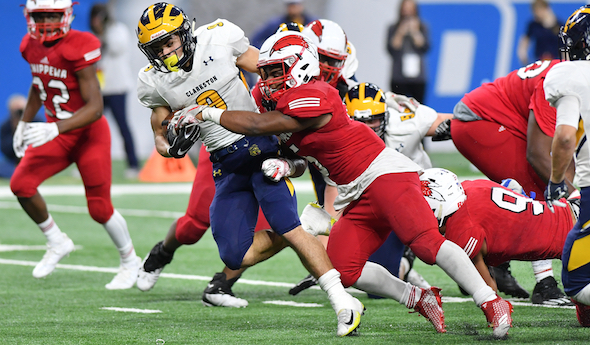
PHOTOS: (Top) Chippewa Valley’s Andre Chenault (5) takes down Clarkston’s Jake Honstetter during Saturday’s Division 1 Final at Ford Field. (Middle) The Big Reds deny the Wolves’ 2-point conversion attempt to secure a 31-30 victory.
Unbeaten Morrice Caps Remarkable Run
November 17, 2018
By Geoff Kimmerly
Second Half editor
MARQUETTE – Hunter Nowak finished his high school career Saturday at Northern Michigan University’s Superior Dome as arguably the most accomplished offensive star in Morrice football history.
But he’d be the first to point out that the Orioles put the finishing touch on their first perfect and championship season because of the effort on the other side of the ball as well.
Nowak capped a three-year varsity campaign rushing 39 times for 199 yards and three touchdowns and throwing for another score as Morrice broke away for a 44-16 win over Pickford to claim the 8-Player Division 1 championship – the Orioles’ first state title in this sport. They also finished 13-0.
And his defense played a big part in making that possible, locking down a Panthers offense that entered the Final averaging 54 points per game and also unbeaten.
“I told them before, going in, ‘Boys, this is your last game. Just sell out,’” Morrice senior linebacker/fullback Connor Lucas said. “’Leave it all on the field. Do not regret it.’
“When we did the (coin) toss, and they said they wanted to receive, we were actually more happy that they wanted to receive because we knew our defense could shut them down.”
Defense has not been a hallmark of the first decade of 8-player football in Michigan. But Morrice seemed to figure it out this fall.
The Orioles gave up 78 points – a mere six per game – and from mid-September through the first week of the playoffs posted six straight shutouts.
Morrice gave up a respectable 21 points per game in going 9-2 in 2017, playing a basic 4-4 scheme. But leading tackler Lucas said this season the defense rotated through about 20 formations.
Pickford’s lowest point total this fall had been 38 points in a Week 3 win over Crystal Falls Forest Park.
“They were quick, they were strong … they were aggressive,” said Pickford junior quarterback Jimmy Storey, who went over 1,000 yards rushing for the season with 92 Saturday, but completed only 4 of 17 passes. “They were really aggressive and tough, and gave us a run for our money.”
Pickford junior running back Stephen LaMothe opened the scoring with a 14-yard run only 2:39 into the game.
But Nowak followed with 45 and 4-yard touchdown runs and a 15-yard scoring pass to senior Austin Edington to take a 22-8 lead into the break. “Going into the locker room at halftime, and we were up, we could definitely tell they were kinda surprised,” Lucas said.
Nowak opened the second half with another scoring run. LaMothe – who finished with 99 yards rushing on 14 carries – broke a 60-yarder at the end of the third quarter to make the score 30-16. But Edington pulled the Orioles away with 54 and 6-yard scoring runs in the fourth quarter.
 Edington finished with 122 yards rushing on 10 carries as the team ran for 317 of its 353 yards total.
“Once we started the game, started gaining a little momentum, we could see some of our run plays were working better than what we thought they (would),” Morrice coach Kendall Crockett said. “We were moving the bigger men on the other team, and Hunter just made the lanes work, and Austin, and Connor was blocking and the plays work. When you design them, and they work in a game, it’s fun to watch.”
Crockett took over the program five seasons ago when Morrice switched from 11-player, and brought to the gameplan some of the spread scheme from his time as an assistant at DeWitt. “When I took over the job in 8-man football, I didn’t have a clue what I was doing,” he said. “I looked to some of the more experienced coaches – Rob McDaniel from Peck, Deckerville, you look to those different coaches to find out what worked for them. We tried their stuff, and that’s when we decided we had to go our own way and see what works for Morrice.
“We came up with the system we have today, and you know what – speed, especially out here, speed hurts.”
Morrice’s previous longest playoff run was to the Class D Semifinals in 1996. The Orioles went 9-2 three seasons ago but fell back to 4-5 in 2016 before starting a two-year climb to history.
“We’ve been dreaming of this since we were in third grade playing together,” Nowak said. “Our sophomore year, things didn’t go right. Last year we made the playoffs, we didn’t do too well. But we knew this year was the year to do it. We played every game super hard, went undefeated – just everything worked out.”
Pickford capped its third straight season of making the Semifinals with its first trip to a championship game. The Panthers will graduate just two of 18 players on Saturday’s roster. Crockett said he saw in the Panthers’ junior class the potential to do what his seniors accomplished this fall.
Senior Chase Warner had 12 tackles for Pickford, while Storey and junior Isaiah May both had 10. Senior Beau Dietz had 10 tackles to lead Morrice.
“We’re going to have to remember it, and work that much harder in the offseason,” Storey said. “We gotta come back next year and get it.”
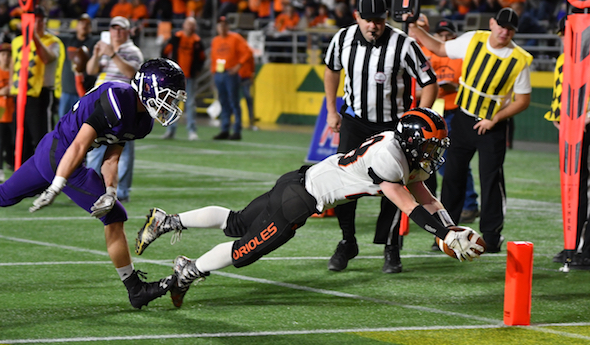
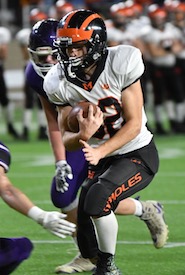
PHOTOS: (Top) Morrice’s Austin Edington dives for the end zone for one of his three touchdowns Saturday at the Superior Dome. (Middle) The Orioles’ Hunter Nowak breaks past a Pickford defender. (Photos by Cara Kamps.)