

Big Stop Locks Up Chippewa Valley Title
November 24, 2018
By Tom Kendra
Special for Second Half
DETROIT – Ironically, it was Clinton Township Chippewa Valley’s defense which stole the show Saturday at Ford Field.
With just 23 seconds to play in the Division 1 Final, Clarkston scored to pull within one point of the Big Reds. Wolves coach Kurt Richardson, himself known statewide for defensive genius over 32 seasons leading the program, rolled the dice and went for a go-ahead 2-point conversion.
After a timeout, fullback Jake Billette took a direct snap and went left, then handed off to receiver Josh Luther running right, who was looking to either run or pass for the conversion.
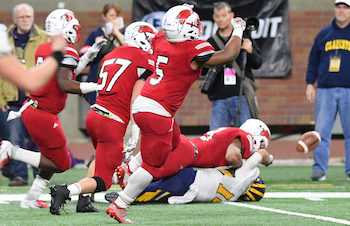
But Chippewa Valley senior defensive lineman Michael Garwood read the play perfectly, stayed home on the reverse and then bull-rushed Luther for a four-yard loss, preserving the Big Reds’ 31-30 victory and first MHSAA football championship since winning Division 2 in 2001.
“A lot of people talk about our offense, but that was a huge defensive play right there, obviously,” said 10th-year Chippewa Valley coach Scott Merchant, whose team finished 14-0 and was known for its offense. “Michael Garwood, our defensive end, stayed home on the backside and really blew up that play.”
Garwood’s tackle for loss ended a valiant comeback for Clarkston, which was looking for its second consecutive Division 1 title and fourth in six years.
The Big Reds stunned the Wolves with two TDs in the first 6 minutes to take a quick 14-0 lead, and still led by that same margin, 24-10, at halftime.
The second half was a different story as Clarkston scored three touchdowns to just one for Chippewa Valley, but the failed two-point conversion attempt proved to be the difference.
“We’ve been aggressive forever here, and that’s the way we play football,” said Richardson, a 1971 Clarkston graduate who has turned his alma mater into a state powerhouse, explaining his end-of-game gamble. “We called a timeout, and we were all in on it. They defended it well, so what can I say? It was just a great high school football game.”
The Big Reds, champions of the Macomb Area Conference Red, were able to move the ball consistently against the vaunted Clarkston defense because of crafty senior quarterback Tommy Schuster and a bevy of dangerous weapons including Martice Bunting, Andrew Chenault and David Ellis.
Schuster, a 6-0, 195-pound senior, was a perfect 13-for-13 through the air for 205 yards and two touchdowns. He set the MHSAA Finals record for passing accuracy for players who have attempted at least 12 passes in one championship game, breaking the record of .846 set in 2011.
Schuster, who had a 36-yard scoring strike to senior Bunting in the first quarter and then a 25-yard scoring pass to Bunting late in the third which proved to be the game-winner, said all of the pregame talk about Clarkston’s defense motivated him and his offensive teammates.
 “We definitely took it as a challenge,” said Schuster, a three-year starter who threw for 1,858 yards with 26 touchdown passes and only one interception this season. “Our gameplan was to come out strong and punch them in the mouth, get their attention, and then keep it up.”
Clarkston’s final drive began at its own 22-yard line with 2:28 remaining and the Wolves trailing, 31-24.
Senior quarterback Jake Jensen, outstanding himself with a game-high 121 rushing yards and 10-of-15 passing for 110 yards through the air, engineered a 10-play, 78-yard drive which culminated with a seven-yard touchdown pass to Matt Miller with 23 seconds left on the clock.
That set the stage for Richardson’s gamble on the conversion and the title-saving tackle by Garwood.
Clarkston actually finished with the edge in total yards, 347-320, including a 213-115 edge on the ground. The difference turned out to be Schuster’s perfect day through the air, as he averaged 16 yards per pass, and also one big special teams play.
After the Wolves closed to within 17-10 on a three-yard scoring run from senior Jacob Honstetter just 41 seconds before halftime, Chippewa Valley speedster David Ellis answered right back.
Ellis, who has committed to Indiana University, took the ensuing kickoff at his own 6-yard line and turned on the jets, sprinting 94 yards along the Clarkston sideline to up the lead to 24-10 at the break.
“I just wanted to make something happen,” explained Ellis, who has 4.4-second speed in the 40-yard dash. “I saw a hole to the left and just ran as fast as I could.
“Clarkston was one of the best defenses that we faced, but we just have too many players. You can stop one, but then there’s five or six others to worry about.”
Ellis added three receptions for 58 yards, and Bunting had three catches for 66 yards. Chenault was the leading rusher with 12 carries for 67 yards. Chippewa Valley’s defense was led by Ja’Von Kimpson with an interception, Myles Harris with eight tackles, Jonathan Zak with six and Garwood with five.
Billette had 11 carries for 70 yards and a touchdown for Clarkston. Luther had four receptions and Conor Donahue and Miller had three catches apiece. Max Nicklin, Aaron Berti, Brendan Barker, Zach Reid and Luther all made six tackles.
The game was the polar opposite of last year’s Division 1 Final, where Clarkston beat West Bloomfield by the baseball-like score of 3-2. That five-point affair was the second-lowest scoring game in Finals history, and Clarkston tied the record for most punts in the Finals with eight.
Just 2:26 into Saturday’s game, the Big Reds eclipsed last year’s total points on a three-yard run by Chenault, capping a six-play, 76-yard drive.
Saturday also was vastly different from Clarkston’s previous four playoff games, where the Wolves allowed a total of 16 points.
Chippewa Valley scored its 17th point early in the second quarter on a 36-yard field goal by Niko Kepi.
By then, both coaches knew it was going to be a whole different type of ballgame.
“This is a huge day for all of us, our football program and our community,” said Merchant. “I am thankful to all of these players for taking me on this ride. This is a special, very humble group of kids that always give credit to other people.”
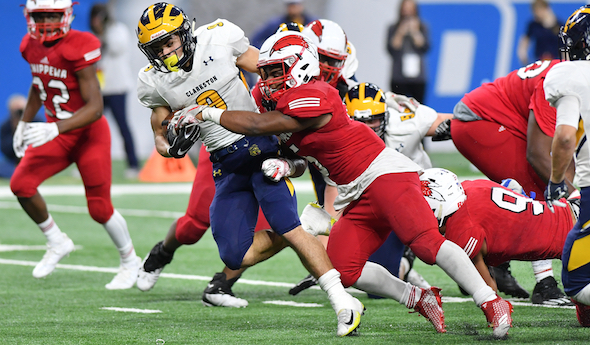
PHOTOS: (Top) Chippewa Valley’s Andre Chenault (5) takes down Clarkston’s Jake Honstetter during Saturday’s Division 1 Final at Ford Field. (Middle) The Big Reds deny the Wolves’ 2-point conversion attempt to secure a 31-30 victory.

Football Finals Protocols Announced
November 21, 2016
By Geoff Kimmerly
Second Half editor
To provide for the convenience and safety of spectators attending the Michigan High School Athletic Association 11-Player Football Finals – presented by the Michigan National Guard – at Ford Field in Detroit, Nov. 25 and 26, attendees are being advised of a variety of items related to transportation and security – including policies regulating types of bags allowed into the stadium.
Parking will be available in Ford Field facilities and lots to the east and north of the stadium and costs $6. A map identifying the designated Ford Field lot (4) and parking deck can be found on the Football page of the MHSAA Website. (There also are a number of privately-operated parking facilities close to Ford Field, but their pricing may differ.)
Fans also are advised that tailgating, including the setting up and use of grilling equipment, and the consumption of alcohol, is prohibited in Ford Field parking facilities and lots.
Gates A, B and G will be available for public entrance during the event. Ticket sales will begin near Gates A and G at 8 a.m. each day, and the building will open its doors to spectators at 9 a.m. Tickets must be paid for in cash only.
Tickets are priced at $10 and allow a fan to see all four games in a single day. Spectators leaving the stadium will be required to purchase another ticket for re-entry. Children under the age of 2 will be admitted without charge for this event. There will not be a public Will Call window.
Upon arrival in the building, fans will find their designated seating areas on the South side of the field if their team is the designated home team for their contest and on the North side for the designated visiting team. Home teams this weekend are Detroit Catholic Central, Walled Lake Western, Muskegon, Grand Rapids Catholic Central, Menominee, Maple City Glen Lake, Pewamo-Westphalia and Muskegon Catholic Central. Brightly lit video boards above the seating areas will display the names of the participating teams each day, and fans should sit on the side of the stadium where they see their school’s name. For general fans, the entire lower bowl of Ford Field will be open for the event.
Security measures also will be in place to help assure spectator safety. Fans will be subject to a visual search, and Ford Field personnel reserve the right to request patrons open their coats, bags and other item-carrying vessels for visual inspection and deny entrance to individuals who do not cooperate.
Items which fans will be prohibited from bringing into the building include, but are not limited to, the following:
• Purses larger than a clutch bag, coolers, briefcases, backpacks, cinch bags, grocery & paper bags, duffle bags, luggage of any kind, computer and camera bags and large camera cases.
• Aerosol cans (hairspray, mace, pepper spray, etc.)
• Animals (except service animals to aid guests with disabilities)
• Balloons (air or helium)
• Balls (beach balls, footballs, etc.)
• Banners or large flags
• Cameras with lenses longer than five inches. Selfie Sticks also are prohibited.
• Decals, stickers, confetti or glitter
• Electronic equipment including laptop computers, video recorders (hand-held video cameras are allowed), tripods and wearable video cameras including Go Pros.
• Fireworks
• Food, beverages or liquids (cans, bottles, boxes, flasks, etc.)
• Illegal substances
• Knives, pocket knives, box cutters, scissors, etc.
• Laser pointers
• Markers (permanent) and/or paint
• Noisemaking devices (bells, horns, kazoos, whistles, etc.)
• Objects that can be used as missiles or projectiles (sticks, bats, clubs, Frisbees, etc.)
• Seat cushions
• Strollers and infant car seats or carriers
• Umbrellas (large size)
• Weapons
The following items will be permitted after inspection:
• Small bags, purses and fanny packs that do not exceed 8½ inches by 14 inches by 10 inches. An exception will be made for medically necessary items after proper inspection at a gate designated for this purpose.
• Diaper bags (only if accompanied by a child)
• Binoculars and binoculars cases
• Cameras and small camera cases (lenses may not measure longer than five inches)
• Small radios (no larger than the size of a football and used with an earpiece)
• Small hand-held video cameras (but no tripods or extension cords)
• Small, compact umbrellas (must be placed securely under seat)
• Posters and signs without poles or sticks, or larger than what one person can hold.
The complete list of prohibited items can be found on the Ford Field Website at the bottom of the web page under Stadium Info, Policies. Prohibited items that are discovered during security inspections at stadium entrances must either be returned to the owner's vehicle or discarded. Items will not be held for later pickup.
Fans are reminded that all image taking (still and video) may be only for personal, non-commercial use.