

Brighton Memories Close to Henson's Heart
By
Steve Vedder
Special for MHSAA.com
November 7, 2017
Drew Henson admits he'll still sneak an occasional peak at the record book.
After 20 years and professional careers in two sports, a quick glance isn't about vanity for Henson. The former Brighton football and baseball star said he's simply curious whether his myriad records are withstanding the test of time.
"Sometimes somebody will send me (a link), and I'll look to see if anybody is getting close," Henson said. "I've got to see who is coming up."
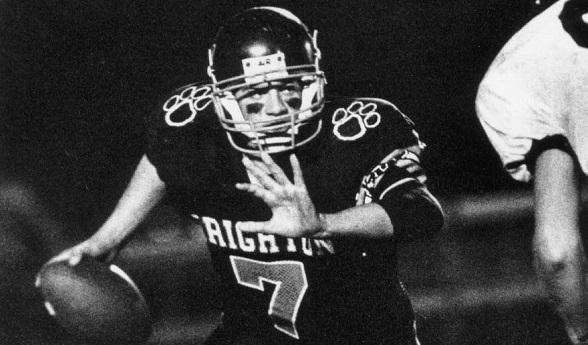
Henson, 37, graduated from Brighton in 1998 having set 11 major hitting records, eight of which he still holds 20 years later. He's also noted among the state football record setters after throwing for 5,662 yards and 52 touchdowns during his Bulldogs career. Twice he threw for more than 2,000 yards in a season during an era right before spread offenses made doing so a much more regular occurrence. In addition, he was a standout basketball player as well at Brighton and his class’ valedictorian.
In baseball, Henson is still the all-time career leader in hits (257), doubles (68), home runs (70), grand slams (10) and RBI (290). The 70 homers is 23 more than those hit by any other Michigan high school player, including eventual major leaguers such as Nate McLouth (Whitehall), Ryan LaMarre (Jackson Lumen Christi) and Zach Putnam (Ann Arbor Pioneer). Henson drove in at least 78 runs every season sophomore through senior years. He's the state's all-time leader in RBI by 87. He also continues to hold national high school records for career RBI and grand slams.
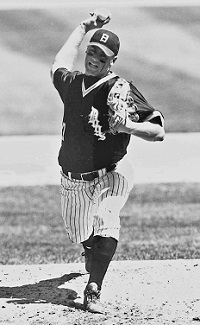
Henson's senior baseball season is unquestionably the best ever amassed by a Michigan prep player. He set single-season records with 22 homers and 83 RBI, batted .605 and went 14-2 as a pitcher, including appearing in an MHSAA tournament game in which he struck out 20 of 21 batters, allowing batters to make contact with a pitch only twice.
 Now living in Tampa, Fla., Henson he still views the records the same way he did before he departed to play quarterback at University of Michigan and then eventually sign $3.5 and $17 million contracts with the Dallas Cowboys and New York Yankees, respectively. Henson, who once fielded ground balls beside Derek Jeter and battled Tom Brady for a starting job, played on four Brighton baseball teams that averaged about 30 wins per year.
"A lot of factors created those opportunities for me. You don't set records like that without playing on a good team with good teammates," he said.
"We were a good hitting team from one through nine in the order. Our goal was to try and win state every year. I wouldn't have hit the homers or driven in the runs every year without my teammates. I have a lot of vivid memories of high school that are near and dear to my heart."
Former Brighton coach Mark Carrow said it's no surprise to him that Henson still owns the record book two decades after graduating. Carrow said Henson was the perfect blend of work ethic and natural talent.
"I coached for 34 years, and he was without question the best player I ever saw," Carrow said. "From the time he came to us as a freshman, it took one look at him throwing or one look hitting to know he was special.
"If there was a checklist for what you wanted in a baseball or football player, he checked the top of the box every time. He could throw 97, 98 (mph) and he could hit. He could dominate a game."
Carrow said the records are even more remarkable when you consider Henson every season would draw more than 40 walks, many intentional.
"Scouts used to come to the games, and I mean teams' top scouts," Carrow said. "And they'd say Drew was as good as they had ever seen."
Henson’s parents both were Division I college athletes, and his father Dan coached football at four Division I programs. Still, Drew’s dual sport professional career nearly took a different path as a youngster. While Henson started playing T-ball as a 5-year-old, his first love during his preteen years was basketball. Henson didn't play his first competitive football game until the eighth grade.
Considering he had interests in virtually every sport and at least in part because his father was a football coach, Henson thought of himself as a "gym rat" growing up. He would tag along to his father's practices, devour box scores in the paper and prop himself in front of the television on fall afternoons.
Much of high school athletics today is focused on specialization, but Henson said he never considered narrowing his sports to one. In fact, he encourages his young daughter to play as many sports as she can fit in.
"It never got dull for me," he said. "For a lot of kids today, it's too much for too long. You don't get a mental break. You can start to lose you."
 While Henson's high school career was one for the record books, and he helped the Wolverines to a 9-3 record and Cotton Bowl win in 2000, his professional career never took off. He was a third-round draft pick by the Yankees (97th overall) in 1998 and sixth-round pick of the NFL's Houston Texans in 2003.
He stalled at Triple-A in the Yankees system, but did make the major leagues in 2003, singling off the Orioles' Eric DeBose for his only big league hit. He wound up retiring from baseball following the season after hitting .248 with 67 homers and 274 RBI in 501 minor league games. He was 23 years old.
In the NFL, Henson wound up making one start for the Cowboys in 2004 and in 2008 joined the Lions for a season. Henson threw one touchdown pass as a Cowboy, to Jeff Robinson in 2004.
Henson, who in July of 2015 still rated a profile in Sports Illustrated a decade after throwing his final pass in the NFL, has been asked many times about his lack of success in professional sports. Past speculation states he was rushed through the Yankees' chain, while participation in professional baseball may have stunted his football development.
Two decades after leaving Brighton, Henson said he still answers the question of which sport was actually his favorite the same way: with diplomacy.
"I've always said nothing was more fun than to play baseball, but there is also nothing like being in the huddle on the football field," he said. "It's hard to say which I liked more. You can play baseball every day, but you can only play football once a week."
The one regret Henson may harbor has to do with patience. If he had to do it all over again, Henson said he'd force himself to slow down and enjoy the process. Henson said he often felt he had to play catch-up in both sports.
"I would tell my younger self to have more patience. There were so many opportunities after my junior year (of college) that would have still been there as a senior," he said. "Because of that I wish I would've had more patience and let the process play out."
Henson said his message to youngsters who face the same challenge is simple.
"Society is so go, go, go," he said. "You just have to learn to hit the pause button. If you're always on to the next thing, you're not embracing the moment. I wish I had done more of that.
"If you like to work and put in the time, you can be successful. All that goes into it. If you have the heart and desire and pay attention to detail, you will be successful."
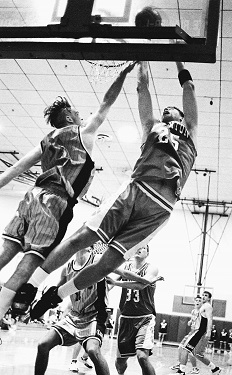
PHOTOS: (Top) Drew Henson starred during the fall at Brighton’s quarterback. (Middle) Henson struck out 20 of 21 batters he faced in a 1997 game against Walled Lake Western. (Below) Henson also was a basketball standout, averaging 22 points per game according to a Sports Illustrated profile published in 1998. (Football and basketball photos courtesy of Brighton High School).
Drive for Detroit: Week 6 in Review
October 7, 2019
By Geoff Kimmerly
Second Half editor
There were a handful of newly-crowned league champions celebrating by the end of this football weekend, and 54 more teams were able to start making playoff plans.
 And then there were the handful of teams turning things upside-down.
For all of the predictions made at the beginning of each season and even over the course of every week, there are still plenty of surprises to enjoy even at this late date. Read more below about all of the above as we head into the final third of this regular season.
"Drive for Detroit" is sponsored by MI Student Aid.
Bay & Thumb
HEADLINER Midland 22, Mount Pleasant 21 Midland controls the Saginaw Valley League Red title race after avenging the 2018 loss that eventually resulted in Mount Pleasant (5-1) becoming last year’s league champion. This time, the teams traded leads throughout the game before the Chemics (6-0) went up for good during the fourth quarter. Click for more from the Midland Daily News and see highlights below from WJRT.
Midland outlasts Mt. Pleasant 22-21 to remain perfect on the season@midlandchemics @tommyjohnstonee https://t.co/SOf4aj5fmE
— ABC12WJRT (@ABC12WJRT) October 5, 2019
Watch list Hemlock 30, Ithaca 6 While the Yellowjackets (5-1) still finished with a share of the Tri-Valley Conference West I title, the headliner from this league finale was Hemlock (4-2) handing Ithaca its first league loss since 2009. Midland Bullock Creek ended up with a share of the title as well thanks to the Huskies’ feat.
Remember this one Goodrich 49, Lake Fenton 14 The Martians (5-1) secured a share of the Flint Metro League “Lower” division title and can win it outright this week again winless Clio. Lake Fenton (3-3), meanwhile, will hope for an upset to claim a share of the championship but also must win out to guarantee a playoff berth after missing the postseason a year ago.
More shoutouts Fenton 24, Linden 21 The Tigers (5-1) earned a share of the Flint Metro League “Upper” division title, their eighth league championship in nine seasons after finishing third in the formerly unified Metro last fall. Richmond 14, North Branch 7 The Blue Devils (6-0) will meet Almont this week with a share of the Blue Water Area Conference title on the line after knocking North Branch (4-2) out of contention.
Greater Detroit
HEADLINER Belleville 20, Dearborn Fordson 19 Belleville made a number of clutch plays during the final six minutes to continue its unbeaten run, first stopping a 2-point conversion attempt after Fordson’s final score and then driving for the game-winning touchdown. Belleville (6-0) remains tied with Livonia Franklin for first in the Kensington Lakes Activities Association East. Those two meet Week 8 – but Franklin also must face Fordson (5-1) this week as the Tractors try to keep their hopes alive for a three-team shared championship. Click for more from M-Live Detroit and see highlights below from State Champs Sports Network.
VIDEO: Check out the highlights from the Belleville at Dearborn Fordson (@Fordsontractors) football game from tonight. @JermainCrowell @BHS_Sec1
Brought to you by @LawrenceTechU, @MHSAA & @hungryhowies pic.twitter.com/kYnY5aMEfs— STATE CHAMPS! (@statechampsnet) October 5, 2019
Watch list Detroit Martin Luther King 32, Detroit Denby 14 The Crusaders (4-2) won this matchup for first place in the Detroit Public School League Division 2, claiming a share of the title while handing Denby (5-1) its only loss.
Remember this one Detroit Renaissance 25, Detroit Cass Tech 20 The Phoenix (4-2) earned a share of the DPSL Division 1 title with something of a historic win; the Technicians (2-4) hadn’t lost a league game since 2015, and to any other league opponent besides King since falling to Detroit Crockett in 2011.
More shoutouts Oak Park 41, Birmingham Seaholm 21 The Knights (5-1) pulled within one more win of locking up a third straight Oakland Activities Association White title by sending Seaholm (4-2) into second place with its first defeat in league play. Clarkston 22, Southfield Arts & Technology 21 (OT) After falling to Southfield 28-14 in Week 1, the Wolves (3-3) got past the Warriors (3-3) in the rematch and held onto control of their playoff prospects as they look to extend a 16-year postseason streak.
Mid-Michigan
HEADLINER Mason 21, Fowlerville 14 Continued improvement was expected from Mason this fall after the Bulldogs jumped from two wins in 2017 to five last season. Check that box, and then some. They are 6-0 for the first time since 2009 and barreled to a share of the Capital Area Activities Conference Red title by handing Fowlerville (5-1) its lone loss. Click for more from the Lansing State Journal.
Watch list Holt 21, East Lansing 14 A week after the Trojans (4-2) shook up the CAAC Blue with a win over DeWitt, Holt has brought half the league back into the race. Those three and Grand Ledge all have one league loss, and the Rams (4-2) have their most wins in a season since 2016.
Remember this one Perry 27, Leslie 21 The Ramblers (3-3) surely are being careful to not look ahead. But it’s tough to not consider what’s happened and what’s coming up as the program continues to seek its first playoff berth. Perry has won four or five games three straight seasons, its best stretch since the early 1990s, and could make a run at six wins with its next three opponents a combined 4-14 this fall.
More shoutouts Stockbridge 16, Lake Odessa Lakewood 14 The Panthers (1-5) earned their first win and in the process locked up part of the Greater Lansing Activities Conference title for Olivet, which meets Lakewood (2-4) this week to either win it outright or share with the Vikings. Central Montcalm 27, Remus Chippewa Hills 14 The Hornets’ incredible turnaround continued as they moved within a win of clinching a share of the Central State Activities Association Gold title. The Hornets were 0-9 a year ago and a combined 3-24 over the last three seasons.
Northern Lower Peninsula
HEADLINER Johannesburg-Lewiston 22, Charlevoix 6 The Cardinals moved to 6-0 for the first time since 2000, and four of those victories have come against teams 3-3 or better including the Rayders (4-2). After two straight non-league games, Johannesburg-Lewiston meets Harbor Springs this week to decide at least partially the Northern Michigan Football League Legacy title. Click for more from the Traverse City Record-Eagle and see highlights below from MI Sports Now.
D8 No. 5 Johannesburg-Lewiston rallies past Charlevoix https://t.co/tPBPJq3n4O pic.twitter.com/qFd027KYCw
— MISportsNow (@MISportsNow) October 5, 2019
Watch list Traverse City St. Francis 17, Boyne City 14 The Gladiators (4-2) kept themselves in the NMFL Legends title mix, one game behind leader Kingsley but with the Stags closing the regular season against two more teams (including Boyne City) with only one league loss.
Remember this one Mancelona 36, Frankfort 18 The Ironmen (4-2) had lost all three games against Frankfort (2-4) since the two became part of the NMFL Leaders division. This win also strengthened Mancelona’s pursuit of a first playoff berth since 2014 with Charlevoix up next but its final two opponents a combined 1-11.
More shoutouts Houghton Lake 20, Evart 6 While still hoping for some help catching Beal City in the Highland Conference, second-place Houghton Lake (4-2) has now doubled up last season’s win total by getting past another improved foe in the Wildcats (3-3). Kingsley 67, Benzie Central 40 The Stags (6-0) are scoring 44 points per game, with this week’s output their highest since 2013 – although Benzie (2-4) also scored its season high.
Southeast & Border
HEADLINER Hillsdale 35, Blissfield 28 After sharing the Lenawee County Athletic Association title last season, Hillsdale (6-0) finds itself a major step closer to another championship after getting past the first of four tough opponents down the stretch. The Hornets moved into first place alone, with Blissfield (4-2) the only team one game back and four more tied for third place – although three of those teams make up Hillsdale’s final three opponents. Click for more from the Hillsdale Daily News.
Watch list Ottawa Lake Whiteford 28, Sand Creek 6 The Bobcats (4-2) did their part to set up this week’s Tri-County Conference-deciding matchup with Clinton, downing a Sand Creek team that stands 4-2 and fell by only six to Clinton three weeks ago.
Remember this one Saline 24, Temperance Bedford 21 Three of the four closest wins during Saline’s 31-game Southeastern Conference winning streak came over Bedford (4-2) – which also handed the Hornets (5-1) their last league loss, in 2013.
More shoutouts Jonesville 46, Springport 0 The Comets (5-1) have guaranteed their best finish since at least 2013 and will square off this week with Reading for a first share of the Big 8 Conference championship. Adrian Madison 38, Petersburg Summerfield 14 After breaking an 11-game losing streak against Summerfield (2-4) this past week, Madison (3-3) has more wins than the last two seasons combined and playoff possibilities as it seeks its first postseason appearance since 2009.
Southwest Corridor
HEADLINER Schoolcraft 27, Constantine 24 While the Falcons became the first team this season to hold Schoolcraft (6-0) under 50 points, the Eagles’ defense also came through by locking down a Constantine offense averaging 40.5 points per game. Schoolcraft extended its winning streak over the Falcons (4-2) to five and remains tied for first in the Southwestern Athletic Conference Valley. Click for more from the Kalamazoo Gazette.
VIDEO: Check out the highlights of the Schoolcraft (@SCSEagles1) at Constantine football game from Friday afternoon.
Brought to you by @LawrenceTechU, @MHSAA & @hungryhowies pic.twitter.com/xkiMuDpUQK— STATE CHAMPS! (@statechampsnet) October 5, 2019
Watch list Cassopolis 41, White Pigeon 0 After giving up its first points this fall (11) to Decatur in Week 5, Cassopolis (6-0) rolled out its fifth shutout of this season to take over first place alone in the Southwest 10 Conference. White Pigeon (5-1) entered tied for first and averaging 34 points per game.
Remember this one Coldwater 21, Marshall 20 All three of Coldwater’s final opponents also have playoff hopes, making this win over Marshall (3-3) of particular importance as the Cardinals (5-1) look to get back to the postseason after a year away. Marshall’s three defeats were by a combined nine points.
More shoutouts Battle Creek Central 32, Kalamazoo Central 29 The Bearcats broke a three-game losing streak to the rival Maroon Giants and kept their playoff hopes alive as both teams sit at 2-4. St. Joseph 34, Portage Central 7 The Bears have two massive nonleague opponents up next – Battle Creek Lakeview and then DeWitt – but with this win over the Mustangs (3-3) guaranteed the Week 9 matchup with Portage Northern will be for the outright Southwestern Michigan Athletic Conference West title.
Upper Peninsula
HEADLINER Iron Mountain 15, Calumet 14 What may end up the game of the year in the Upper Peninsula couldn’t have been more evenly matched. Iron Mountain scored first and Calumet (5-1) scored last, and the teams piled up nearly the same amount of yardage and first downs. But the Mountaineers (6-0) emerged alone atop the Western Peninsula Athletic Conference Copper and having now avenged both of its league defeats from a year ago. Click for more from the Iron Mountain Daily News.
Watch list Escanaba 26, Menominee 20 The Great Northern Conference could finish up any number of ways, as these two are among three teams with one league loss behind leader Marquette – which is only 2-4 overall and has yet to play Menominee (4-2). Escanaba (5-1) has just one league game left and will have to wait and watch through Week 9 to see if it ends up as the league’s overall or co-champion or having fallen just short.
Remember this one Gladstone 20, Sault Ste. Marie 8 The Braves’ schedule is becoming more impressive by the week and could end up featuring three league champions. After three straight losses Gladstone (3-3) got back on track with a needed win over the Blue Devils (4-2).
More shoutouts Ishpeming Westwood 36, Hancock 23 The Patriots (4-2) have won three straight and put themselves in position to earn a third-straight playoff berth with this key win over the improved Bulldogs (4-2). West Iron County 24, Lake Linden-Hubbell 16 The Wykons (5-1) earned an opportunity to play Ishpeming this week for first place in the West PAC Iron, getting past another possible playoff team in the Lakes (3-3).
West Michigan
HEADLINER Muskegon Orchard View 30, Ludington 14 The Cardinals clinched a share of their first Lakes 8 Conference title since 2008 and can finish the run outright this week against Muskegon Heights Academy. The Cardinals were just 2-7 a year ago, but avenged last season’s loss to Ludington (4-2) to get to 6-0 for the first time since 2005. Click for more from the Local Sports Journal and see highlights below from FOX 17.
Orchard View improves to 6-0 with win over visiting Ludington https://t.co/OxrSQlKvLv
— FOX 17 Blitz (@FOX17Blitz) October 5, 2019
Watch list Hudsonville 44, Grandville 21 The Eagles (5-1) were never forgotten in the Ottawa-Kent Conference Red, of course, with that lone loss by a point to nonleague Holt. But the Week 8 Grandville/Rockford matchup was starting to look like the likely decider in the league title race. Instead, that unofficial championship game could come this week when the Eagles meet the Rams. Hudsonville came back from a halftime deficit, scored its most points since Week 1 and held the Bulldogs (5-1) to their season low.
Remember this one Cedar Springs 30, Grand Rapids Forest Hills Central 6 Four of seven teams in the O-K White are 4-2 or better, and with this win reigning champ Cedar Springs (5-1) set itself up to play Lowell this week for first place. The Red Hawks have wins already over the other contenders including now the Rangers (4-2).
More shoutouts East Grand Rapids 59, Grand Rapids South Christian 35 The O-K Gold race appears down to EGR (4-2) and Grand Rapids Christian, although South Christian (3-3) still could make an impact as it takes on the Eagles this week. Ravenna 17, Montague 7 North Muskegon or Hart could play spoiler this week, but if not the West Michigan Conference title will be decided in Week 8 when Ravenna (5-1) takes on Muskegon Oakridge as they’ve handed back-to-back defeats to reigning champion Montague (4-2).
8-Player
HEADLINER Martin 60, Bridgman 16 The Clippers have begun their 8-player history as league champions, downing another first-year 8-player program Bridgman (5-1) to lock up a share of the inaugural Southwest Michigan 8-Man Football League title. Martin (6-0) did so scoring its second-most points of the season, and can clinch the championship outright Week 8 against St. Joseph Michigan Lutheran. Click for more from TownBroadcast.com.
Watch list Gaylord St. Mary 48, Suttons Bay 47 This didn’t affect any league race but did provide a glance at what could become one of the key playoff matchups in two months. Had the playoffs started this past week, St. Mary (6-0) and Suttons Bay (5-1) would’ve entered tied for the third-highest playoff point average in 8-player Division 1.
Remember this one Powers North Central 34, Crystal Falls Forest Park 8 Not only did this win over the rival Trojans (4-2) pull North Central within one more victory of clinching a share of the Great Lakes Conference West title, but the Jets (6-0) were tied for first and the Trojans fifth in last week’s projected 8-player Division 2 playoff listings.
More shoutouts Deckerville 44, Mayville 12 Five of six teams in the North Central Thumb League Blue are 4-2 or better, and Deckerville (6-0) remains tied with Kingston atop the league after handing Mayville (4-2) its first Blue defeat. Kinde North Huron 22, Peck 14 The Warriors (5-1) should be eager for their chance at Deckerville this week coming off a solid win over the Pirates (4-2).
Second Half’s weekly “Drive for Detroit” previews are powered by MI Student Aid, a part of the Office of Postsecondary Financial Planning located within the Michigan Department of Treasury. MI Student Aid encourages students to pursue postsecondary education by providing access to student financial resources and information. MI Student Aid administers the state’s 529 college savings programs (MET/MESP), as well as scholarship and grant programs that help make college Accessible, Affordable and Attainable for you. Connect with MI Student Aid at www.michigan.gov/mistudentaid and find more information on Facebook and Twitter @mistudentaid.
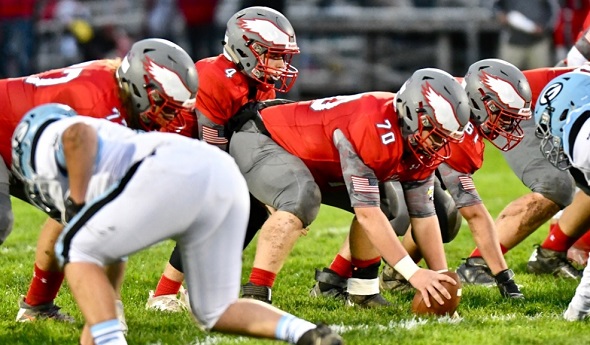
PHOTO: Frankenmuth's quarterback surveys the Essexville Garber defense before the snap during Friday's Eagles win. (Photo by Dan Brovont.)