

Cass Tech Comes Back, Leaves as Champ
By
Tom Markowski
Special for Second Half
November 26, 2016
DETROIT – Mission accomplished.
Shortly after Nov. 28 of last year, the momentum toward an MHSAA championship began at Detroit Cass Tech. The Technicians had just lost to Romeo, 41-27, in the Division 1 Final, and the work began in the weight room for a return trip to Ford Field with the mindset that there would be a different outcome.
Rodney Hall, who did not play in the Semifinal and Final last season after suffering a severe left ankle sprain in a Regional Final, threw five touchdown passes to lead the Technicians to 49-20 victory over Detroit Catholic Central in the Division 1 championship game Saturday at Ford Field.
Donovan Peoples-Jones was a junior and starting receiver on the team that lost to Romeo, and he said the focus on this season began almost immediately.
“When you fall down you have to get back up,” he said. “As soon as we lost, we were heartbroken. You always come into a season wanting to win a state championship. Now that we won it, it’s a dream come true.”
Coupled with Detroit Martin Luther King’s victory in the Division 2 Final on Friday, Cass Tech’s victory marks the first time two teams from the Detroit Public School League have won MHSAA titles in the same season. Cass Tech and King each have won three championships.
The Technicians also finished their first undefeated season 14-0.
An injury also added drama to this year’s title game. Austin Brown, DCC’s sophomore quarterback, suffered a broken leg in last week’s Semifinal and was on the sideline in a wheelchair.
It’s unlikely that with Brown the outcome would have been different. Cass Tech played that well.
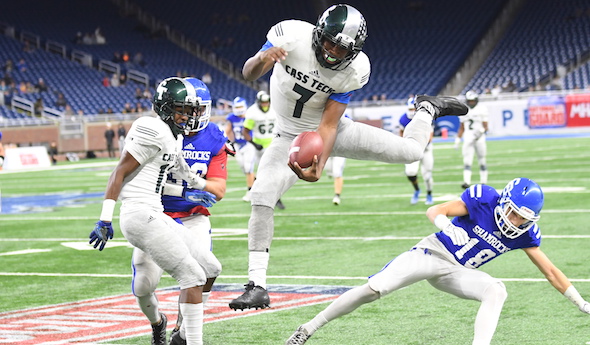
Hall was 10 of 18 passing for 220 yards, with one interception to go with the five scoring passes – which tied the MHSAA Finals record held by three others. Peoples-Jones had six receptions for 118 yards and two touchdowns. Cass Tech rushed for 163 yards on 22 carries and did not punt. Hall gained 58 of those yards, on seven carries.
“I’m just excited to play out here,” Hall said. “It’s great to go out, throw five touchdowns. It was fun to play in this game.
“I came in (this season) a little timid to run. My coaches got behind and gave me confidence. I was able to run in the first game, but I was still timid.”
Cass Tech trailed 14-7 before Hall and the offense began to click.
He had a big hand in the Technicians’ second touchdown. His 7-yard run gave Cass Tech a first down at the DCC 46. On a 3rd-and-15, Hall scrambled for 27 yards, and then three plays later he threw a 20-yard touchdown pass to Teone Allen to tie the score at 14-14 with 5:33 left in the half.
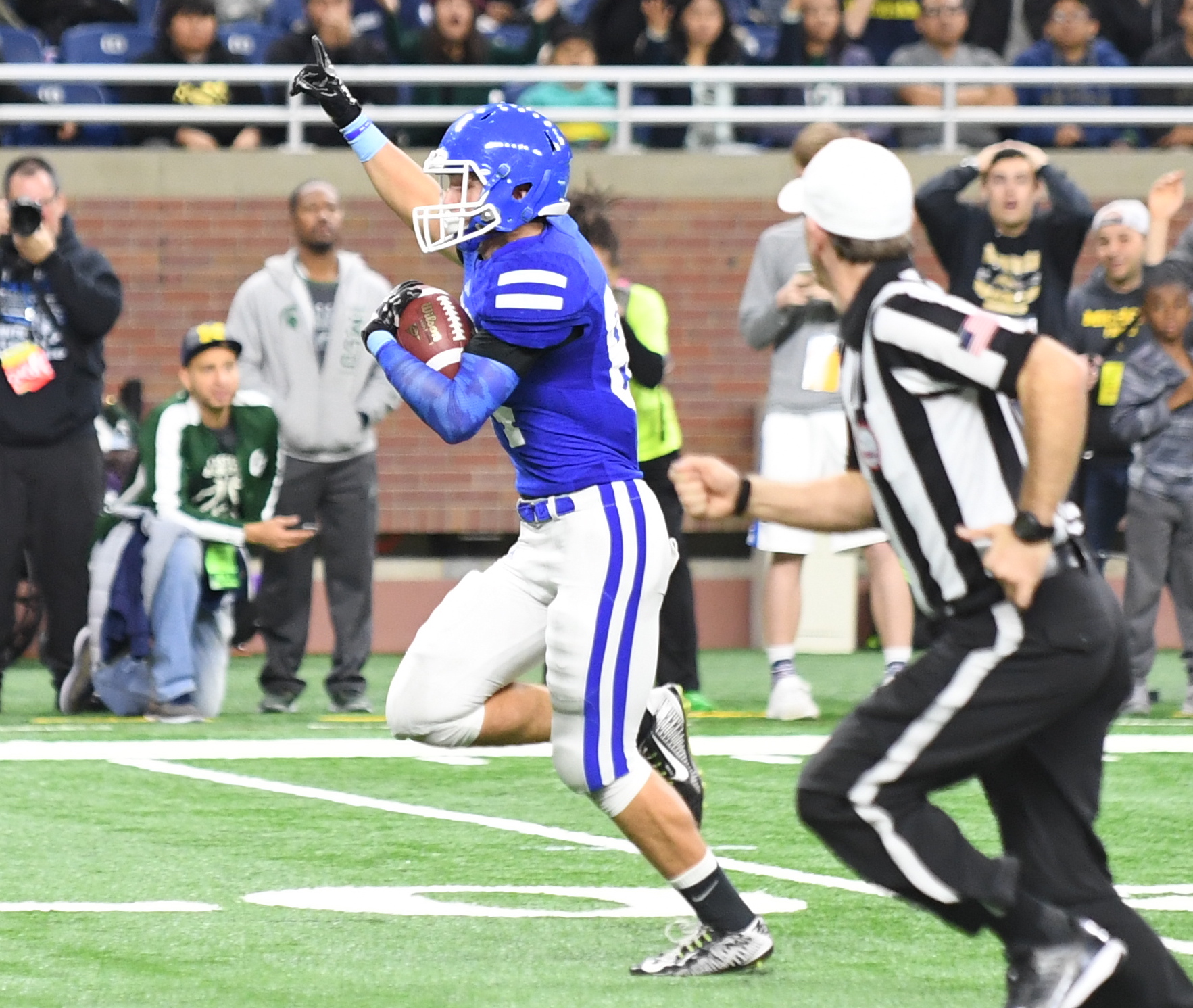 Less than a minute later, after a DCC punt, Donovan Johnson broke free on a counter play to the left. A number of Shamrocks defenders appeared to have an angle on Johnson, but he ran untouched for a 60-yard score.
“It meant a lot to the team,” Johnson said of the run. “It was a little hole there. I knew it was going to be open on the outside.”
Cass Tech led 21-14 at halftime and outgained DCC 211 yards to 108 by that point.
DCC was unsuccessful on an onside kick attempt to open the second half, and on the second play Hall threw a 42-yard touchdown pass to Donovan Parker for a 28-14 lead.
Cass Tech scored touchdowns on its next two possessions to blow the game open.
“We planned that during the week,” DCC coach Tom Mach said of the onside kick. “We thought that was a good opportunity.
“We got it put to us pretty good today.”
DCC was making a record 17th appearance in the MHSAA Finals, after sharing the previous record of 16 with Farmington Hills Harrison.
It took the Shamrocks five seconds to score their two touchdowns. They went 73 yards in 15 plays to tie the score at 7-7 on Isaac Darkangelo’s 1-yard run. On the next play, the last of the first quarter, Jack Morris returned an interception 35 yards for a touchdown, and the Shamrocks led 14-7. Cass Tech then scored the next 42 points.
“We just stay focused,” Cass Tech coach Thomas Wilcher said. “Everyone just stayed engaged. We knew we had to pass. We had to take advantage of what we had.”
This season, Cass Tech had a lot. Peoples-Jones is rated as the state’s top college prospect. Hall committed to Northern Illinois. Jaylen Kelly-Powell has committed to Michigan, and Johnson will take an official visit to Penn State next weekend and said he will make his decision soon between Penn State and Virginia Tech.
Nick Capatina led DCC (13-1) with 85 yards rushing on 12 carries.
The MHSAA Football Finals are sponsored by the Michigan National Guard.
PHOTOS: (Top) Detroit Cass Tech quarterback Rodney Hall eludes a Detroit Catholic Central defender during Saturday's Division 1 Final. (Middle) DCC's Jack Morris sprints toward the end zone for a first-half score.
Fugate Carries CC On 1 More Trophy Run
By
Paul Costanzo
Special for MHSAA.com
November 24, 2017
DETROIT – As classmates and fans screamed his name from the Ford Field stands Friday night, Nolan Fugate put the focus on his teammates.
 “I cannot thank my offensive line and my outside receivers enough,” the Grand Rapids Catholic Central senior running back said. “Without them none of this would be possible, and I just can’t thank them enough. They’re the best offensive line in the state.”
That line paved the way for Fugate, who gained 306 yards on the ground and tied an MHSAA Finals record with five total touchdowns as the Cougars defeated Edwardsburg 42-31 in the Division 4 championship game.
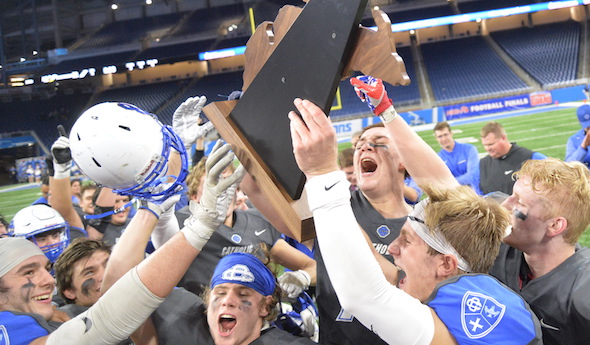
It was the second straight title for Catholic Central (14-0), and the program’s fourth overall. Coach Todd Kolster has led the Cougars to three of them (2010, 2016 and 2017).
“It has nothing to do with me,” Kolster said. “I’m the beneficiary of being the head coach for three of these, but it’s the kids that do all the work. They’re outstanding. This senior class, I love them so much. I’ve been so critical of them, and I say that all the time, because I came back here to Catholic Central with that class when they were freshmen and now they’re seniors. It’s really special to see these guys enjoy this, because they’ve earned every bit of it.”
This year’s title game was in stark contrast to last season’s when the Cougars eked out a 10-7 victory in a defensive struggle against Detroit Country Day. Big plays from both offenses highlighted Friday night’s game as Catholic Central had to battle to hold off a relentless Edwardsburg team down the stretch.
“They all mean the same,” Kolster said. “They all come in the right column, so we’ll take it.”
Seven of the game’s scoring plays were 20 yards or longer, including an MHSAA Finals record-tying 99-yard kick return touchdown by Edwardsburg’s Caden Goggins, and a MHSAA Finals record-tying 90-yard touchdown run by his teammate Nick Bradley.
On the night, the Eddies (12-2) averaged 9.7 yards per play and 10.8 yards per carry, while Catholic Central averaged 7.7 yards per play in managing to outgain Edwardsburg 448-369.
“Our defense, they played well -- we gave up a couple big plays, and Edwardsburg is a heck of a football team,” Kolster said. “We gave up three (big) kickoff returns and three big plays, but we handled them pretty well. That’s what they do, and that’s why they’re so good. That’s why they’re here, because they just keep at it, they keep at it and they’ll pop one, and they have confidence in that. But we have confidence in our guys.”
The Cougars’ defense did stiffen when it absolutely had to, as sophomore Ethan Lott came up with a tackle for loss on a 4th-and-1 play late in the fourth quarter to all but seal the game.
“Our guys did a great job on that 4th-and-1; it’s just a matter of reading their keys,” Kolster said. “I’m really proud of them.”
 The game was absolutely put away when Fugate went 58 yards on a 3rd-and-10 in the final minute, barely getting tripped up at the Edwardsburg 10. It was another in a long line of huge plays for Fugate, who had touchdown runs of one, five, 54 and 32 yards, as well as a 20-yard touchdown reception from Jack Bowen.
Fugate also had 86 yards receiving and came down with a 38-yard catch along the sideline on a crucial 3rd-and-28 play midway through the fourth quarter with his team clinging to a 35-31 lead.
“The long third down, I saw (Bowen) leave the pocket and I was running my route and knew I had to get open,” Fugate said. “I just kind of boxed my guy out and said throw the ball, and I just did my best to make a play on the ball, and I was able to come down with it.”
The game put Fugate over 2,900 yards rushing for the season, and capped off a brilliant career that saw him set the school’s all-time career rushing record.
“Fugate is obviously a terrific runner,” Edwardsburg coach Kevin Bartz said. “I thought he ran as hard as I’ve ever seen him. We watched a good portion of film on him, and we knew he was fast, but I guess what I was more impressed with today is how hard he ran. He picked up lots of extra yards after contact. He’s an impressive athlete.”
Bartz was equally impressed with his team, which was playing in the title game for the first time and kept finding ways to hang around despite trailing by 16 midway through the third quarter.
On top of the record-tying touchdowns, the Eddies had scoring runs of 55 and 78 yards from Kyle Shrider, and 64 yards from Chase Sager. Shrider finished with 162 yards rushing, while Bradley had 96 and Sager had 73.
“Just to make it to this point, this was a team that was not expected to be here,” Bartz said. “With the number of kids we lost last year, we were kind of expected, I think, by most to be average at best. For them to come out here and perform against a top-level team like Grand Rapids CC, I’m extremely proud of these kids. They’ve now set the bar pretty high for everybody else at Edwardsburg.”
Bowen finished with 128 yards passing for the Cougars, while Erik Grabow had a 14-yard touchdown run.
The MHSAA Playoffs are sponsored by the Michigan Army National Guard.
PHOTOS: (Top) Grand Rapids Catholic Central players raise the winner's trophy after Friday night’s Division 4 championship game. (Middle) Edwardsburg’s Kyle Shrider pulls away from a Cougars defender.