

Catch These New Rules as Fall Kicks Off
August 7, 2014
By Geoff Kimmerly
Second Half editor
The first practices of 2014-15 begin next week for approximately 110,000 student-athletes taking part in eight sports in which the Michigan High School Athletic Association sponsors postseason tournaments, with nearly 41,000 football players practicing under a new policy in that sport aimed at continuing to improve player safety.
The new practice policy was proposed by a Football Task Force made up of coaches, administrators and MHSAA staff which met during 2012 and 2013, and approved by the MHSAA’s Representative Council at its Winter Meeting on March 21.
The modifications are meant to promote heat acclimatization and limit helmet-to-helmet contact during practices. They include:
- During the first week of practice, only helmets are allowed the first two days, only shoulder pads may be added on the third and fourth days, and full pads may not be worn until the fifth day of team practice.
- Before the first regular-season game, schools may not schedule more than one “collision” practice in a day. A collision practice is defined as one in which there is live, game-speed, player-versus-player contact in pads involving any number of players.
- After the first regular-season game, teams may conduct no more than two collision practice days in any week, Monday through Sunday.
- No single football practice may exceed three hours, and the total practice time for days with multiple practice sessions may not exceed five hours. Neither strength/weight training activities nor video/classroom sessions are considered practice for the purposes of the three or five-hour limits.
Previously, schools were required to conduct at least three days of practice without pads before beginning contact. The change to four days for gradual addition of pads was added to assist athletes in acclimating to being physically active in hot weather. Guidelines reducing the amount of collision practice go hand in hand with rules changes that have been made to reduce helmet-to-helmet contact in game situations. The policies in detail can be found on the Football page of the MHSAA Website.
“We think these new policies, with respect to the number of collision practices there can be before the first game, and after the first game, really are where 85 to 90 percent of our coaches already were,” said John E. “Jack” Roberts, executive director of the MHSAA. “This new policy sends a signal to that 10 to 15 percent to get on board with the rest of us to make football just as safe as it can possibly be.”
Practice in football must begin on August 11 for all schools wishing to begin regular-season games the weekend of August 28-30. Schools must have 12 days of preseason practice at all levels before their first game, and those 12 days of practice may not occur before 16 calendar days.
Practice sessions for all other sports begin on Wednesday (August 13). In golf and tennis, competition may commence no earlier than after three separate days of team practice, and not before seven calendar days. The first day competition may take place in golf and tennis is August 20. In all other fall sports, contests can take place after seven days of practice for the team and not before nine calendar days. The first day competition may take place in cross country, tennis, soccer, swimming and diving, and volleyball is August 22.
Only one football date precedes Labor Day, and most varsity games will take place on Thursday, August 28, that week. Subvarsity competition may begin on Wednesday, August 27. In Week 1, 255 games will be played on Thursday, 53 contests will be played on Friday, and five games will be played on Saturday.
Continuing the focus on player safety, a number of rules changes were made in football for 2014:
- Rules were added restricting targeting of opponent and illegal helmet contact with defenseless players, with both resulting in 15-yard penalties. Targeting is defined as taking aim at an opponent with the helmet, forearm, hand, fist, elbow or shoulder to initiate contact above the shoulders and with an intent beyond making a legal tackle or block, or playing the ball. A defenseless player can be considered one no longer involved in a play, a runner whose progress has been stopped, a player focused on receiving a kick or a receiver who has given up on an errant pass, or a player already on the ground.
- Illegal contact to a quarterback now will be considered roughing the passer, and the offense will receive an automatic first down in addition to the previous 15 yards from the penalty.
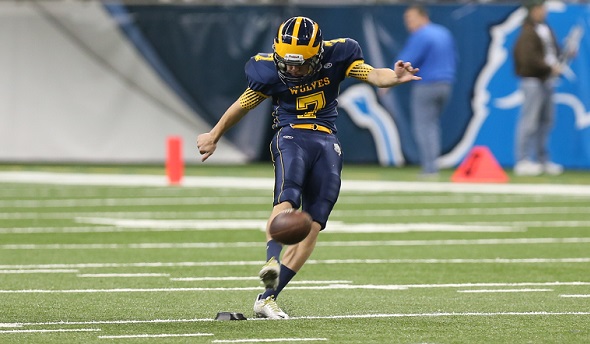
- On kickoffs, the kicking team must have at least four players on either side of the kicker, and no kicking team players except for the kicker may line up more than five yards behind the free-kick line. These changes were made to improve safety by balancing the kicking formation and shortening the potential run-up by kicking team players heading down the field to tackle the ball carrier.
A number of significant rules changes will go into effect for other fall sports:
- In cross country, the ban on wearing jewelry has been lifted (and also for track and field in the spring). The National Federation of State High School Associations deemed the ban unnecessary in these two sports because there is little risk of injury with minimal contact between competitors. Elimination of the rule will allow officials to further focus on the competition.
- In soccer, Michigan has adopted the National Federation rule stating home teams must wear solid white jerseys and socks, with visiting teams in dark jerseys and socks (dark defined as any color contrasting white). Also, officials may now wear green and blue shirts in addition to red and black as alternates to the primary yellow shirt with black pinstripes.
- Also for soccer, both field players and goalkeepers must now leave the field when injured and the referee has stopped the clock. Previously, an injured goalkeeper was not required to leave the game when the referee stopped the clock; going forward, the keeper must be replaced.
- In swimming and diving, one change affects the beginning of races and another impacts a specific event. The use of starter’s pistols is now prohibited; starters must use an alternative sounding device to start races. Additionally, in the backstroke, a swimmer may not submerge his or her entire body after the start except for during turns. The swimmer must remain on or above the water surface on the finish, eliminating the abuse of submerging well before touching the wall. This change also applies to the finish of the backstroke leg of the individual medley.
The 2014 Fall campaign culminates with postseason tournaments beginning with the Upper Peninsula Girls Tennis Finals the week of Sept. 29, and wraps up with the 11-Player Football Playoff Finals on Nov. 28-29. Here is a complete list of fall tournament dates:
Cross Country:
U.P. Finals – Oct. 18
L.P. Regionals – Oct. 24 or 25
L.P. Finals – Nov. 1
11-Player Football:
Selection Sunday – Oct. 26
Pre-Districts – Oct. 31 or Nov. 1
District Finals – Nov. 7 or 8
Regional Finals – Nov. 14 or 15
Semifinals – Nov. 22
Finals – Nov. 28-29
8-Player Football:
Selection Sunday – Oct. 26
Regional Semifinals – Oct. 31 or Nov. 1
Regional Finals – Nov. 7 or 8
Semifinals – Nov. 15
Finals – Nov. 21
L.P. Girls Golf:
Regionals – Oct. 8 or 9 or 10 or 11
Finals – Oct. 17-18
Soccer:
Boys L.P. Districts – Oct. 13-18
Boys L.P. Regionals – Oct. 21-25
Boys L.P. Semifinals – Oct. 29
Boys L.P. Finals – Nov. 1
L.P. Girls Swimming & Diving
Diving Regionals – Nov. 13
Swimming/Diving Finals – Nov. 21-22
Tennis:
U.P. Girls Finals – Oct. 1 or 2 or 3 or 4
L.P. Boys Regionals – Oct. 9 or 10 or 11
L.P. Finals – Oct. 17-18
Girls Volleyball:
Districts – Nov. 3-8
Regionals – Nov. 11 & 13
Quarterfinals – Nov. 18
Semifinals – Nov. 20-21
Finals – Nov. 22
The MHSAA is a private, not-for-profit corporation of voluntary membership by more than 1,500 public and private senior high schools and junior high/middle schools which exists to develop common rules for athletic eligibility and competition. No government funds or tax dollars support the MHSAA, which was the first such association nationally to not accept membership dues or tournament entry fees from schools. Member schools which enforce these rules are permitted to participate in MHSAA tournaments, which attract more than 1.4 million spectators each year.
MHSAA Finals: Prepare for Impact
November 21, 2012
By Geoff Kimmerly
Second Half editor
Recognize more than a few of this season's MHSAA 11-player football finalists? You should.
Only three first-timers will be making the trip to Ford Field this weekend. The other 13 contenders have combined for 68 championship game appearances over the 37-year history of the playoffs.
A couple games will look extremely familiar. Detroit Cass Tech and Detroit Catholic Central meet again in Division 1 after the Technicians claimed last year's title matchup 49-13. Ithaca and Constantine also face a Division 6 rematch, with the Yellowjackets looking to repeat last season's 42-14 result and add to their 41-game winning streak.
The Shamrocks will be appearing in their 15th MHSAA Final, good for second-most all-time. Birmingham Brother Rice and Orchard Lake St. Mary's also are among the top 10 on that list and will add to their totals.
The Division 8,4,6 and 2 games are Friday, with the odd-numbered divisions playing Saturday. All games but Division 4 will be broadcast on Fox Sports Detroit (Division 4 will be on FSD Plus, but not available to Direct TV subscribers) and can be heard audio-only on the MHSAA Network web site. Tickets cost $10 and are good for all four games on one day. Click for a full schedule.
Here’s a look at all 16 finalists. (Rankings and all-state honors were voted upon by The Associated Press’ media panel. Statistics were provided by schools; all are through Regional Finals except those for Portland, which are through the District Final. Cass Tech did not submit.)
 Division 1
DETROIT CASS TECH
Record/rank: 11-2, No. 7
Coach: Thomas Wilcher, 17th season (148-51)
League finish: First in Detroit Public School League West
Finals history: MHSAA Division 1 champion in 2011.
Best wins: 34-27 over No. 3 Lake Orion (Semifinal), 21-14 over No. 10 Saline (Regional Final), 37-3 over honorable mention Grosse Pointe South (District Semifinal), 25-18 over Division 2 No. 3 Birmingham Brother Rice.
Players to watch: WR/DB Jourdan Lewis, 5-11/165, sr.; QB Jayru Campbell, 6-3/185, soph.; OT/NG David Dawson, 6-5/285, sr.; OT/DE Dennis Finley, 6-5/285, sr.; DB Dejuan Rogers, 6-0/170, sr., FS Delano Hill, 6-0/195, sr.; OG/DT Kenton Gibbs, 6-2/260, sr. (Statistics not submitted.)
Outlook: Many from the incredible class that led the school to its first championship moved on to college football, but this group also is loaded with players who will continue at the next level. Lewis has committed to sign with the University of Michigan, Finley with Michigan State, Hill with Iowa, Pace with Eastern Michigan and Rogers with Toledo. And Dawson might be the best prospect of the bunch. Despite a number of new faces, the defense remains solid giving up only 13 points per game. And Campbell threw five touchdown passes, tying a Finals record, in his championship game debut last fall.
DETROIT CATHOLIC CENTRAL
Record/rank: 9-4, unranked
Coach: Tom Mach, 37th season (330-80)
League finish: Tied for first in Detroit Catholic League Central.
Finals history: 10 championships (most recent 2009), four runner-up finishes.
Best wins: 35-6 over No. 4 Rockford (Semifinal), 28-7 over honorable mention Plymouth (Regional Final), 21-15 over honorable mention Hartland (District Semifinal), 35-13 over Division 3 No. 4 Orchard Lake St. Mary’s.
Players to watch: DT Wyatt Shallman, 6-4/250, sr.; RB/LB Anthony Darkangelo, 6-0/200, sr. (164 carries, 1,036 yards, 14 TDs, 16 receptions, 262 yards receiving); OL/DL Derek Edwards, 6-5/270, sr.; RB/LB David Houle, 5-11/230, sr. (114 carries, 583 yards, 12 TDs).
Outlook: Half the Shamrocks' losses came to Ohio powers and the other half to teams also playing at Ford Field this weekend, so don’t be deceived by the less impressive record. Darkangelo and Houle also were main offensive cogs last season – each scored one of the team’s two touchdowns in the championship game. Leading the way in front of them are some impressive blockers led by Edwards, who has committed to sign with Central Michigan. Shallman will sign with Michigan and plugs the middle for a defense giving up 11 points per game in the playoffs. And keep an eye out for senior Garrett Moores. He’s the quarterback, but also a reliable kicker.
 Division 2
BIRMINGHAM BROTHER RICE
Record/rank: 11-2, No 3
Coach: Al Fracassa, 44th season (371-98-2)
League finish: Tied for first in Detroit Catholic League Central.
Finals history: Seven championships (most recent 2011), four runner-up finishes.
Best wins: 42-12 over honorable mention Walled Lake Western (Regional Final), 20-14 over Detroit Catholic Central, 30-29 over Cincinnati (Ohio) LaSalle.
Players to watch: QB Cheyne Lacanaria, 5-9/165, sr. (93 of 160 passing, 1,221 yards, six TDs); LB Jon Reschke, 6-3/232, sr.; RB Brian Walker, 5-8/225, jr. (226 carries, 1,352 yards, 20 TDs; LB Lucas Cherocci, 6-1/218, sr.
Outlook: The Warriors bear similarities to the team that won last season’s championship – Lacanaria is back at quarterback, Reschke keys a strong defense, and a running back carries the load. That back this time is Walker, but like Devin Church last season he’s put up some big numbers. Reschke will sign with Michigan State and with Cherocci mans the middle for a defense giving up only 14 points per game despite a loaded schedule. Brother Rice’s losses were to Cass Tech and Orchard Lake St. Mary’s – and it has given up only a combined 21 points over the last three games.
MUSKEGON
Record/rank: 12-1, No 2
Coach: Shane Fairfield, third season (28-8)
League finish: Second in O-K Black.
Finals history: Five MHSAA titles (most recent 2008).
Best wins: 36-21 and 15-13 (District Semifinal) over No. 5 Lowell, 49-21 over No. 1 Midland (Regional Final), 21-14 over Division 3 No. 4 Orchard Lake St. Mary's, 21-9 over Division 1 No. 4 Rockford.
Players to watch: RB/LB John King, Jr., 5-11/210, sr. (139 carries, 1,565 yards, 20 TDs); LB Demetrius Brown, 5-8/185, sr.; QB Jalen Smith, 6-0/160, sr. (30 of 64 passing, 593 yards, seven TDs, 137 carries, 854 yards, 12 TDs rushing); RB Marcus Smith, 5-8/185, sr. (45 carries, 599 yards, seven TDs, 15 receptions, 391 yards, five TDs receiving).
Outlook: The Big Reds are back at Ford Field for the first time under Fairfield, who previously served as defensive coordinator during the last title run and before that led Holton to two league titles. This defense has been good too, giving up 18 points per game against arguably the toughest schedule in the state. But the offense is what scares opponents most – heading into last weekend, the Big Reds had gained 5,175 yards and all but 1,008 on the ground. A one-point loss to Zeeland East in Week 9 is all that has kept Muskegon from perfection so far.
 Division 3
GRAND RAPIDS CHRISTIAN
Record/rank: 12-1, No. 2
Coach: Don Fellows, third season (29-6)
League finish: First in O-K White
Finals history: Has never appeared in an MHSAA Final.
Best wins: 31-7 over No. 3 Stevensville Lakeshore (Regional Final), 45-6 over No. 9 Fruitport (District Semifinal), 52-28 over No. 10 DeWitt (Semifinal), 38-28 over Grand Rapids South Christian, 21-7 over Division 2 No. 5 Lowell.
Players to watch: QB Alex VanDeVusse, 6-1/180, sr. (173 of 311, 3,226 yards, 35 TDs passing, 167 carries, 652 yards, 12 TDs rushing); WR Drake Harris, 6-4/180, jr. (76 receptions, 1,552 yards, 20 TDs); DL Zach Crouch, 6-5/255, sr., RB Seth McIntosh, 5-10/205, sr. (108 carries, 854 yards, seven TDs).
Outlook: The Eagles have improved steadily over the past four seasons beginning with a 4-5 finish in 2009. They've scored fewer than 31 points only once this season, and have put up 196 points during the playoffs alone. VanDeVusse is a dangerous dual threat and Harris – already committed to Michigan State – might be the best receiver in Michigan. Teams can’t pay him all the attention though; senior Davaris Collier also has caught 36 passes including eight for scores. And they’re helped as well by one of the best kickers in MHSAA history; unofficially, senior Joel Schipper has made a career record 168 extra points in 169 tries, and also has 12 field goals in 14 tries this fall. Crouch, signing with Central Michigan, is among standouts on the unheralded but solid defense.
ORCHARD LAKE ST. MARY’S
Record/rank: 11-2, No. 4
Coach: George Porritt, 24th season (214-59)
League finish: Tied for first in Detroit Catholic League Central.
Finals history: Five championships (most recent 2011), five runner-up finishes.
Best wins: 49-14 over No. 7 Auburn Hills Avondale (District Final), 13-6 over Division 1 No. 7 Detroit Cass Tech, 24-14 over Division 2 No. 3 Birmingham Brother Rice, 27-10 over Detroit Catholic Central.
Players to watch: RB/LB Grant Niemiec, 6-1/220, sr. (232 carries, 1,587 yards, 23 TDs); RB Parker McInnis, 6-0/185, sr. (199 carries, 1,236 yards, 18 TDs); QB Matt Linehan, 6-3/180, sr. (86 of 127 passing, 1,299 yards, 13 TDs).
Outlook: Niemiec and McInnis were among standouts from last season’s championship game win, and might be the best one-two running back tandem in the state this fall. Niemiec has committed to Miami (Ohio) and also keys a defense giving up just under 12 points per game. McInnis also had three punt return touchdowns this fall heading into Semifinal weekend. The Eaglets’ lone losses were on opening night to Muskegon and in Week 8 to Detroit Catholic Central; St. Mary’s avenged that latter loss the next week in the Catholic League Prep Bowl.
 Division 4
DETROIT COUNTRY DAY
Record/rank: 11-2, No. 9
Coach: Dan MacLean, 15th season (108-58)
League finish: Does not play in a conference.
Finals history: Three MHSAA titles (most recent 1999), three runner-up finishes.
Best wins: 47-14 over No. 4 Grosse Ile (Regional Final), 14-12 over No. 10 Pontiac Notre Dame Prep (District Final).
Players to watch: QB Tyler Wiegers, 6-3/190, jr. (129 of 209 passing, 1,822 yards, 18 TDs); RB Richard Wilson, 6-0/185, jr. (154 attempts, 1,074 yards, 24 TDs); NG Poet Thomas, 6-6/295, sr.
Outlook: Country Day will try to cap its seventh-straight playoff season with its first championship since 1999; the Yellowjackets also made Finals in 2007 and 2008. Wilson might be the name fans know most – he ran for four more touchdowns last week against Saginaw Swan Valley to give him 28 on the ground total this fall. But few defenses have been better during the postseason; Country Day has given up just 26 points in those four games and shut out two opponents. Thomas, literally and figuratively, has been one of the biggest college prospects in the state this season.
GRAND RAPIDS SOUTH CHRISTIAN
Record/rank: 10-3, unranked
Coach: Mark Tamminga, fourth season (23-18)
League finish: Second in O-K Gold
Finals history: Division 4 champion 2002, three runner-up finishes.
Best wins: 21-7 over No. 6 Comstock Park (Semifinal), 48-0 over No. 3 Paw Paw (District Semifinal), 42-23 over Division 5 No. 5 Dowagiac (in D4 for playoffs, District Final), 33-7 over Grand Rapids West Catholic.
Players to watch: RB/DB Chad Sterk, 5-10/150, sr. (77 carries, 413 yards, 10 TDs, 42 receptions, 480 yards, two TDs receiving); QB Jon Wassink, 6-2/175, soph. (182 of 276 passing, 2,564 yards, 23 TDs, 116 carries, 713 yards, nine TDs rushing); WR/DB Jason Miller, 6-1/170, sr. (59 receptions, 683 yards, six TDs, five interceptions).
Outlook: Former longtime assistant Tamminga was on the sideline for the 2002 championship team and 1999 runner-up, and has the Sailors back after three seasons of either four or five wins. South Christian started 4-3 this fall before romping through its final two regular-season opponents and a tough playoff slate. This season’s team has set a school record for points – and that’s saying something considering the program has four other championship game appearances and seven other seasons with at least 10 wins.
 Division 5
GRAND RAPIDS WEST CATHOLIC
Record/rank: 10-3, unranked
Coach: Dan Rohn, sixth season (62-11)
League finish: First in O-K Bronze
Finals history: Division 5 champion 2010, one runner-up finish.
Best wins: 13-6 over No. 2 Muskegon Oakridge (District Final), 20-17 over No. 9 Menominee (Semifinal), 28-0 over Division 4 No. 6 Comstock Park.
Players to watch: QB Travis Russell, 5-11/160, soph. (182 of 368 passing, 2,143 yards, 20 TDs); WR David Kuzma, 6-2/165, sr. (65 receptions, 1,084 yards, 11 TDs); RB Andy Corey, 5-8/160, jr. (282 carries, 1,435 yards, 11 TDs, 37 receptions, 264 yards receiving); DL Daniel Green, 6-0/260, sr.
Outlook: West Catholic is going for its second championship in three seasons and has at least 10 wins for the fourth straight and fifth season in six. This fall’s success came after a 1-3 start, and the Falcons are especially tough in close games – six of those wins were by eight points or fewer. Corey is dangerous whenever he touches the ball, and averages 29 yards per kickoff return. Green earned an all-state special mention at nose guard.
PORTLAND
Record/rank: 12-1, unranked
Coach: John Novara, 14th season (89-53)
League finish: Second in Capital Area Activities Conference White
Finals history: Has never appeared in an MHSAA Final.
Best wins: 45-28 over No. 1 Flint Powers Catholic (Regional Final), 37-7 over Division 3 No. 10 DeWitt.
Players to watch: RB/DB Jacob Kimmell, 5-11/185, jr. (116 carries, 1,278 yards, 17 TDs); OL/LB Adam Goodman, 6-0/200, sr.; QB Tanner Allison, 6-1/180, jr. (52 of 94 passing, 794 yards, 14 TDs); RB/DB Justin Goodman, 5-9/165, sr.
Outlook: Portland’s is one of the neatest stories of this season’s Finals; Novara resigned as coach amid a 1-8 season and some player commitment issues in 2002, but rescinded that resignation at the request of his players and since has led them to 10 straight playoff appearances and their first championship game. The Raiders’ lone loss this fall was the reigning MHSAA runner-up Lansing Catholic. Kimmell earned an all-state honorable mention, but Portland has more weapons. Senior Caleb Hickling had run for more than 800 yards through 11 games and junior Auston Brandt had caught nearly half of Allison’s completions for more than two-thirds of the team’s passing yards.
 Division 6
CONSTANTINE
Record/rank: 11-2, No. 9
Coach: Shawn Griffith, eighth season (82-17)
League finish: Third in Kalamazoo Valley Association
Finals history: One championship (2004), three runner-up finishes.
Best wins: 49-35 over T-No. 3 Hillsdale (Regional Final), 40-27 over No. 2 Schoolcraft (District Final).
Players to watch: FB/LB Ben Mallo, 5-7/170, sr. (175 carries, 1,627 yards, 16 TDs); LB/RB Justin Hull, 5-8/165, soph. (33 carries, 296 yards, three TDs).
Outlook: Constantine is back for its second straight Final and with at least 10 wins for the fourth straight season thanks in large part to a wing-T offense that needs only seven more points to break 600 for the second time in nine years. The Falcons had run for 5,096 yards coming into last week’s Semifinal, and Hull broke out with 245 yards and a touchdown in that win over Monroe St. Mary Catholic Central. Mallo was the team's leading rusher in last season’s championship game.
ITHACA
Record/rank: 13-0, No. 1
Coach: Terry Hessbrook, ninth season (85-17)
League finish: First in Tri-Valley Conference West
Finals history: MHSAA Division 6 champion 2011 and 2010.
Best wins: 31-0 over No. 10 Montrose (Regional Final), 49-14 over No. 5 Hemlock (District Final), 33-21 over Division 5 honorable mention Carrollton.
Players to watch: QB Travis Smith, 6-2/200, jr. (140 of 226 passing, 2,264 yards, 36 TDs, 109 carries, 732 yards, 13 TDs rushing); TE/DB Jared Evers, 5-11/225, sr. (36 receptions, 469 yards, nine TDs); DB Jordan Hessbrook, 5-8/160, sr.; (four interceptions); OL/DL Bradley Martyn, 5-8/190, sr.
Outlook: Smith, named all-state earlier this week, had one of the most impressive passing performances in MHSAA history in 2011 – 18 of 25 for 299 yards and a score, plus he ran for two more – and must be tracked at all times. But he’s got plenty of help. Four receivers have at least 24 catches and at least seven for touchdowns: Evers plus Caden Kipp, Markes Gadlen and Zach Allen. Jordan Hessbrook also made all-state and is among leaders of a defense no one talks about but should – the Yellowjackets have given up only 83 points this fall and have seven shutouts.
 Division 7
DETROIT LOYOLA
Record/rank: 13-0, No. 1
Coach: John Callahan, fourth season (38-8)
League finish: First in Detroit Catholic League Intersectional
Finals history: Has never appeared in an MHSAA Final.
Best wins: 50-7 over honorable mention Grosse Pointe Woods University Liggett (District Final), 51-20 and 36-7 (District Semifinal) over honorable mention Royal Oak Shrine, 28-18 over honorable mention Waterford Our Lady.
Players to watch: RB Keymonn’e Gabriel, 5-11/208, sr. (103 carries, 2,195 yards, 32 TDs); DE/OL Malik McDowell, 6-7/290, jr.; DL/OL Kajohn Armstrong, 6-5/275, jr.
Outlook: Loyola is in its first Final after reaching its second-straight Semifinal a week ago, and is led by one of the top scorers in MHSAA history. Gabriel, an all-stater, added three more touchdowns last week and now has 314 points this season – good for second-most in the MHSAA record book. He runs behind a massive line keyed by Associated Press Division 7-8 Player of the Year McDowell at right tackle and Armstrong at the left plus three more blockers weighing in between 250-270. The defense has given up only 77 points and more than seven only twice.
ISHPEMING
Record/rank: 12-1, No. 4
Coach: Jeff Olson, 21st season (143-75)
League finish: Second in Mid-Peninsula Conference
Finals history: Two MHSAA titles (most recent 1979), one runner-up finish.
Best wins: 32-0 over No. 3 Mancelona (District Final), 8-7 over Pewamo-Westphalia (Semifinal).
Players to watch: RB Eric Kostreva, 5-7/185, sr. (157 carries, 1,153 yards, 17 TDs); LB/TE R.J. Poirier, 5-11/205, sr. (six catches, 119 yards, TD); OTL/DT Brad Wootke, 6-2/255, sr.
Outlook: The Hematites are back at Ford Field for the second time in three seasons and just missed last time, falling 28-26 to Hudson. Their only loss this fall was to league rival Negaunee, a Regional finalist in Division 6, and that also was the only game in which Ishpeming gave up more than 14 points; the Hematites have allowed just 31 total in four playoff games. Poirier earned honorable mention all-state as a linebacker and Wootke special mention as a lineman.
 Division 8
BEAL CITY
Record/rank: 13-0, tied for No. 2
Coach: Lou Rau, 13th season (132-29)
League finish: First in Highland Conference
Finals history: Two MHSAA titles (most recent 2009), three runner-up finishes.
Best wins: 38-19 and 28-21 (District Final) over No. 9 Mount Pleasant Sacred Heart, 25-7 over No. 4 St. Ignace (Semifinal).
Players to watch: QB/LB Sam Schafer, 6-1/180, sr. (74 of 107 passing, 1,546 yards, 19 TDs); RB/LB Ty Rollin, 5-8/180, jr. (124 carries, 869 yards, 18 TDs; OL/DL Nate Schafer, 6-0/200, sr.
Outlook: Only one opponent – rival Mount Pleasant Sacred Heart, the second time they played – has gotten within 12 points of stopping the Aggies this fall. Sam Schafer and Rollin were all-state honorable mentions at their offensive positions, and the team has broken 40 points in eight games. Nate Schafer made the all-state first team and along with those two and four more also starts on both sides of the ball. They make double duty work well: The defense has given up more than 19 points only twice.
HARBOR BEACH
Record/rank: 12-1, No 6
Coach: Troy Schelke, 16th season (108-59)
League finish: First in Greater Thumb Conference East
Finals history: Class C runner-up 1991.
Best wins: 56-20 over T-No. 2 New Lothrop (District Final), 17-10 over Division 7 honorable mention Waterford Our Lady (D8 for playoffs, Regional Final), 32-27 over No. 8 Muskegon Catholic Central (Semifinal).
Players to watch: QB/DB Eli Kraft, 5-11/180, jr. (71 of 95 passing, 1,129 yards, 11 TDs, 102 carries, 740 yards, 14 TDs rushing, five interceptions on defense); FB Derek Pfaff, 5-10/165, sr. (109 carries, 828 yards, 15 TDs); LB/RB Aaron Ginther, 6-0/180, sr. (39 carries, 452 yards, six TDs, 30 receptions, 501 yards, seven TDs receiving).
Outlook: It’s tough to believe Harbor Beach was 1-8 just three seasons ago – the Pirates are 23-2 over the last two and have tied the school wins record set in 2007. Kraft is the main playmaker among some dangerous ones on offense and earned an all-state honorable mention at quarterback. But Harbor Beach is tough on passers too – he had five interceptions and three teammates had three apiece going into last week. The team’s lone loss came in Week 3 to eventual Division 5 Semifinalist Menominee.
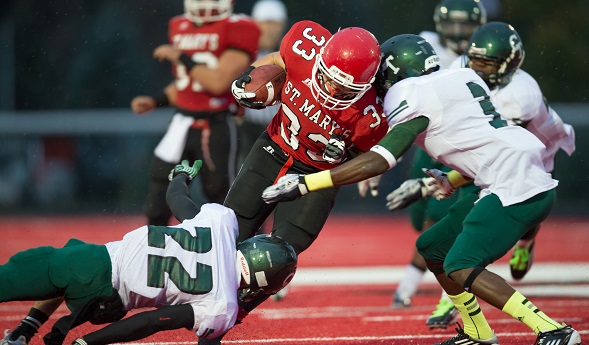
PHOTO: Orchard Lake St. Mary's senior Parker McInnis (33) is tackled by Detroit Cass Tech seniors Dejuan Rogers (3) and DaQuan Pace (22) during their Week 5 game. (Click for more from Terry McNamara Photography.)