

Center Leading Big Reds Back for More
September 4, 2019
By Tom Kendra
Special for Second Half
Muskegon High School’s offensive line sustained some BIG losses after last season.
 Four of the starting five offensive linemen from that MHSAA Division 3 runner-up team, totaling 1,245 pounds in weight – and including 6-foot-5, 360-pound right tackle Anthony Bradford, who is now playing at Louisiana State University – are gone.
The lone returning starter is senior center D’Andre Mills-Ellis, which makes it all the more impressive the way the Big Reds dominated two-time reigning Division 2 champion Warren De La Salle Collegiate, 41-7, during Friday’s Xenith Prep Kickoff Classic at Wayne State University.
“All summer long, we were hearing that we weren’t going to be anything with all of the big boys gone,” said Mills-Ellis, who is certainly a big boy himself at 6-0 and 305 pounds. “We’re not as big, but we’re more athletic.”
Mills-Ellis and the young Big Reds’ linemen certainly made a statement Friday, posting a 285-94 edge in rushing yards against the Pilots, who feature 6-7, 320-pound senior two-way lineman Grant Toutant, an Ohio State commit.
Muskegon (1-0) has no time to sit back and enjoy its big season-opening win, as the Big Reds face another long road trip and another monumental challenge this Friday night at Detroit Martin Luther King (0-1) – a rematch of last year’s Division 3 championship game, which King won, 41-25.
The Big Reds will be out for revenge, led by senior quarterback and returning MLive Michigan Player of the Year Cameron Martinez (6-0, 190), who also has verbally committed to Ohio State. Martinez carried the ball 21 times for 184 yards and three touchdowns against De La Salle, while completing 6-of-11 passes for 57 yards.
Martinez is the latest of an incredible stretch of quarterbacks at Muskegon – most recently bolstered by Kalil Pimpleton, now a starting slot receiver at Central Michigan, and then La’Darius Jefferson, now a major contributor at running back at Michigan State.
“We’ve been blessed with great quarterbacks here lately, but it all starts with D’Andre getting the ball to them,” said 10th-year Muskegon coach Shane Fairfield, who has guided the Big Reds to MHSAA Finals six times in the past seven years and led them to the Division 3 title in 2017.
Mills-Ellis said it’s an honor to block for such talented runners.
“The thing is, you don’t have to get pancakes with backs like that,” said Mills-Ellis, a college prospect who currently has offers from Judson (Ill.) and Northwood and wants to major in biology. “All those guys need is a little bit of room and they’re gonna go.”
 The center always plays a critical role on the offensive line, getting to the ball first, surveying the defense and making sure that everyone up front knows their assignments. Mills-Ellis is used to that job, but he has become much more vocal in it with two sophomores and one junior starting alongside him.
The only other senior up front for the Big Reds is left tackle Billie Roberts (6-3, 255), a converted tight end who Muskegon offensive line coach Matt Bolles says has Division I skills. Starting next to Roberts is junior guard Tayvid Elmore (5-11, 280), while the right side has a pair of sophomores in guard Jamarrius Dickerson (5-10, 295) and tackle Duane Anderson (6-1, 285).
“It’s different for him this year because now he’s our rock, our leader up there,” explained Fairfield. “He’s always kinda been the comedian, but he’s had to scale that back a little, so that when it’s time to get serious the other guys will listen to him.”
The senior is known for his steady snaps, as the Big Reds line up almost exclusively in the pistol formation, with Mills-Ellis initiating every play with a quick snap back to Martinez. While his center is pretty much automatic these days, Muskegon offensive coordinator Brent White said that wasn’t always true.
“We converted him from tackle, and he was a little rocky with his snaps at first,” said White, who gave credit for his improvement to snapping to Jefferson, who is nicknamed ‘Sippy’ because he’s from Mississippi. “Sippy didn’t like bad snaps and he had a way of letting him know that, so he got better in a hurry.”
Mills-Ellis, who is one of the strongest players in West Michigan with a squat of 675 pounds, is also starting for the first time this season at defensive tackle.
Fairfield said during the preseason that he believes his team will be much improved on defense, and it certainly appeared that way in the opener as tackles Mills-Ellis and Roberts completely stuffed any interior running plays.
Muskegon limited De La Salle to just one touchdown, but a bigger defensive challenge awaits this week against a Detroit King team packed with Division I prospects – notably battering-ram running back Peny Boone (committed to Maryland), receiver Rashawn Williams (Indiana) and freshman quarterback Dante Moore, who already has an offer from Michigan.
King shredded Muskegon through the air and on the ground in November’s championship game at Ford Field, but Mills-Ellis said the Big Reds are determined to not let that happen again.
“We couldn’t overlook De La Salle, because they have a great program, but deep down inside, the game we all want and that we’ve been talking about all summer is King,” said Mills-Ellis. “You have to understand, us seniors here aren’t used to losing. This is our chance to make up for that loss.”
 Tom Kendra worked 23 years at The Muskegon Chronicle, including five as assistant sports editor and the final six as sports editor through 2011. E-mail him at [email protected] with story ideas for Muskegon, Oceana, Mason, Lake, Oceola, Mecosta and Newaygo counties.
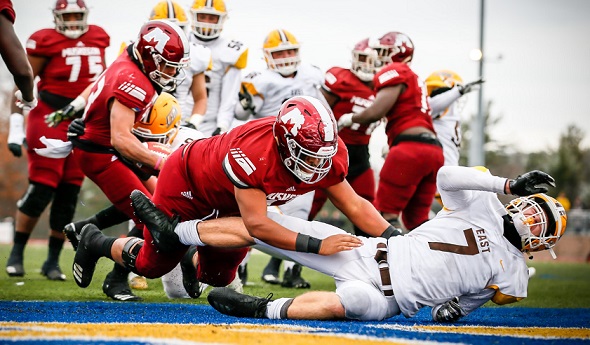
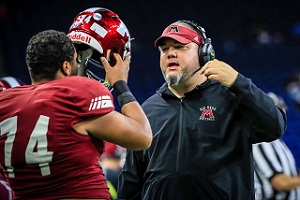
PHOTOS: (Top) Muskegon center D'Andre Mills-Ellis throws the key lead block as quarterback Cameron Martinez scores a touchdown during the Big Reds' 45-22 Division 3 Semifinal victory over Zeeland East last season at Grand Haven High School. (Middle) Mills-Ellis talks to Muskegon offensive line coach Matt Bolles during last year's Division 3 championship game at Ford Field. (Photos by Tim Reilly.)
Brogan Shepherds Lumen Christi Legacy
By
Chip Mundy
Special for Second Half
November 17, 2017
By Chip Mundy
Special for Second Half
JACKSON – It has been nearly 38 years since Herb Brogan became head football coach at Jackson Lumen Christi. It is hard to imagine anyone facing tougher circumstances in a promotion than he did early in 1980.
 Lumen Christi was coming off its second Class B championship in three seasons, this one capping an undefeated season. Head coach Jim Crowley was named the Michigan High School Football Coaches Association Class B Coach of the Year, and Brogan had been on the varsity staff since 1973 and had been part of the program since 1971.
It was a close coaching staff, but everything changed on the first Friday night of 1980. Crowley confronted a man in his driveway as he returned home from picking up his daughter. After sending his daughter inside, Crowley was shot and killed, leaving the Jackson community shocked and saddened.
At age 30, Brogan was chosen to succeed Crowley, his friend and mentor who had been the coach at rival St. John while Brogan played for St. Mary. The two schools merged in 1968, and Crowley was named head coach. Crowley and Brogan formed a strong friendship during their years together, and Brogan was the obvious choice to be the new head coach after Crowley’s sudden death.
“You’re in shock,” Brogan said of his recollections of that tragic night. “It played out slowly, and it was a long, long night. I remember that.”
Taking over the program under those circumstances was challenging for Brogan.
“It was hard just because I missed Jim,” he said. “I had the support of his family, and the coaching staff remained the same and constant, and the kids bonded together. We just worked our way through it.”
A year later, the MHSFCA created the Jim Crowley Award, and continues to hand it out each season.
Through the years, Brogan put his own stamp on the program, but the Crowley influence always has been evident to those who could recognize it.
“A lot of the plays are the same; that play-action pass is the way we ran it back then,” Brogan said. “He established the foundation, and a lot of the things are run the same way. Circumstances have changed, but the tradition has stayed the same.”
Maintaining tradition
Brogan’s first two teams both finished the regular season undefeated. In 1980, Lumen Christi lost to Farmington Hills Harrison 7-6 in the Class B Regional, and in 1981, the 9-0 Titans were denied a playoff spot despite outscoring their opponents by a combined score of 301-26.
 From 1981-94, Lumen Christi made the playoffs just twice but still had 12 winning seasons out of 14 and never finished worse than 4-5. In 1995, Lumen Christi had an unbeaten regular season and won a playoff game before losing to Detroit Country Day.
The following season, Lumen Christi won its third MHSAA title – and the first with Brogan as head coach – and the most prolonged successful run in school history was underway.
Since 1992, Lumen Christi has not been worse than 6-3 in any season. It also has 263 wins – an average of more than 10 per season over 26 seasons. The Titans won seven MHSAA championships during that run, including two capping back-to-back 14-0 seasons in 2000-01.
Brogan said each title brought its own satisfaction.
“They are all different, and the kids are different,” he said. “Sometimes you expect it, like in 2000 and 2001 and in 1996. It would have been a disappointment if we didn’t win those.”
And sometimes the expectations are not as high. At the beginning of the 2016 season, Brogan saw promise in his young team but was unsure how things would turn out. It did not look real promising after the Titans started 1-2.
“The team did what we hoped it would do,” he said. “We knew we weren’t going to be very good early on, and we weren’t, but we were young and we had a chance to get a lot better and we did.”
Lumen Christi ran the table, winning its last 11 games with a few key victories along the way. One of those came in the sixth week against Coldwater.
“The Coldwater game that we won in overtime was a big confidence booster because we had already lost two games at that point,” senior fullback/linebacker Kyle Minder said. “It was a big game to win.”
Senior left guard Austin Maynard, then a junior, pointed to the victory over Schoolcraft in the Division 6 District Final as a key point in the season.
“We found out we can win it all because that team was probably the best we faced all year,” he said. “When we won that game, we looked at each other saying. ‘It’s possible that we could win it all.’ “
The 11-game run was capped with a 26-14 victory over Maple City Glen Lake at Ford Field in Detroit.
“It was what everyone dreams about; the feeling that happens when you win is indescribable,” Maynard said. “It feels like you are on top of the world and nothing can bring you down. You know all the hard work that you put in during the summer paid off.”
The players, however, wanted more.
“They have embraced the challenge of being the defending champions,” Brogan said. “We’ll see what happens, but it’s been on their minds ever since we walked off Ford Field last year.”
Driven to repeat
Brogan does not shy away from scheduling a tough foe or two in the non-conference, and this season the Titans opened against four-time reigning Division 5 champion Grand Rapids West Catholic for the second year in a row. They knocked off the Falcons 27-24 to get the season off to a rousing start.
“In the non-conference, there is nobody better to play than Grand Rapids West Catholic,” senior tight end/defensive end Cameron White said. “Just having them on our schedule is great, and to come out with a win was awesome.”
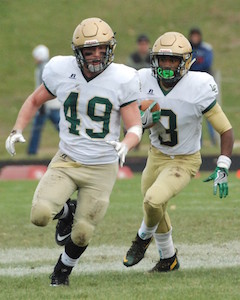 One of the neat aspects for this group of players is that it is the first to complete an entire season of playing its home games at the high school. In the past, Lumen Christi has always played its home games at Withington Community Stadium, which is located at Jackson High School. A few years ago, Lumen Christi opened its own field and eventually ended up playing all of its home games there.
“I was a little bit concerned about that because Withington is such a nice venue, and we wondered how the kids would accept it, but they love it,” Brogan said. “I think the kids in the school like it, and they have their own little section down there in the end zone and there is a lot of enthusiasm down there.
“It’s nice getting dressed here and walking out to play a ballgame.”
It certainly has been a hit with the players.
“It’s nice to be at our own school and not have to travel for home games,” senior receiver/defensive end Sam Mizner said. “It’s nice to have that LC in the middle of the field all of the time.”
Maynard said it’s a different feeling to be playing on the school grounds.
“When we played at Jackson High, they are one of our biggest rivals in football, so playing there you just didn’t feel at home,” he said. “Here we are playing in front of our home crowd at home.”
This year’s team is experienced with strong line play, and one improvement over last year – at least statistically – is on defense. The Titans have allowed an average of 12.8 points per game after giving up 17 a year ago.
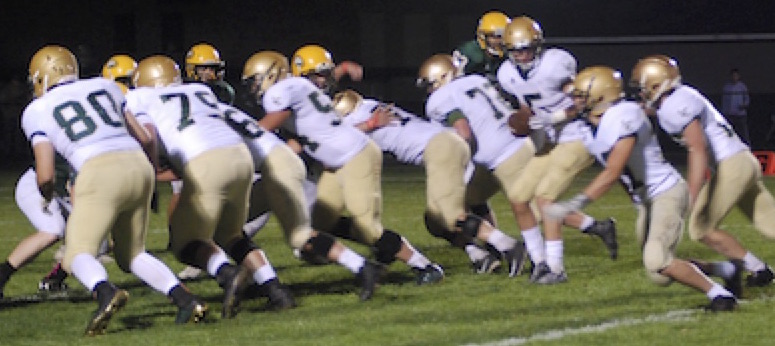
“Offensively, we’re physical, and we have a great offensive line,” Brogan said. “I’d say that’s the strength of our team. We’ve been able to block everybody all year long. We have two good tailbacks who have rushed for 1,800 yards and a fullback who has rushed for 750. Our quarterback has thrown for about 1,200 yards and completed 68 percent. We haven’t thrown it a lot, but we have thrown it effectively off our play-action stuff. When we have been able to run it well, we’ve been able to hurt people.
“It’s an experienced group. Most of these kids had a role in the state championship last year. We returned a lot. It’s a mature group. They are fun to coach and fun to be around. They enjoy themselves and play hard and play with intensity, but they have a lot of fun doing it.”
Lumen Christi played an eight-game schedule this regular season and went 7-1 with a one-point loss to Battle Creek Harper Creek in the third week of the season.
“I think it was a very good point in the season when we ended up losing,” White said. “It was a wake-up call that everything wasn’t going to be easy and everything wasn’t going to be given to us.
“It showed that we need to work that much harder.”
Lumen Christi will take an eight-game winning streak into its Division 6 Semifinal on Saturday. The first eight Finals championships in school history were either in Class B or Division 5, but declining enrollment dropped the Titans to Division 6 in 2014. But that hasn’t necessarily meant an easier road to a title. This year, perennial powers Ithaca and Traverse City St. Francis are meeting in the other Semifinal game.
“Last year, I thought Division 5 was more difficult than Division 6, but overall this year, Division 6 is probably more difficult than Division 5,” Brogan said. “What I have found over the years is that there are really good teams in every division, just the further down you go there are less of them.
“We felt last week that seven of the eight teams who were left could win it, and now, any of the four could win it.”
Brogan – The Leader
With a lengthy resume as impressive as Brogan’s, there is no doubt who is in charge. And the players know of him long before they ever play for him.
 “When you come into the program in seventh grade, you look at Coach and he’s a very intimidating guy,” Maynard said. “You know the hard work that he is going to put you through just from the stories you’ve heard, and true football players want that; they want coaches to come up to you and challenge you and put you through the most difficult workouts you’ve ever been through.”
And, when they mess up, they will hear about it.
“At first, you are scared of making a mistake, but you have to do everything 100 percent,” Mizner said. “You know you are going to get yelled at because you’re not perfect, but things will happen and you’ll get better during the season.”
Brogan will coach with an iron fist, but he isn’t one to run up the score. Often during his career a 28-0 halftime lead ended with something like a 35-0 victory.
He preaches clean play and will not tolerate any of his players doing something that might be deemed dirty. His players told of one such instance this season. One of the Titans pushed an opposing player after the play, and as White told it, that player felt the wrath of Brogan.
“Coach Brogan got in his face,” White said. “It solved the problem, and the player learned his lesson. And he learned his lesson at conditioning, too.”
And finally, there is a saying around football circles in Jackson. It goes something like this: “If Lumen Christi is close at halftime, the coaches will more often make the proper halftime adjustments to give the Titans the edge in the second half.”
In typical style of the low-key coach, Brogan directs that credit to his assistant coaches.
“I think we have a great coaching staff, and honestly, they do a lot more of that stuff than I do,” he said. “We have an offensive staff and an offensive coordinator and a defensive staff and a defensive coordinator, and my job is to sit here and talk to the media.”
Brogan is fifth all-time in coaching wins in the state of Michigan and second among active coaches. His career record is 341-83, and he is one of just 10 coaches to reach 300 career victories. He doesn’t appear to be slowing down.
“It’s still fun,” he said. “I don’t have a lot of classes anymore, and in the offseason I can kind of do what I want to do. I’m coaching with great guys and coaching great kids.
“I’ll be here as long as these guys want me around.”
 Chip Mundy served as sports editor at the Brooklyn Exponent and Albion Recorder from 1980-86, and then as a reporter and later copy editor at the Jackson Citizen-Patriot from 1986-2011. He also co-authored Michigan Sports Trivia. E-mail him at [email protected] with story ideas for Jackson, Washtenaw, Hillsdale, Lenawee and Monroe counties.
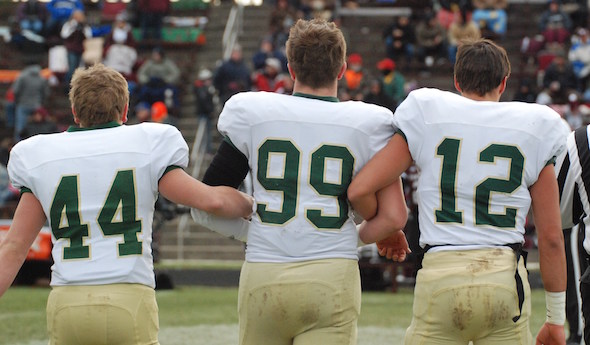
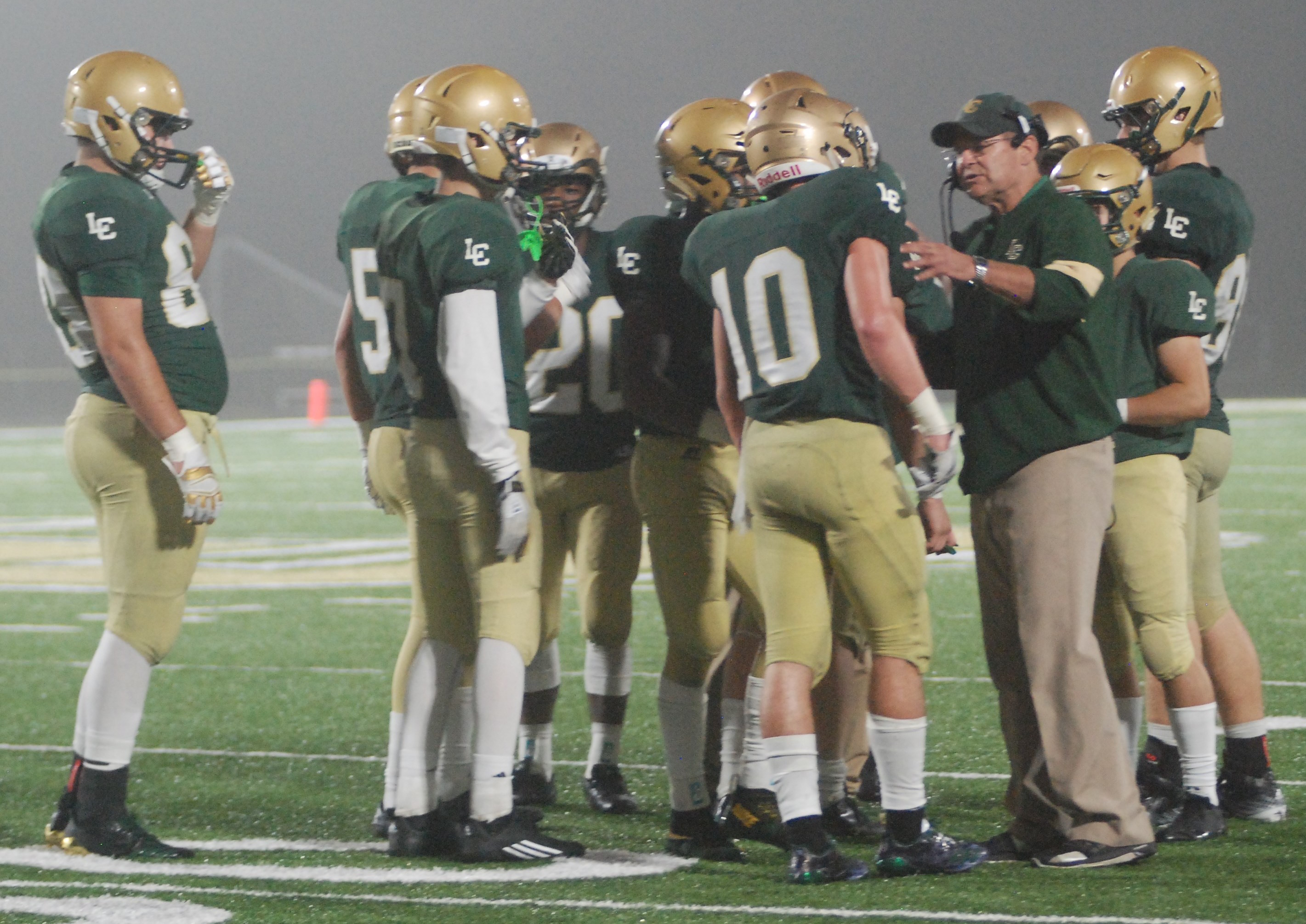
PHOTOS: (Top) Lumen Christi players stand arm-in-arm. (Middle top) Titans coach Herb Brogan talks things over with his players. (Middle below) Lumen Christi fullback Kyle Minder, left, leads the way for tailback Sebastian Toland. (Below) The Titans are succeeding again behind a powerful offensive line. (Photos courtesy of the Jackson Lumen Christi football program.)