

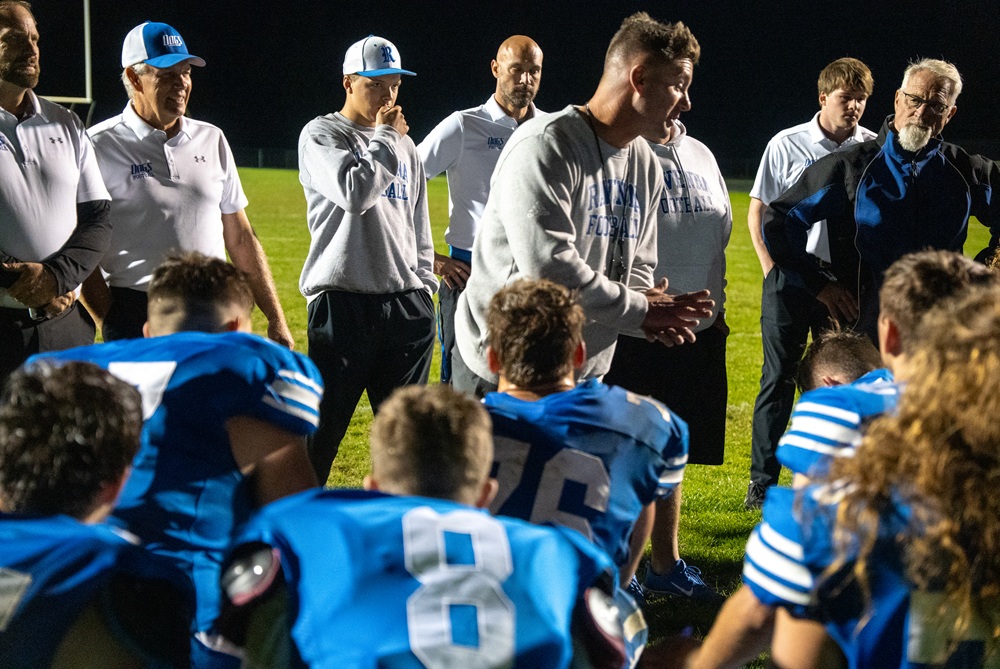
Champion Coaches - Including Local Legends - Unite to Restore Ravenna Glory
By
Scott DeCamp
Special for MHSAA.com
October 8, 2026
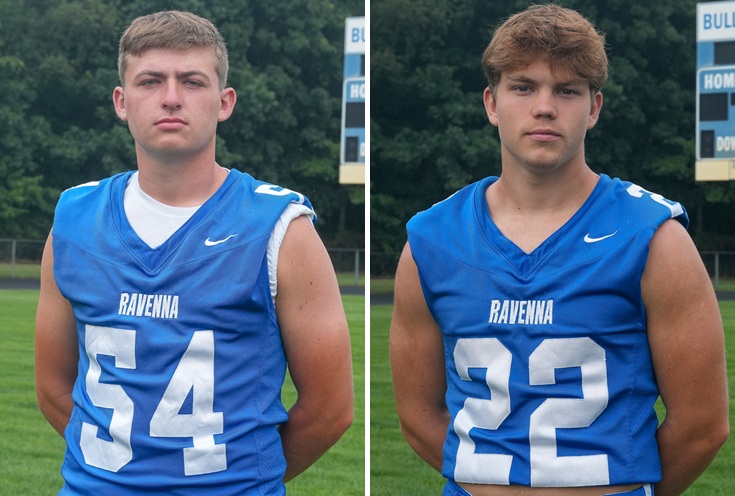
RAVENNA – Whether they want to or not, Ravenna seniors Joel Kantola and Colton Rolison hear about the glory days of Bulldogs football from their fathers.
 Kantola’s dad, Brandon, watches old games from the 1994 season when he was a two-way starter on Ravenna’s first MHSAA Finals championship team.
“He can’t remember very well, but he’ll see a play and he’s like, ‘Oh, I remember doing that play!’” Joel Kantola said. “It’s one of the best things to hear something (from that era). He loves it, too.”
Rolison’s dad, Willy, shares memorable stories from back in the day when he was a dynamic running back on the Bulldogs’ 1997 Class C title squad.
“It’s just insane that he still has all these stories that I’ve never heard. He’s still bringing them up, new ones every day,” Colton Rolison said with a smile.
Three decades have passed since the 1990s heyday of Ravenna football, when the Bulldogs won three of their program’s four Finals titles. But in the small town located on the eastern edge of Muskegon County, the band is back together, one might say.
Steve Czerwon was hired in March as Ravenna’s head football coach, coming from a highly successful 13-year tenure at his Muskegon Catholic Central alma mater where he guided the Crusaders to Division 8 championships all of his first four seasons (2013-16).
One of Czerwon’s first orders of business in Ravenna was securing the commitments of legendary coaches Dusty Fairfield and Randy Helsen – architects of the Bulldogs’ championship teams in 1994, 1996, 1997 and 2003 – to bring their wisdom and serve as a link from the storied era to this current one.
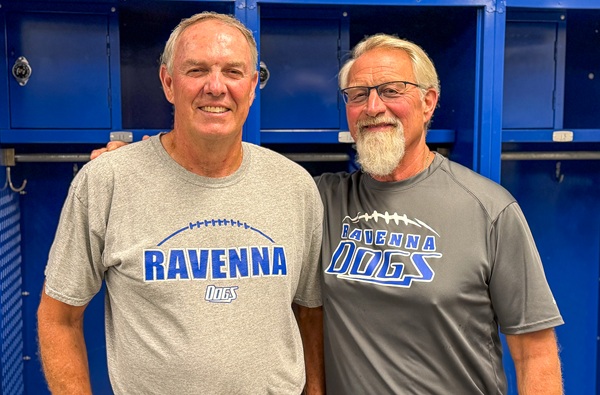
They agreed, others from the old guard hopped aboard, and a couple more experienced coaches joined Czerwon’s staff. Now, entering the final third of the 2026 regular season, the Bulldogs appear to have regained a little traction despite coming off three straight losing campaigns.
Ravenna carries a 5-1 overall record and five-game winning streak into this Friday’s West Michigan Conference Rivers home game against Hesperia.
Next week, Ravenna plays at North Muskegon with at least a share of the WMC Rivers title on the line. Should the Bulldogs win this Friday, they’ll take on the Norsemen for the outright league championship.
Since the WMC expanded and split into two divisions in 2022, North Muskegon has not lost a Rivers football game. Meanwhile, Ravenna has not won a conference title since sharing one with two teams in 2001.
In their football history, the Bulldogs have as many Finals titles as they do conference championships (four), illustrating the enduring strength of the West Michigan Conference.
This pack is hungry to etch its own history: Winning a conference title and making a run in the Division 7 playoffs. But, as Helsen laid out, there’s a price to pay.
“Steve addressed the fact (with the players),” Helsen recalled. “‘You wanted these guys to come back and you wanted what they had in the ’80s through the ’90s into the 2000s, and what it’s going to take is every effort you’ve got and even take it up from where you are. If you want to leave a legacy, that’s what you have to do. These guys (have) a legacy.’”
When Helsen says “these guys,” he’s referring to Fairfield and himself, but also other connections from the days of Ravenna football prominence.
In 20 seasons as Ravenna’s head coach covering two stints – the second ending in 2010 – Fairfield sported a 164-55 record. He’s a Michigan High School Football Coaches Association Hall of Famer.
Helsen served as Ravenna’s defensive coordinator for all of those seasons, and then some. He and Fairfield are both Ravenna Athletic Hall of Famers, their plaques side-by-side on the wall of the high school’s athletic wing.
Fairfield and Helsen are both retired and they’re volunteer assistants on Czerwon’s staff. They are not at every practice, but they fill critical roles: The former works with the secondary and quarterbacks, plus he’s on the headset in the press box on game days, while the latter coaches defensive linemen.
“They have so much knowledge, and I think it really does connect the past to the current,” said Czerwon, who did his student teaching at Ravenna in the early 2000s and was a member of the Bulldogs coaching staff during their most recent state title season in 2003. “A lot of kids here, they heard from their uncles and their fathers about some really good teams that Ravenna had in the ’90s and early 2000s, and those guys are the actual link.
“I talk to Dusty daily, and he just reinforces the importance of relationships you have with the kids,” Czerwon added. “He’s second to none at that, and it reinforces to me the importance of that.”
Geoff Nelson, who was a starting lineman on Ravenna’s 1994 team, coaches the offensive line. Neil Sladick, who helped the Bulldogs win Finals titles in 1996 and 1997, works with linebackers. Mark Jacobs, who starred on Ravenna’s first Finals group in 1988, helps coach defensive backs.
Canaan Groff is Ravenna’s defensive coordinator, and Nate Smith specializes in offense. Both bring experience to the table, including as head coaches. Czerwon, Groff, Sladick, and Smith all work in Ravenna school buildings, which is an advantage for coaches.
“I think that we’re bringing back a lot of accountability. I think we don’t settle,” Nelson said about Ravenna’s coaching staff. “This has been a great group. We had to break a lot of bad habits, but they’re starting to form new habits and starting to go in the right direction.”
Ravenna got a reality check to start the season in a 33-7 loss to Division 8 top-ranked Beal City, a perennial small-school power. Czerwon admitted he may have asked too much of his players right away in terms of new schemes and such.
Since then, the Bulldogs have exhibited gradual improvement, including winning a couple of one-point games, and now they’re starting to establish an identity of physical football. That was at its peak in last week’s 28-0 win at Mason County Central, which by the way is coached by Ravenna alumnus David Smith, a former Bulldogs head coach who was a member of Class C championship teams in 1994 and 1996.
Things are moving in the right direction for Ravenna.
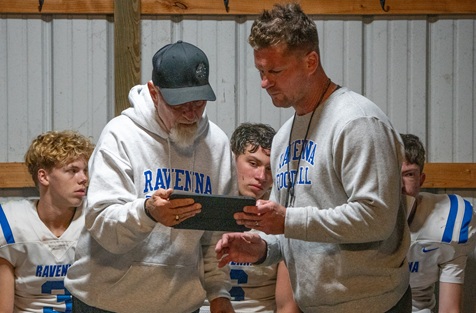
“There hasn’t really been a lot of drama or anything like that. We love each other. That wins games,” said Rolison, a linebacker who suffered a fractured collarbone in Week 3. Chances of a return this season are up in the air, he said.
“(The coaches have all) worked together before and nobody motivates like Dusty Fairfield – there’s not a single person out there who does,” Rolison added. “Coach Randy Helsen, he knows his stuff. He knows more than I probably ever will about football.”
According to Helsen, getting to know young people at the ground level is Fairfield’s specialty: Types of music they like, their hunting spots, etc.
In terms of accountability, everybody is responsible for that.
“We get after them if they’re not getting it done,” Helsen said. “Kids that were not getting after it five, six weeks ago and kind of rolling their eyes at me when I’m coaching them on scout defense, they’re now in the starting lineup. I said, ‘You’re getting coached by a guy that coached defense here for 27 years. I’m giving you the same coaching that our all-staters and all-conference players got.’”
Fairfield’s goal in returning was to help lay building blocks for current and future success. He believes the overall health of football in Ravenna is strong considering participation numbers from high school to youth levels, especially at a time when similarly small communities across the state are canceling varsity seasons or not fielding enough players to form junior varsity squads.
“It’s been a good experience, and it’s made me realize, you know, what we did in the past really meant something, and it made me realize how hard we worked because I’m totally invested in the team right now. It is fun with the camaraderie with not just the boys but also the coaches,” Fairfield said.
“You know, it’s my last hurrah where I get to experience what I did for a living for over 30 years. I get to experience it one more time before I, you know, go off into the sunset,” he added with a chuckle.
For families such as the Kantolas and Rolisons, things are coming full circle – and they could not be more excited. Brandon Kantola is enjoying his son’s senior season while also reminiscing about the good ol’ days.
“I think he was invested back then,” said Joel Kantola, Ravenna’s starting center, “but he’s more excited for us than I think he was back then.”

Scott DeCamp has worked more than 25 years in sports media, including 21 at MLive Media Group as a reporter and editor. He is founder and owner of DeCamp Creative Solutions. Email him at [email protected] with story ideas for Lake, Mason, Mecosta, Muskegon, Newaygo, Oceana, and Oceola counties.
PHOTOS (Top) Ravenna head coach Steve Czerwon addresses the team following a 28-14 victory over Shelby on Sept. 25. (2) Ravenna assistant coaches Randy Helsen, left, and Dusty Fairfield are pictured in the Bulldogs' locker room in August. (3) Joel Kantola, left, is a senior center for the Ravenna football team, and Colton Rolison is a senior linebacker. (4) Fairfield, left, and Czerwon look at an iPad during halftime of a 28-0 victory over Mason County Central on Friday. (Photos by Scott DeCamp.)
Early Wins Leader Maskill Built Champions
November 12, 2019
By Ron Pesch
Special for Second Half
The long shadows of “midcentury modern” coaching legends have mostly disappeared from the gridirons of Michigan.
One more vanished in late October at the age of 96.
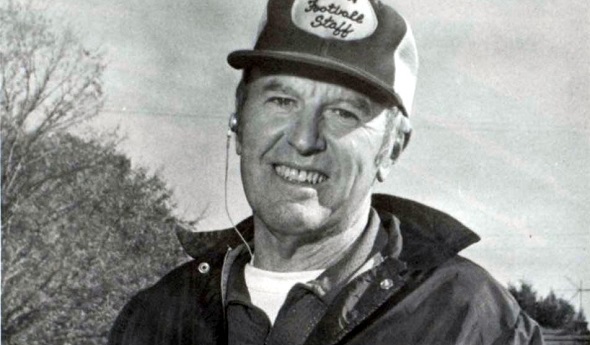
Bill Maskill was once the winningest football coach in Michigan high school history, chalking up the majority of his victories at Galesburg-Augusta. One of only six who could claim such an honor – coaches are first counted after reaching 200 wins – he received his start in coaching at Sheridan High School (now known as Central Montcalm since the Sheridan and Stanton school districts merged in 1963). In 1980, he became only the second coach to compile 200 varsity victories as a coach, and in the fall of 1982 he surpassed Muskegon Heights’ coaching legend Oscar E. ‘Okie’ Johnson on the victory list.
Maskill’s coaching accomplishments – and their historic significance – are a reminder of a change in eras. Michigan prep sports in the pre-playoff days were filled with coaches with Swiss-Army like skills, as many were expected to coach multiple sports at their respective schools. The gridiron season was unlike today’s in many ways, and the differences are reflected in a variety of manners within the state record books.
Coaching and player season performances up to the creation of the MHSAA Playoffs in 1975 were constrained by the schedule. In general, nine games was the max. (With the playoffs, a season can extend up to 14 games.) Maskill’s victory total now ranks 16th overall in Michigan high school history, as there are 63 coaches with at least 200 varsity wins. Two coaches, John Herrington of Farmington Hills Harrison – the state’s current leader – and Al Fracassa, long of Bloomfield Hills Brother Rice, amassed more than 400 varsity victories during their careers. In both cases, more than 65 victories were earned during the postseason.
The MHSAA postseason was approaching its eighth year of existence when Maskill passed Johnson as the winningest football coach in state history. To that point, Maskill’s Rams had twice qualified for the playoffs – the first time in 1976, and again in 1980 – but had yet to win a game during the postseason.
But he stayed atop the state’s football wins list for more than a decade – and later found playoff successes as well, more crowning achievements for a coach whose many wins came after turning around both programs fortunate enough to employ him over a combined 44 seasons.
A Rough Start
Maskill’s career, at least in his eyes, was nearly derailed during his first season at the helm.
“The year was 1949, and Bill Maskill was in his first year as varsity football coach at Sheridan High, about 50 miles north of Lansing. He thought it would probably be his last. His team did not win a single game. ‘A couple of times, I thought of throwing in the towel,’” Maskill told Mick McCabe of the Detroit Free Press in October 1982, when he surpassed Johnson in victories.
There was little likelihood that Maskill would be dismissed as coach after that disappointing season. But it took a few years for his Redskins to become competitive.
“Previous to his work there, Sheridan had not played football and there was little interest in the game,” noted the Battle Creek Enquirer in the spring of 1957, when Maskill was announced as the new football and baseball coach at Galesburg-Augusta High School. “He built up interest to the point that during the past five years, Sheridan has won the Montcalm County League championship once and finished second for four years. During this period, the team’s overall record was 31 won, 9 lost and 2 tied. In baseball, he had one county championship, finished second twice and third twice.”
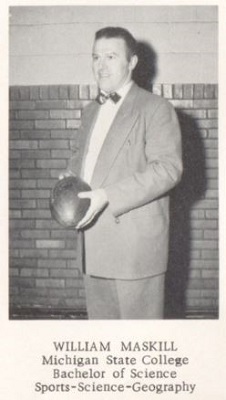
A 1941 graduate of Detroit DeLaSalle, Maskill had been a hard-plunging fullback on the football team who also boxed in Catholic Youth Organization tournaments. Following graduation, he initially enrolled at the University of Michigan in 1942, receiving his freshman numerals from coach Wally Weber, but only after a year at prep school near Pittsburgh.
“I screwed around a lot in high school and couldn’t get into Michigan,” he told McCabe years later, laughing. “They sent me to this prep school, and I couldn’t believe all the studying I had to do. It was the best thing to ever happen to me.”
He ended up at Michigan State, where he earned a varsity letter from coach Charlie Bachman in 1944 and his bachelor’s degree.
“He was hard of hearing; he had it bad,” recalled Bob Ludwig of Muskegon, a football teammate with Maskill in the backfield for the Spartans in 1945. “Our quarterback would mouth the words of the play to him.”
Over time, Maskill had multiple operations in hopes of correcting the issue.
The attempts improved his hearing, according to Maskill, “to about six percent. And that’s the truth. But there are some advantages. The kids can cuss at me and I don’t know it.”
The disability never stopped him. He told McCabe that the only thing he ever wanted to be in life was a football coach: “I just liked playing football, and that made me want to coach.”
Another Rough Start
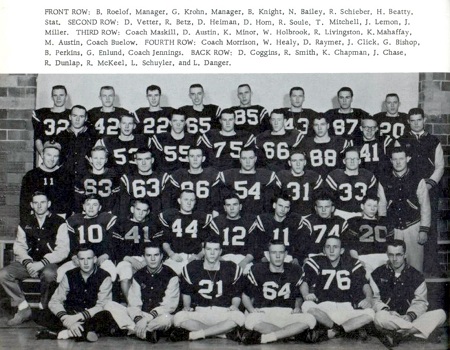
At Galesburg-Augusta, he inherited a team that finished with a single tie amid eight losses the year prior to his arrival. Improvement certainly wasn’t reflected in the standings in Maskill’s first year in charge. The Rams completed the eight-game season without a victory or a tie to show for their efforts. That changed in year two, as G-A finished with a 7-1 mark. The only loss was to unbeaten Bangor, 40-21, in the season finale. In 1959, Maskill and his stable of assistants had completely flipped the table, as the Rams ended with a perfect 8-0 mark.
“Galesburg-Augusta blasted Bangor, 27-0, before a crowd of more than 2,500 fans at jam-packed Angell Field in Kalamazoo … in a battle between the Kalamazoo Valley’s unbeaten football teams. Bangor’s great 21-game winning streak simply collapsed before the high-powered running attack as the Rams rolled to their seventh straight victory of the season,” wrote Dick Kishpaugh in his coverage for the Enquirer. Kishpaugh would later be known as Michigan’s authority on high school sports.
A week later, the Rams trounced a solid Paw Paw team on the road, 33-7. They finished third in the United Press International season-ending Class C-D rankings behind Charlevoix and Cassopolis.
Statewide Success
That was the first of eight G-A squads to finish the regular season undefeated for Maskill. The next four would each be named mythical state champions according to the polls.
His 1962 team allowed only 14 points across eight games to end the year as Class C-D champion ahead of St. Joseph Catholic according to The Associated Press poll of Michigan sportswriters and sportscasters.
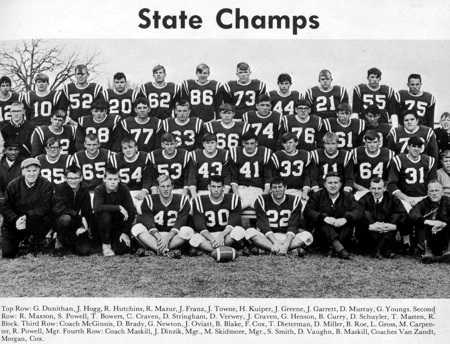
Maskill’s 1966 and 1967 Rams squads each finished unbeaten and untied in nine contests. The 1967 team scored a school-record 389 points on the year, and held opponents to a mere seven points – a touchdown and an extra point scored by Springfield in a midseason 27-7 triumph. The 1970 team also finished with a flawless 9-0 mark, topping the 1967 team’s offensive output with 408 points on the season.
Maskill’s 1976 team ended the regular season 9-0 and was one of only four teams to advance to the Class C postseason in place during those earliest days of the MHSAA playoff system. G-A immediately was eliminated by Flat Rock, the eventual champion.
The media spotlight came to Galesburg-Augusta in 1980 for a regular season-ending contest with Constantine. A victory would give the veteran coach another perfect regular season and push Maskill’s career win total to 200. The week played out under television station coverage and multiple newspaper reports.
“More than 120 of Maskill’s former players were on hand, some wearing varsity letter jackets that were nearly 20 years old. All trotted onto the field, according to their graduation years, during halftime festivities,” said Bob Byington in the Enquirer. “… The warmest embrace and greeting were reserved for Maskill’s son, Bill Jr., an assistant coach at the University of Louisville. The younger Maskill drove in from Kentucky to surprise his dad …”
 The Rams won 28-6 to finish 9-0, qualifying for the MHSAA Playoffs for the second time in school history. The team ranked fifth in the final AP poll. A loss to White Pigeon in the opening round capped the season.
Despite impressive 8-1 records in 1981, 1982 and 1983, the Rams didn’t return to the playoffs until 1985. There, they won their first postseason contest, downing Hudson, 21-6, in a Pre-Regional. G-A fell the next weekend to eventual Class C titlist Lansing Catholic Central.
Lansing Catholic would again eliminate the Rams from the postseason the following year.
We Have a Lot of Heart
The MHSAA approved an expansion to the football playoff system in 1990, doubling the classifications from four to eight, which in turn doubled the number of annual qualifiers. While the Rams finished the regular season with a single defeat, they were unranked in the weekly press polls. Thanks to the changes to the playoff system, they were in the tournament, but weren’t expected to go far.
Rumors had circulated that this – Maskill’s 40th year as a head coach – would be the last go-around for the 67-year-old veteran coach. The first-round opponent was No. 4-ranked Dansville. With the Rams trailing 17-0 with 8:33 remaining in the third quarter, the result didn’t look promising.
But Jason Meek would have none of that. The Rams started their comeback with a trick play – a halfback pass by Meek off a lateral for a touchdown reception by Rusty Smith. It was followed on the next possession by a 27-yard TD reception by Meek from reserve quarterback Dave Lemmien. A pair of 2-point conversions by Rick Tyson had cut the lead to 17-16. Tyson scored the game winner on a one-yard touchdown run, set up by an interception by Meek that capped a 14-play, 59-yard drive – all rushes – that burned 6:53 off the clock. The defense shut down Dansville for the remaining six minutes of the contest.
A week later, the Rams lined up against No. 1 Schoolcraft, the two-time reigning Class C champion which was riding a 16-game win streak. The Eagles had lost only three of their last 57 games.
Galesburg-Augusta stunned all prognosticators with a 15-13 win before nearly 5,000 fans.
The Rams ran the ball 52 times, with Tyson handling the ball 28 occasions for 78 yards including a 19-yard TD that opened the game’s scoring. Schoolcraft tied the game at 7-7 just before the half, then opened a 13-7 lead on its second drive of the second half.
“It took all of us to do it,” said G-A junior fullback Paul Zimmerman, who scored the game-tying touchdown, and winning 2-point conversion on nearly identical plays with 4:01 remaining in the game.
Again, like the previous week, the Rams’ defense rose to the occasion, shutting down the Eagles for the remaining minutes.
“They kept the football,” said Larry Ledlow, coach of Schoolcraft about the second half. “Our defense was on the field much too long.”
G-A would win its Week 12 Semifinal contest with Clinton, 22-7, to advance to its first MHSAA Final. Corky Meinecke wrote a career-respective feature on Maskill that appeared in the Free Press on the day of the game:
“Just about everyone who loves, respects and admires Bill Maskill … figures he’ll announce his retirement sometime after the Rams play Muskegon Catholic Central … in the Class C championship game at the Silverdome. The timing couldn’t be better. Getting the Rams (11-1) to the Silverdome was the last notch on a heavyweight coaching belt that includes four mythical state titles … and five playoff appearances. He is the winningest football coach in state prep history …”
Weighing into the pending decision was a surprising aspect few ever considered.
“Maskill never figured he’d run out of players before he ran out of desire,” wrote Meinecke, “but that appears to be the case. Of G-A’s 24 players, only six are underclassmen. The school did not field a freshman team and the junior varsity – comprised of mostly freshmen – forfeited its last two games because it could not suit up enough players.”
 “A normal person would retire,” said Ken Buelow, Maskill’s assistant for all but three of the coach’s seasons at G-A and Sheridan. “But you have to remember, Bill is not a normal person. You’re talking about one hell of a human being here.”
“We don’t have size, we don’t have quickness and we don’t have speed,” Maskill said to Meinecke about this team that was perhaps the most satisfying of his career. “But we have a lot of heart.”
The Rams lost to MCC.
Changing landscapes
Maskill’s decision still took time. In August 1991, the G-A administration officially announced that the district would not field a varsity football team that coming fall.
“We do not have the numbers,” said athletic director Alex Forrester at the time. “It has nothing to do with money. … We do not have enough players.”
G-A chose to sponsor only a JV team that season. Instead of walking away, Maskill chose to stay on.
“I’ve never not coached a varsity,” he told Mark Bradley of the Enquirer. “I won’t know how to coach at the junior varsity level. But coaching is coaching, whether it be at the varsity or junior varsity level.”
He had retired from teaching following the 1980-81 school year and was one of 30 individuals inducted into the inaugural class of the Michigan High School Football Coaches Association’s Hall of Fame in April 1983. In October 1986, the school district honored him by naming the G-A football field in his honor. Without Maskill walking the halls and recruiting, fewer and fewer kids came out for football. After a year leading the JV, in July of 1992, he officially stepped aside from coaching. Forrester, one of his longtime assistants, took charge.
Maskill had purchased a tire company after he retired from teaching, and that became his focus.
In October 1994, over 12 years after Maskill had passed Johnson on the win list, Marysville’s Walt Braun passed Maskill in total wins. Leo “Smokey” Boyd of Saginaw Nouvel overtook Braun on the list in 1996. In turn, Fracassa topped Boyd in 2001, and Herrington bettered Fracassa’s total in 2017.
The “Ram Family”
The floor-to-ceiling mementos from his career that Maskill shared with Meinecke during their conversation were a feature of a party that Maskill would host annually.
“… It was not unusual to have 200-plus (former players, coaches, and new and old friends) there to celebrate the man they knew as ‘Coach’,” wrote Bill Broderick in a heartfelt article in the Enquirer, announcing Maskill’s passing.
Several years back, Buelow, his old assistant coach, had organized a group to create “a would-be Galesburg-Augusta football museum” in Maskill’s basement.
“… I was shocked when I heard,” said Bill Maskill, Jr., to Broderick concerning his Dad’s passing. Head football coach at Midwestern State University in Wichita Falls, Texas, since 2002, Bill Jr. had earned all-state honors at quarterback as a senior at G-A in 1966. "He went out and walked a mile on Monday. We all thought he would live forever."
 Ron Pesch has taken an active role in researching the history of MHSAA events since 1985 and began writing for MHSAA Finals programs in 1986, adding additional features and "flashbacks" in 1992. He inherited the title of MHSAA historian from the late Dick Kishpaugh following the 1993-94 school year, and resides in Muskegon. Contact him at [email protected] with ideas for historical articles.
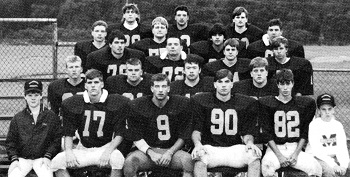
PHOTOS: (Top) Bill Maskill Sr., here during the 1980-81 school year, was the state’s winningest high school football coach all-time after his final varsity season in 1991. (2) Maskill, shown here during the 1954-55 school year, played football and earned his bachelor’s degree from Michigan State. (3) The 1959 Galesburg-Augusta team finished 8-0. (4) The 1966 Galesburg-Augusta team was named a mythical state champion by media rankings. (5) Maskill took his team to the MHSAA Finals for the first time in 1990, when it finished Class C runner-up. (Photos gathered by Ron Pesch.)