

Chippewa Valley Leads Macomb Charge
By
Tom Markowski
Special for Second Half
November 8, 2018
CLINTON TOWNSHIP – Since winning the Division 2 title in 2001, Clinton Township Chippewa Valley has played in the shadow of traditional Macomb County powers Macomb Dakota, Romeo, Sterling Heights Stevenson and Utica Eisenhower.
 Before this season, Chippewa Valley’s record against those four schools over the last 17 years was 26-52. The Big Reds did own a 10-8 record against Stevenson, but twice Stevenson reached MHSAA Finals while Chippewa Valley’s best showing since its championship season was a Semifinal appearance in 2003.
That trend started to change in 2017 as Chippewa Valley went 4-1 against these teams (including a second win over Dakota in the playoffs). This season, the Big Reds took another step forward posting a 6-0 mark and capturing their first outright title in the Macomb Area Conference Red.
And for the first time in program history, Chippewa Valley is 11-0. The Big Reds were 9-0 in 1975, the first season the MHSAA sponsored state playoffs, but did not qualify for the postseason (only four teams in each of the four classifications were selected for the playoffs that first year).
Scott Merchant is in his 10th season as head coach at Chippewa Valley, and the Big Reds have made the playoffs eight times during his tenure. These past two seasons have been his best by far. Last season, Chippewa Valley finished 10-2 losing to Detroit Cass Tech, 32-26, in a Division 1 Regional Final.
Most expected a rematch of that game this week. But Dearborn Fordson (10-1) upset Cass Tech last week, 41-14, and Chippewa Valley will host Fordson in the Division 1 Region 4 Final at 7 p.m. Friday. The teams have met just once before – and that game, in 2003, also took place in a Regional Final with Chippewa Valley claiming a 30-12 victory.
Merchant’s team is experienced, confident and loaded with talent. He has four three-year starters and eight seniors starting on defense.
“Dakota set the bar for the whole conference,” Merchant said of Chippewa Valley’s sister school (both are in the Chippewa Valley school system) and biggest rival. “In the mid- to late 2000s they had like five or six Regional titles. Our streak of losing to Dakota started in ’04, and I didn’t get here until ‘09. It was huge for us to win in 2014. It was the first time we beat them in 10 years. That was a big weight being lifted.”
When a team loses so often to another, especially a rival, the losses and the years often run together. For the record, here’s how bad it got for the Big Reds:
Beginning with a 7-0 loss to Dakota in a Division 1 Regional Final in 2004, the Big Reds lost 16 consecutive games to Dakota, and only six of the 16 were by 10 or fewer points. A 28-27 victory in a 2014 District Final ended this streak.
One loss stung most. In 2013, both teams were 7-0 and state-ranked. Dakota won 52-7.
“To this day I can’t explain what happened,” Merchant said. “It was one of the most disappointing losses I’ve had. A lot of it was mental.”
The tables have turned. Chippewa Valley has won five of the last six in the series and is two wins this month from reaching what would be the program’s second MHSAA Final.
The Big Reds’ success last season gave the players confidence and also fed their appetite for more. The 2017 team scored a school-record 463 points, and this season Chippewa Valley has scored 445.
The productivity is similar, but the means by which the offense this season has been successful is different. There’s a difference in personality. Last year Chippewa Valley was more of a finesse team that concentrated on the passing game. This team is more physical and its offense is geared more for the run, which is often more effective in November playoff games.
 Quarterback Tommy Schuster is a three-year starter who threw for 3,100 yards over his first two seasons. His numbers (1,400 yards) are down a tad this season, but he’s thrown 20 touchdown passes and just one interception. Schuster also is carrying the ball more as he showed last week by rushing for 60 yards in the 51-10 victory over Dakota.
This added dimension has become a fine complement to the Big Reds’ top two running backs, Andre Chenault and Ja’Von Kimpson. Chenault is the team’s leading rusher with 888 yards and 13 touchdowns on 107 carries while Kimpson, who also starts at cornerback, is more of a featured back in 3rd down situations. He’s scored nine touchdowns rushing and one receiving.
“Our run game has been dominant all season,” Schuster said. “The offensive line has gotten better and better. It took a little time. They’re all (first-year) starters, and they’re confident now.”
Replacing the entire offensive line was the main concern for Merchant and his staff coming into this season. With just one senior, this group grew up fast. In the opener, Chippewa Valley trailed Saline 13-0 before the offense began to click and the Big Reds won 31-26. Senior captain Ryan Cyrowski, the center, is the leader and juniors Charles Wesley, the left tackle, and Donovan McBride, the right guard, have developed nicely. The Big Reds rushed for an-eye-popping 445 yards last week.
Merchant’s top two players could well be linebacker Marcel Lewis, who also sees time at tight end, and David Ellis. Ellis rarely comes off the field as he starts at receiver and defensive back and is a dangerous kick returner. He has 33 tackles on defense, five rushing touchdowns, six receiving scores, three more on kickoff returns and he’s returned a punt for a touchdown.
“We don’t have any weaknesses,” Schuster said. “This team, all year, hasn’t panicked. We’re ready for whatever happens. Last year’s team was like that, too. The reason we’ve been so successful (the past two seasons) is we have great players and great coaches.
“Playing quarterback on this team is a lot of fun. There’s so many options. If the run game isn’t working, we have no problem throwing the ball.
“I’ve grown up a lot over these three years. I’ve gotten to work on my speed, and I’m able to help the younger guys out too. It’s easier for me now. There’s nothing that’s new to me.”
The experience Schuster and many of his teammates have is a big reason Chippewa Valley has come out on top in a number of close games. In addition to the victory over Saline, the Big Reds held on to defeat Romeo (41-34) and Dakota (24-17) during the regular season. All three of those games were on the road.
“We’ve had way more close games this year than last,” Merchant said. “It’s been great to see the program grow.”
 Tom Markowski is a columnist and directs website coverage for the State Champs! Sports Network. He previously covered primarily high school sports for the The Detroit News from 1984-2014, focusing on the Detroit area and contributing to statewide coverage of football and basketball. Contact him at [email protected] with story ideas for Oakland, Macomb and Wayne counties.
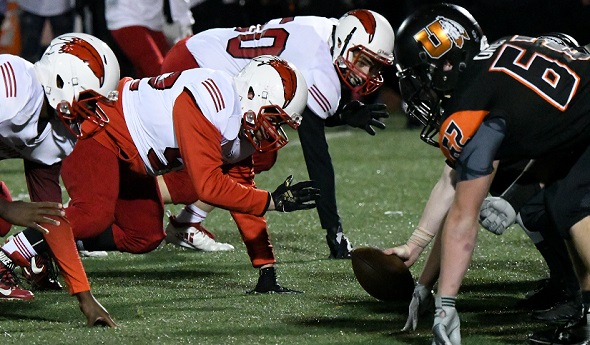
PHOTOS: (Top) Chippewa Valley’s defensive front lines up against Utica during a 49-0 Week 9 win. (Middle) David Ellis (8) follows his blockers into an opening against Utica Eisenhower in a 34-7 first-round playoff victory. (Photos courtesy of the Chippewa Valley athletic department.)

Parking, Entrance Protocols Announced For Ford Field
November 25, 2013
By Geoff Kimmerly
Second Half editor
To provide for the convenience and safety of spectators attending the Michigan High School Athletic Association Football Finals at Ford Field in Detroit, Nov. 29 and 30, attendees are being advised of a variety of items related to transportation and security – including new policies regulating types of bags that are allowed into the stadium.
In cooperation with Olympia Entertainment, more than 2,000 parking spaces will be available in close proximity to Ford Field and Comerica Park to the west, east and north of the ball parks. These parking lots will be clearly marked with Olympia Entertainment signs and will be charging $6. A map identifying the designated Olympia Entertainment lots can be found on the Football page of the MHSAA Website. (There also are a number of privately-operated parking facilities close to Ford Field, but their pricing may differ.)
Fans also are advised that tailgating, including the setting up and use of grilling equipment, and the consumption of alcohol, is prohibited by City of Detroit ordinances.
Gates A, B and G will be available for public entrance during the event. Ticket sales will begin near Gates A and G at 8 a.m. each day, and the building will open its doors to spectators at 9 a.m.
Tickets are priced at $10 and will allow a fan to see all four games in a single day. Spectators leaving the stadium will be required to purchase another ticket for re-entry. Children under the age of 2 will be admitted without charge for this event. There will not be a public Will Call window.
Upon arrival in the building, fans will find their designated seating areas on the South side of the field if their team is the designated home team for their contest and on the North side for the designated visiting team. Home teams this weekend are Clarkston, Muskegon, Zeeland West, Grand Rapids South Christian, Menominee, Ithaca, Ishpeming and Beal City. Brightly lit video boards above the seating areas will display the names of the participating teams each day, and fans should sit on the side of the stadium where they see their school’s name. For general fans, the entire lower bowl of Ford Field will be open for the event.
Security measures also will be in place to help assure spectator safety. Fans will be subject to a visual search, and Ford Field personnel reserve the right to request patrons open their coats, bags and other item-carrying vessels for visual inspection and deny entrance to individuals who do not cooperate. The NFL this season has enhanced its safety policy to further monitor what type of bags may be brought into stadiums. Those additions are noted in bold below.
Items which fans will be prohibited from bringing into the building include, but are not limited to, the following:
- Purses larger than a clutch bag, coolers, briefcases, backpacks, diaper bags, fanny packs, cinch bags, grocery & paper bags, duffle bags, luggage of any kind, computer bags and camera & binocular bags or cases. Visit www.nfl.com/allclear for additional details.
- Aerosol cans (hairspray, mace, pepper spray, etc.)
- Animals (except service animals to aid guests with disabilities)
- Balloons (air or helium)
- Balls (beach balls, footballs, etc.)
- Banners
- Cameras with lenses longer than five inches
- Decals, stickers, confetti or flitter
- Electronic equipment including laptop computers, large video recorders and video cameras, and tripods (hand-held video cameras are allowed)
- Fireworks
- Food, beverages or liquids (cans, bottles, boxes, flasks, etc.)
- Illegal substances
- Knives, pocket knives, box cutters, scissors, etc.
- Laser pointers
- Markers (permanent) and/or paint
- Noisemaking devices (bells, horns, kazoos, whistles, etc.)
- Objects that can be used as missiles or projectiles (sticks, bats, clubs, Frisbees, etc.)
- Seat cushions
- Strollers and infant car seats or carriers
- Umbrellas
- Weapons
The following items will be permitted after inspection:
- Bags that are clear plastic, vinyl or PVC and do not exceed 12 inches by 6 inches by 12 inches
- One-gallon clear plastic freezer bags (Ziploc bag or similar)
- Small clutch bags, approximately the size of a hand, with or without a handle or strap. For details, visit www.nfl.com/allclear. An exception will be made for medically necessary items after proper inspection at a gate designated for this purpose.
- Small radios (no larger than the size of a football and used with an earpiece).
- Small hand-held video cameras (but no tripods or extension cords).
- Binoculars (but no cases).
The complete list of prohibited items can be found on the Ford Field Website under Policies & Info. Prohibited items that are discovered during security inspections at stadium entrances must either be returned to the owner's vehicle or discarded. Items will not be held for later pickup.
Fans are reminded that all image taking (still and video) may be only for personal, non-commercial use.
The MHSAA is a private, not-for-profit corporation of voluntary membership by more than 1,500 public and private senior high schools and junior high/middle schools which exists to develop common rules for athletic eligibility and competition. No government funds or tax dollars support the MHSAA, which was the first such association nationally to not accept membership dues or tournament entry fees from schools. Member schools which enforce these rules are permitted to participate in MHSAA tournaments, which attract more than 1.4 million spectators each year.