

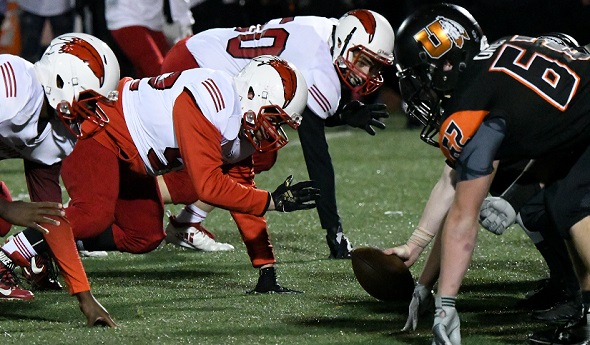
Chippewa Valley Leads Macomb Charge
By
Tom Markowski
Special for Second Half
November 8, 2018
CLINTON TOWNSHIP – Since winning the Division 2 title in 2001, Clinton Township Chippewa Valley has played in the shadow of traditional Macomb County powers Macomb Dakota, Romeo, Sterling Heights Stevenson and Utica Eisenhower.
 Before this season, Chippewa Valley’s record against those four schools over the last 17 years was 26-52. The Big Reds did own a 10-8 record against Stevenson, but twice Stevenson reached MHSAA Finals while Chippewa Valley’s best showing since its championship season was a Semifinal appearance in 2003.
That trend started to change in 2017 as Chippewa Valley went 4-1 against these teams (including a second win over Dakota in the playoffs). This season, the Big Reds took another step forward posting a 6-0 mark and capturing their first outright title in the Macomb Area Conference Red.
And for the first time in program history, Chippewa Valley is 11-0. The Big Reds were 9-0 in 1975, the first season the MHSAA sponsored state playoffs, but did not qualify for the postseason (only four teams in each of the four classifications were selected for the playoffs that first year).
Scott Merchant is in his 10th season as head coach at Chippewa Valley, and the Big Reds have made the playoffs eight times during his tenure. These past two seasons have been his best by far. Last season, Chippewa Valley finished 10-2 losing to Detroit Cass Tech, 32-26, in a Division 1 Regional Final.
Most expected a rematch of that game this week. But Dearborn Fordson (10-1) upset Cass Tech last week, 41-14, and Chippewa Valley will host Fordson in the Division 1 Region 4 Final at 7 p.m. Friday. The teams have met just once before – and that game, in 2003, also took place in a Regional Final with Chippewa Valley claiming a 30-12 victory.
Merchant’s team is experienced, confident and loaded with talent. He has four three-year starters and eight seniors starting on defense.
“Dakota set the bar for the whole conference,” Merchant said of Chippewa Valley’s sister school (both are in the Chippewa Valley school system) and biggest rival. “In the mid- to late 2000s they had like five or six Regional titles. Our streak of losing to Dakota started in ’04, and I didn’t get here until ‘09. It was huge for us to win in 2014. It was the first time we beat them in 10 years. That was a big weight being lifted.”
When a team loses so often to another, especially a rival, the losses and the years often run together. For the record, here’s how bad it got for the Big Reds:
Beginning with a 7-0 loss to Dakota in a Division 1 Regional Final in 2004, the Big Reds lost 16 consecutive games to Dakota, and only six of the 16 were by 10 or fewer points. A 28-27 victory in a 2014 District Final ended this streak.
One loss stung most. In 2013, both teams were 7-0 and state-ranked. Dakota won 52-7.
“To this day I can’t explain what happened,” Merchant said. “It was one of the most disappointing losses I’ve had. A lot of it was mental.”
The tables have turned. Chippewa Valley has won five of the last six in the series and is two wins this month from reaching what would be the program’s second MHSAA Final.
The Big Reds’ success last season gave the players confidence and also fed their appetite for more. The 2017 team scored a school-record 463 points, and this season Chippewa Valley has scored 445.
The productivity is similar, but the means by which the offense this season has been successful is different. There’s a difference in personality. Last year Chippewa Valley was more of a finesse team that concentrated on the passing game. This team is more physical and its offense is geared more for the run, which is often more effective in November playoff games.
 Quarterback Tommy Schuster is a three-year starter who threw for 3,100 yards over his first two seasons. His numbers (1,400 yards) are down a tad this season, but he’s thrown 20 touchdown passes and just one interception. Schuster also is carrying the ball more as he showed last week by rushing for 60 yards in the 51-10 victory over Dakota.
This added dimension has become a fine complement to the Big Reds’ top two running backs, Andre Chenault and Ja’Von Kimpson. Chenault is the team’s leading rusher with 888 yards and 13 touchdowns on 107 carries while Kimpson, who also starts at cornerback, is more of a featured back in 3rd down situations. He’s scored nine touchdowns rushing and one receiving.
“Our run game has been dominant all season,” Schuster said. “The offensive line has gotten better and better. It took a little time. They’re all (first-year) starters, and they’re confident now.”
Replacing the entire offensive line was the main concern for Merchant and his staff coming into this season. With just one senior, this group grew up fast. In the opener, Chippewa Valley trailed Saline 13-0 before the offense began to click and the Big Reds won 31-26. Senior captain Ryan Cyrowski, the center, is the leader and juniors Charles Wesley, the left tackle, and Donovan McBride, the right guard, have developed nicely. The Big Reds rushed for an-eye-popping 445 yards last week.
Merchant’s top two players could well be linebacker Marcel Lewis, who also sees time at tight end, and David Ellis. Ellis rarely comes off the field as he starts at receiver and defensive back and is a dangerous kick returner. He has 33 tackles on defense, five rushing touchdowns, six receiving scores, three more on kickoff returns and he’s returned a punt for a touchdown.
“We don’t have any weaknesses,” Schuster said. “This team, all year, hasn’t panicked. We’re ready for whatever happens. Last year’s team was like that, too. The reason we’ve been so successful (the past two seasons) is we have great players and great coaches.
“Playing quarterback on this team is a lot of fun. There’s so many options. If the run game isn’t working, we have no problem throwing the ball.
“I’ve grown up a lot over these three years. I’ve gotten to work on my speed, and I’m able to help the younger guys out too. It’s easier for me now. There’s nothing that’s new to me.”
The experience Schuster and many of his teammates have is a big reason Chippewa Valley has come out on top in a number of close games. In addition to the victory over Saline, the Big Reds held on to defeat Romeo (41-34) and Dakota (24-17) during the regular season. All three of those games were on the road.
“We’ve had way more close games this year than last,” Merchant said. “It’s been great to see the program grow.”
 Tom Markowski is a columnist and directs website coverage for the State Champs! Sports Network. He previously covered primarily high school sports for the The Detroit News from 1984-2014, focusing on the Detroit area and contributing to statewide coverage of football and basketball. Contact him at [email protected] with story ideas for Oakland, Macomb and Wayne counties.
PHOTOS: (Top) Chippewa Valley’s defensive front lines up against Utica during a 49-0 Week 9 win. (Middle) David Ellis (8) follows his blockers into an opening against Utica Eisenhower in a 34-7 first-round playoff victory. (Photos courtesy of the Chippewa Valley athletic department.)

1st & Goal: Playoff Week 1 Preview
October 29, 2020
By Geoff Kimmerly
Second Half editor
During a football season full of new and different this fall, this weekend will be right up there for first-time opportunities.
With the regular season shortened to six games because of COVID-19 precautions, tonight begins the first MHSAA Playoffs with nearly every team in the state taking part. And with more playoff games than ever before, this first round will see 15 games played Thursday night.
The 11-player bracket kicks off with District First Round games, while 8-player begins in the Regional First Round. Click for links to all 10 brackets and monitor the MHSAA Score Center all weekend for scores as they come in.
Spectator limits remain in effect (check with your local school for purchasing information). So if you can’t attend in person, check out one or more of 87 games being broadcast on MHSAA.tv or FOX Sports Detroit.
Let’s take a glance at a game that jumps out from each division this opening weekend. Games below are Friday unless noted.
11-Player
DIVISION 1
Lake Orion (3-2) at Grand Blanc (5-1)
The Bobcats haven’t reached the second round of the playoffs since 2012, but have seemed on the verge of taking a step – and last week’s 14-13 win over previously-undefeated Saline provided an indication the time may be now. Lake Orion had trouble with league rivals Clarkston and West Bloomfield this fall, but has to be one of the stronger five seeds – this District is topped by three undefeated teams.
Keep an eye on these FRIDAY Lapeer (3-3) at Davison (6-0), Utica Eisenhower (2-4) at Clinton Township Chippewa Valley (2-3). SATURDAY East Kentwood (2-3) at Hudsonville (4-2), Detroit Western (5-1) at Dearborn Fordson (4-2).
DIVISION 2
Grand Rapids Forest Hills Northern (4-2) vs. Grand Rapids Forest Hills Central (5-1) at Forest Hills Eastern
Everything looks to be going the Rangers’ way heading into this rematch, as they’ve won all five recent meetings with Forest Hills Northern – including 28-13 in Week 5 – and picked up a share of the Ottawa-Kent Conference White championship with Friday’s win over Lowell. But the Huskies are on a roll too; they’ve won their last four games, all by double digits, and also including a victory over the Red Arrows.
Keep an eye on these FRIDAY Lowell (3-3) at Byron Center (5-1), Warren De La Salle Collegiate (2-4) at Roseville (4-2), Ypsilanti Community (3-3) at Dearborn Heights Crestwood (5-1), Birmingham Groves (3-3) at Auburn Hills Avondale (3-3).
DIVISION 3
Trenton (3-3) at Allen Park (4-2)
These Downriver League rivals also have met in the playoffs the last two seasons. Allen Park won both of those games and also this regular season’s opener, 29-7. But that’s only half the history. Before this fall’s first meeting, Trenton had taken the last three during the regular season. Semi-related, both played Brownstown Woodhaven to nearly matching one-score losses over the last five weeks.
Keep an eye on these FRIDAY Parma Western (4-2) at Battle Creek Harper Creek (4-2), Sturgis (3-3) at Coldwater (4-2), Garden City (3-3) at South Lyon East (4-2), Gibraltar Carlson (4-2) at River Rouge (4-1).
DIVISION 4
Imlay City (4-2) at Croswell-Lexington (5-1)
This is a rematch of a season opener, won by the Pioneers 54-12. But the Spartans have gone on to guarantee their second-straight winning finish (after a string of mostly sub-.500 seasons over the last decade). That said, Croswell-Lexington was a seven-point loss to North Branch from a perfect regular season and league title – also a good improvement story after finishing 4-5 a year ago.
Keep an eye on these FRIDAY Ada Forest Hills Eastern (3-3) at Allendale (3-3), Plainwell (3-2) at Vicksburg (4-2), Armada (3-3) at Goodrich (5-1), Detroit Henry Ford (3-3) at Detroit Country Day (3-2).
DIVISION 5
Belding (5-1) at Hopkins (5-1), Saturday
This is among the most surprising first-round matchups, as these two played for the O-K Silver championship just three weeks ago. Chalk it up to being in a District that includes an unbeaten team and four at 5-1. The Vikings’ got the best of their first meeting with Belding, 34-28, but are coming back off a week off while the Black Knights went on to win their last two games by a combined 108-3.
Keep an eye on these FRIDAY Lake Odessa Lakewood (3-3) at Portland (5-1), South Haven (4-2) at Dowagiac (3-3), Hillsdale (4-2) at Olivet (5-1). SATURDAY Ogemaw Heights (3-3) at Kingsford (3-2).
DIVISION 6
Kent City (5-1) at Clare (6-0)
This is another big-time matchup for the first round, with third-seeded Clare the Jack Pine Conference champion and sixth-seeded Kent City the winner of the Central State Activities Association Silver title. The Eagles’ lone loss came in last week’s finale, 26-20 to Muskegon Orchard View, and they’ll surely be revved up play spoiler this time. But they’ll have to figure out a Pioneers defense giving up only 9.3 points per game in what could be a low-scoring one – Kent City gives up just 8.8 on average.
Keep an eye on these FRIDAY Negaunee (3-3) at Gladstone (2-3), Harrison (4-2) at Sanford Meridian (4-2), Comstock (3-3) at Niles Brandywine (3-3). SATURDAY Flint Hamady (3-3) at Detroit Pershing (3-3).
DIVISION 7
Houghton Lake (4-2) at Evart (4-2)
In just six games, Evart tied its win total from a year ago and best season since 2016. After opening 0-2, the Wildcats got rolling with a 29-22 win over Houghton Lake and now are seeking their first playoff win since 2012. The Bobcats are coming off a loss to undefeated Oscoda but still guaranteed to end with their third winning season in four years. Whoever comes out on top in this rematch will see Highland Conference champ McBain next week.
Keep an eye on these FRIDAY Morley Stanwood (4-2) at Ravenna (3-3), Hesperia (4-2) at Pewamo-Westphalia (5-1), Delton Kellogg (3-3) at Bronson (3-2), Jackson Lumen Christi (2-4) at Hanover-Horton (4-2).
DIVISION 8
Gwinn (3-3) at East Jordan (3-3)
One of these teams will end the night celebrating its first playoff win since 1999 – both are seeking to break a two-decade drought. After a fast start, East Jordan has had some troubles especially on offense the last two weeks – but with one more win, the Red Devils would equal their total from last season. Gwinn is a tough read because two wins came by forfeit. But a 22-14 loss two weeks ago to undefeated West Iron County is an indication the Modeltowners will be up for this challenge.
Keep an eye on these FRIDAY Frankfort (3-3) at Saginaw Nouvel (4-2), Marlette (3-3) at Unionville-Sebewaing (4-2), Saugatuck (3-3) at White Pigeon (3-2). SATURDAY Saginaw Michigan Lutheran Seminary (2-4) at Harbor Beach (3-3).
8-Player
DIVISION 1
Deckerville (4-2) at Merrill (5-1), Saturday
Deckerville had a few stumbles against the co-champions in its league, but few programs have done the playoffs better over the last decade – Deckerville is 16-7 during the postseason since moving to 8-player in 2012. Merrill is the latest new force in 8-player, not entirely surprising after back-to-back 6-4 finishes in 11-player the last two seasons, and will be looking to extend the run into its first playoff win since 2010.
Keep an eye on these THURSDAY Genesee (4-2) at Mayville (6-0). SATURDAY Newberry (3-3) at Onaway (6-0), International Academy of Flint (3-3) at Adrian Lenawee Christian (6-0), Camden-Frontier (2-4) at New Buffalo (3-3).
DIVISION 2
Lake Linden-Hubbell (3-3) at Crystal Falls Forest Park (4-1), Saturday
These longtime league and occasional playoff rivals in 11-player will face off for the first time in 8-player – and first time at all since 2015 since Lake Linden-Hubbell made the format switch this fall. The Lakes are 3-1 on the field and gave undefeated Powers North Central easily its closest game, falling 34-22 two weeks ago. Forest Park has played two games on the field, but both were wins over teams that entered the postseason with .500 records.
Keep an eye on these THURSDAY Rudyard (3-3) at Rapid River (5-1), Climax-Scotts (3-3) at Colon (5-1). SATURDAY Ashley (3-3) at Peck (3-3), Waldron (4-2) at Tekonsha (4-2).
PHOTO by Robert Batzloff.