

Cisco Recalled for Jefferson Greatness, Care for Kids & Staff Over Half-Century as Coach
By
Doug Donnelly
Special for MHSAA.com
October 1, 2026
Marc Cisco was a gruff old football coach who was intimidating and set in his ways.
 Not really.
In fact, to those who knew him, Cisco was more like a teddy bear who had passions for good football, watching student-athletes play the game right and spending time with his close circle of friends.
Cisco died Sept. 24 in Grand Rapids at the age of 90, leaving a legacy on high school football in southeast Michigan. He was best known for coaching the Monroe Jefferson varsity football team for a remarkable 47 years. His teams won 241 games, including the 1994 Class B championship in the Pontiac Silverdome.
“It appeared he was this mean old guy. He might yell at you, but he would be the first one to pat you on the back and tell you good job,” said one of his former players, Jeff Potter. “He really cared about his kids and nurtured his players. He was mostly a big teddy bear.”
Cisco made a career in education as a teacher and coach. In addition to coaching the Jefferson football team for 47 years, he coached track & field for almost as many seasons.
His son, Zeke, played for his father and was the Jefferson quarterback. Later, Zeke was a walk-on at the University of Nebraska. When Zeke was away at college and would come home for a visit each May, he would volunteer to work at the Jefferson Invitational track meet because that’s where he would find his dad.
“He was just a coach,” Zeke said. “My childhood was all about sports. If I wanted to see him in the fall, I had to go to practice. If I want to hang around with him in the winter, he kept score at basketball games, so I would go to the basketball games. He kept the scoreboard during wrestling meets. I usually would sit under his legs, underneath the scorers’ table. I would hit him in the legs a lot because he would get bored and forget to add the score on.
“He was nestled in the fabric of the high school in every way, shape or form.”
Niles Kruger, sports editor at The Monroe News, said when Zeke was at Nebraska, Marc Cisco was usually one of the first coaches every Friday to call in his stats and scores because he would be jumping in a car to drive to watch his son play.
“He was one of my favorite postgame interviews because he was always the same, win or lose,” Kruger said. “He was quite a character and pretty good at cussing. He would always say afterwards, ‘Clean that up for me.’”
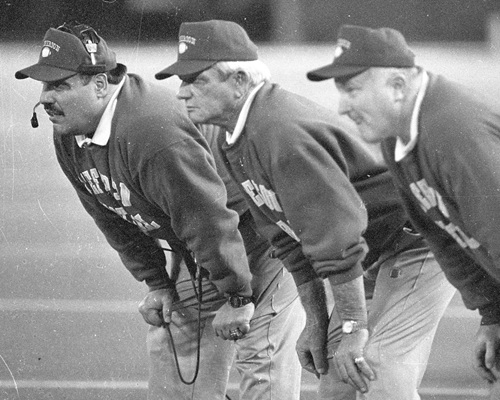
Cisco had a tremendous relationship with his assistant coaches. Several members of the Jefferson coaching staff were there for at least 40 of Cisco’s 47 years.
“His vacations, his fun things to do, were always with other coaches, their wives and their families,” Zeke Cisco said. “They would get together for card nights. They would go to Toledo Raceway (harness racing) Park. Pretty much every coach’s driveway, roof and deck were all built by the other coaches on the staff. They took care of each other.”
Cisco’s legacy includes an extended coaching tree filled with former players. Zeke has built a very successful program at Byron Center. Jason Gendron is the Gibraltar Carlson coach and in the middle of a tremendous run with the Marauders. Potter has coached at Ida for a decade and made that program a playoff regular.
“He was a big part of why I became a coach,” Potter said. “He was like a second family. My dad coached with him for 40 years. He was my Godfather. Our offense now is pretty much the same offense we ran in high school.”
Cisco had spent time in Florida after retiring but made his home in Reading near the Michigan-Indiana border the last few years.
“He would drive up to our games on Fridays,” Zeke said. “He would be in the parking lot at 3 o’clock.”
Marc had health issues over the last year, suffering from a stroke and congestive heart failure. He took a turn for the worse a little more than a week ago. He and his wife Donna, also a former coach at Jefferson, were together for more than 56 years. She survives.
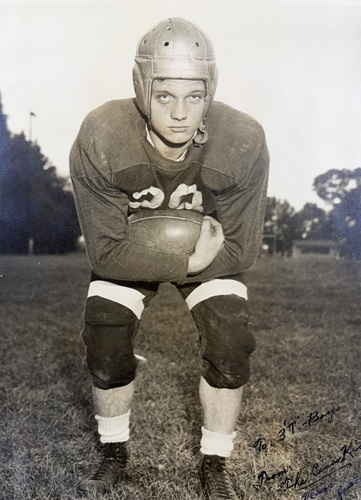
Marc Cisco was a legend long before he started blowing the coaching whistle. Growing up in Morenci, he earned 16 varsity letters – four each in football, basketball, baseball and track – before graduating in 1954. The Bulldogs football team won 44 straight games during his career, and he made The Associated Press all-state team three times.
Larry Tuttle, the winningest baseball coach in Michigan high school history, was a student at Morenci when Cisco was a player.
“I never missed one of his games because my mom and dad would go to all of them,” he said. “Later on, we became good friends. He was such a great football player.”
Cisco played football at Michigan State University under head coach Duffy Daugherty and later at the University of Toledo.
He got his teaching start at Britton Macon High School in Lenawee County, before moving closer to the banks of Lake Erie and Jefferson in 1961.
It was 1963 when Cisco first coached Jefferson, leading the varsity to a 4-3 season – the first of three straight winning campaigns. The tide turned in 1966 when Jefferson went 0-6. The team won seven games over the next three seasons before Cisco stepped down.
He regained the job in 1973 and stayed until 2012. He was the Bears’ varsity coach 41 years in all. From the time his 1983 team went 9-0 until the mid-2000s, Jefferson was a model of consistency, producing winner after winner. The 1993 team went 10-1, the 1994 team 12-1, and the 1999 team 11-2. It was the 1994 Bears that won the Class B title.
Zeke Cisco said when his father retired, it was rather unceremonious. There was no big announcement or celebration, although the school had much earlier renamed the football and track stadium after him.
“He just sort of stepped away,” he said. “He would come up here and watch his grandsons play.”
Marc Cisco never took himself or his wins too seriously.
“You know, I used to always give him hell,” Zeke said. “I'd call him and go, oh, ‘It's the winningest coach Monroe County.’ He goes, ‘I'm also the losingest coach in Monroe County.’”
 Doug Donnelly has served as a news and sports reporter at the Adrian Daily Telegram and the Monroe News for 30 years, including 10 years as city editor in Monroe. He's written a book on high school basketball in Monroe County and compiles record books for various schools in southeast Michigan. He is now publisher and editor of The Blissfield Advance, a weekly newspaper. E-mail him at [email protected] with story ideas for Jackson, Washtenaw, Hillsdale, Lenawee and Monroe counties.
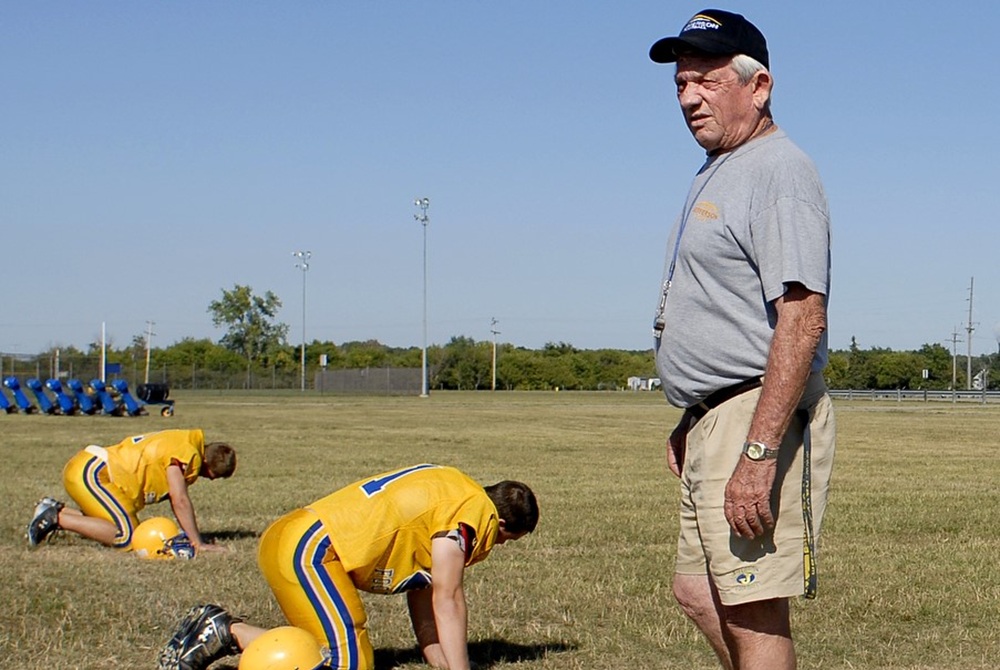
PHOTOS (Top) Marc Cisco coaches his Monroe Jefferson football team. (Middle) From left, John Castiglione, Cisco and Dave Potter monitor the action at the Silverdome during their team’s 1994 Class B Final. (Below) Cisco, while starring at Morenci. (Jefferson photos courtesy of the Monroe News. Morenci photo courtesy of Larry Tuttle.)
Thank Roosevelt for Football Weekends
December 20, 2013
By Rob Kaminski
MHSAA benchmarks editor
The next time you find yourself immersed in a tense crosstown football rivalry on a Friday night followed by a Saturday pilgrimage to the nearest college campus and a Sunday afternoon with a remote and your favorite snacks and beverages, take a moment to consider what the weekend would be like if it weren’t for Teddy Roosevelt.
The man who became our 26th President shortly after the turn of the 20th Century following the assassination of William McKinley in 1901 was a football fan like you. Maybe more so.
Today’s game of football has reached a critical crossroads. Player size and speed have increased across the board. Savage use of equipment as weapons rather than protective gear has been glorified on television networks and social media. Leaders of the game at all levels have recognized the need for change, employing new rules and widespread educational efforts to aid in preserving the sport.
History, as they say, is repeating itself.
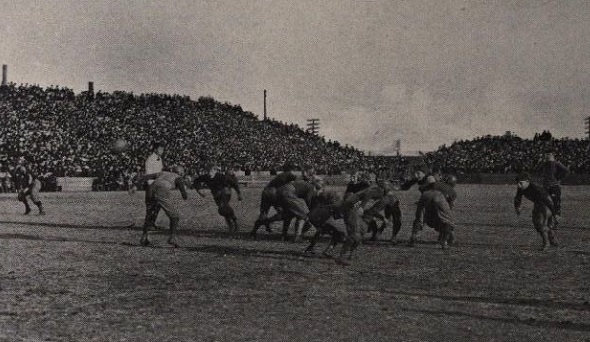
In an ironic twist, it was Roosevelt who saved the then-brutally violent game of football from itself more than 100 years ago. Yes, the same “Rough and Ready Teddy” who led the charge up San Juan Hill during the Spanish-American War and often sparred in the boxing ring while in office from 1901-09 opined that football was becoming so gruesome that he delivered an ultimatum: clean up the game or it would be outlawed.
The Chicago Tribune reported that in 1904 alone, there were 18 football deaths and 159 serious injuries, mostly among prep school players. Football deaths suffered by younger players were reported on a nearly weekly basis, as outraged citizens called on colleges and high schools to banish football outright.
In stepped Roosevelt, who called head coaches and representatives from Harvard, Yale and Princeton – college powers at the time – to the White House in 1905 urging them to eliminate excessive violence and set an example of fair play for the rest of the country. When the casualties actually rose by one during the ensuing season, Roosevelt reacted with greater resolve and convened leading football authorities for the purpose of authoring drastic rules changes. What emerged was an intercollegiate conference which was the predecessor of the NCAA.
Among the most effective changes for the 1906 season were the legalization of the forward pass, the elimination of mass formations, and the creation of a neutral zone. Football fatalities fell to 11 in each of the next two seasons, and severe injuries fell drastically.
Thanks to the introduction of protective equipment and ever-evolving rules changes, football during the 100-plus years to follow has become an exponentially safer game. Yet, the game’s leaders always will need to adjust and react to scrutiny that comes with the territory.
So, as the game once again undergoes rules modifications in the name of safety, give a tip of the cap to President Roosevelt while you enjoy college bowl season and the NFL playoffs and begin to think ahead to the first high school practice of 2014.