


Clarkston Kicker Grabs QB Opportunity
By
Tom Markowski
Special for Second Half
October 13, 2015
CLARKSTON – This season seemed to be going from bad to worse for Clarkston.
The Wolves were blitzed by Macomb Dakota, 35-10, in the opener and in their third game were tied 14-14 with West Bloomfield when starting quarterback Anthony Reiner suffered a broken hand.
 The two-time defending Division 1 champion went on to lose that game, 35-21, to fall to 1-2.
As poorly as Clarkston started the season, its fortunes changed. Alex Kessman, a senior who will in all likelihood be a place kicker at a Division I college next season, got an opportunity he really didn’t expect.
Kessman hadn’t played quarterback since the ninth grade, when he led Clarkston’s freshmen team to an undefeated season. When Reiner went out last month, coach Kurt Richardson went to Kessman – and he’s responded as if he was an experienced quarterback.
Kessman couldn’t rescue Clarkston against West Bloomfield, but the Wolves are 4-0 since with Kessman as the starter. He’s thrown seven touchdown passes including three in a 28-0 over Troy Athens.
If Kessman wasn’t such a fine place kicker and punter he likely would have started the season at quarterback. Instead he was in the secondary, kicked and was Reiner’s backup.
 “We wanted to groom (Kessman) during the summer but he was always at kicking camps,” Richardson said. “The other guy was working real hard and we went with (Reiner).
“When Anthony got hurt it was a natural thing. I told him he was our best quarterback. At first it didn’t come quick. He’s gotten better every week. He’s got a very strong arm. We still run the same offense. We’re throwing more (with Kessman).”
Kessman no longer plays defense but he is still kicking, and kicking well. He kicked a 56-yard field goal against Dakota and has since kicked one from 53 yards out.
Kessman made his third visit to University of Pittsburgh last weekend and said the Panthers are at the top of his college list at this point. Mississippi State has offered Kessman preferred walk-on status and other schools such as Michigan, Florida and Tennessee also are in the mix.
Physically, Kessman is not your typical kicker. He’s 6-3 and weighs 185 pounds. He played basketball until his sophomore year, when he decided to concentrate on his kicking.
Kessman started playing football in the seventh grade and was a kicker even back then. As a sophomore he played safety and kicked as a member of the junior varsity. Last season Kessman was the punter and place kicker on varsity but did not play defense.
Now he’s showing he’s more than just a kicker, at least at this level.
“I wasn’t really rusty,” he said. “I was prepared if Anthony went down. I didn’t practice a lot (at quarterback). I threw occasionally. The first couple of plays I was nervous. I got comfortable. It was at halftime of the West Bloomfield game. Thanks to my teammates I have no trouble getting comfortable now.”
As one would guess, one of his biggest challenges was learning an extensive playbook. Richardson’s quarterbacks have much responsibility making proper decisions on read option plays and checking down on second and third receivers.
“I know the ins and outs now,” Kessman said. “That comes from off-the-field stuff. I put a lot of time in on my own. The toughest part is reading the corners and reading the safeties.”
Clarkston is averaging 40 points a game in Kessman’s four starts but it would be unfair to give him all the credit. The five offensive linemen who started in last season’s MHSAA Final graduated, and Clarkston is starting three underclassmen up front including two sophomores. The line struggled early on, but is playing much better now.
Then there’s Nolan Eriksen, a senior running back. Eriksen suffered a high ankle sprain in Clarkston’s inter-squad game during the preseason and made his season debut against Troy Athens. He scored four touchdowns in last week’s 42-0 victory over Troy.
“Eriksen is obviously fantastic,” Kessman said. “I know when I hand it off to him he’ll get at least five yards or take it all the way.”
 Tom Markowski is a columnist and directs website coverage for the State Champs! Sports Network. He previously covered primarily high school sports for the The Detroit News from 1984-2014, focusing on the Detroit area and contributing to statewide coverage of football and basketball. Contact him at [email protected] with story ideas for Oakland, Macomb and Wayne counties.
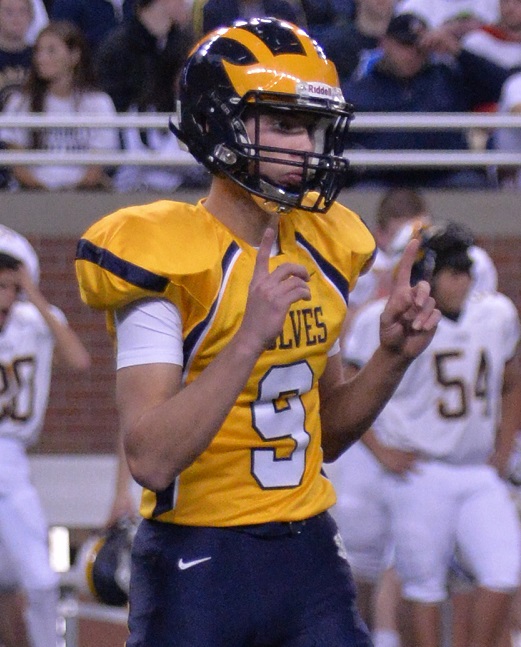
PHOTOS: (Top) Clarkston’s Alex Kessman lines up for a punt during last season’s Division 1 Final at Ford Field (Middle) Kessman signals before another punt. (Below) Kessman is considered a Division I college prospect as a kicker.
A Game for Every Fan: Week 5
September 20, 2012
By Geoff Kimmerly
Second Half editor
Some of the strongest followings of high school football in this state take place in some of our smallest communities.
And some of Michigan's smallest towns should see some of the best games of this week, the midpoint of the 2012 regular season.
See below for this observer's picks of the best matchups from your corner of the state. And remember to visit the MHSAA Score Center all weekend for updated scores and standings.
(All are tonight unless noted. Go to Score Center for additional dates and kickoff times.)
Bay and Thumb
Vassar (4-0) at Reese (4-0)
A move into the Greater Thumb Conference West five years ago, from the Tri-Valley Conference East, has paid off for Vassar. The Vulcans are 30-14 in that time, including a 4-0 start this fall during which they’ve outscored opponents 127-6. The only league team they haven’t beaten since the move: Reese, which handed Vassar its only GTC West losses the last two seasons and is averaging 45 points per game.
Others that caught my eye: Merrill (2-2) at Carrollton (4-0), Saginaw Swan Valley (4-0) at Freeland (3-1), Mount Pleasant (2-2) at Midland (4-0), Essexville Garber (3-1) at Millington (3-1).
Greater Detroit
Livonia Churchill (4-0) at Canton (3-1)
Churchill is lining itself up well for its best season in decades. The Chargers have the most playoff points in the state through four games, have scored at least 35 points in each, and with a another win over Canton – Churchill beat the Chiefs by a point last season – the Chargers will be heavy favorites to win their first league championship since 1979. What about Canton? Its only loss this season was by a point to undefeated Midland.
Others that caught my eye: Detroit Cass Tech (4-0) at Orchard Lake St. Mary (3-1), Farmington (4-0) at Oak Park (4-0), Warren Michigan Collegiate (4-0) at Detroit University Prep (4-0), Wyandotte Roosevelt (4-0) at Taylor Truman (4-0).
Upper Peninsula
Cedarville (4-0) at Eben Junction Superior Central (4-0)
In no other division is the importance of playoff points as cut and dried as in 8-player. The top 16 teams, based on playoff points, make the postseason. Simple as that. These two are in fine shape so far; Cedarville is second only to Portland St. Patrick in points, and Superior Center is third. And they’re also two of three 4-0 teams atop the Bridge 8-Man Football Alliance (Rapid River is the third.). Cedarville and Rapid River shared the title in 2011.
Others that caught my eye: Powers North Central (3-1) at Crystal Falls Forest Park (4-0), Iron Mountain (2-2) at Ishpeming Westwood (2-2), Hurley, Wis (2-2) at Bessemer (3-1), Engadine (2-1) at Rapid River (4-0).
Southwest and Border
Watervliet (4-0) at Hartford (4-0)
No league’s teams have enjoyed more nonconference success than the members of the Southwestern Athletic Conference South. Five of the six have started the season 4-0, with these two perhaps the most impressive so far. Watervliet has followed its 10-win season of last fall by outscoring its first opponents in 2012 by a combined 204-13. Hartford hasn’t been far behind that pace, winning all of its games by at least 28 points.
Others that caught my eye: Lawton (4-0) at Decatur (4-0), Three Rivers (3-1) at Edwardsburg (3-1), St. Joseph (3-1) at Portage Central (3-1), Stevensville Lakeshore (4-0) at Niles (3-1).
West Michigan
Whitehall (2-2) at Montague (3-1)
These West Michigan Conference rivals have played annually for the “Bell” since 1906, with Montague winning the last five meetings. Despite a big loss to Muskegon Oakridge, the Wildcats have won their other three games this fall by a combined score of 152-0. But don’t count out Whitehall; after a 2-0 start, its losses were by eight and four points to Shelby and North Muskegon the last two weeks, respectively.
Others that caught my eye: Caledonia (4-0) at Grand Rapids Christian (3-1), East Grand Rapids (2-2) vs. Grand Rapids Forest Hills Central (3-1) at Fifth Third Ballpark, Hudsonville Unity Christian (2-2) at Grand Rapids South Christian (3-1), Muskegon Oakridge (4-0) at Ravenna (2-2).
Mid-Michigan
DeWitt (3-1) at St. Johns (4-0)
Both coming off of one-point wins last week, these Capital Area Activities Conference Red rivals either will be worn down, or more likely raring to go against what has arguably become the biggest rival for both. These teams haven’t had to play this many close games in a while, and this one should be tight too – all four Redwings wins this season have come by six or fewer points, and DeWitt has scored as many as it has given up. The Panthers hold a 4-3 edge since the series was renewed in 2005.
Others that caught my eye: East Lansing (4-0) at Holt (2-2), Charlotte (2-2) at Mason (4-0), Portland (4-0) at Williamston (3-1), Comstock Park (3-1) at Belding (2-2).
Lower Up North
Pellston (4-0) at Pickford (4-0)
Pellston is arguably the biggest surprise of the northern Lower Peninsula – the Hornets had won a combined four games over the last three seasons, and last won four in one season in 2002. But Pickford also has to be excited about its best start since 2005, especially in its first season in the Ski Valley Conference, which added teams and split into the North and South this fall. The Panthers are just two more wins from their first playoff berth since 2007.
Others that caught my eye: Traverse City Central (3-1) at West Branch Ogemaw Heights (2-2), Onaway (4-0) at Mancelona (4-0), Lake City (4-0) at McBain (2-2), Boyne City (4-0) at Traverse City St. Francis (2-2).
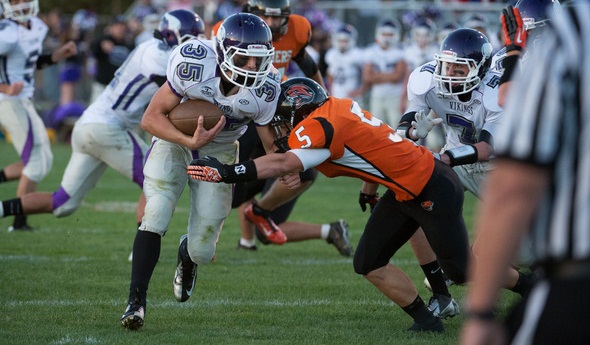
PHOTO: Saginaw Swan Valley (white jerseys) defeated Alma last week to remain atop the Tri-Valley Conference Central standings. (Click to see more from HighSchoolSportsScene.com.)