


Clarkston Kicker Grabs QB Opportunity
By
Tom Markowski
Special for Second Half
October 13, 2015
CLARKSTON – This season seemed to be going from bad to worse for Clarkston.
The Wolves were blitzed by Macomb Dakota, 35-10, in the opener and in their third game were tied 14-14 with West Bloomfield when starting quarterback Anthony Reiner suffered a broken hand.
 The two-time defending Division 1 champion went on to lose that game, 35-21, to fall to 1-2.
As poorly as Clarkston started the season, its fortunes changed. Alex Kessman, a senior who will in all likelihood be a place kicker at a Division I college next season, got an opportunity he really didn’t expect.
Kessman hadn’t played quarterback since the ninth grade, when he led Clarkston’s freshmen team to an undefeated season. When Reiner went out last month, coach Kurt Richardson went to Kessman – and he’s responded as if he was an experienced quarterback.
Kessman couldn’t rescue Clarkston against West Bloomfield, but the Wolves are 4-0 since with Kessman as the starter. He’s thrown seven touchdown passes including three in a 28-0 over Troy Athens.
If Kessman wasn’t such a fine place kicker and punter he likely would have started the season at quarterback. Instead he was in the secondary, kicked and was Reiner’s backup.
 “We wanted to groom (Kessman) during the summer but he was always at kicking camps,” Richardson said. “The other guy was working real hard and we went with (Reiner).
“When Anthony got hurt it was a natural thing. I told him he was our best quarterback. At first it didn’t come quick. He’s gotten better every week. He’s got a very strong arm. We still run the same offense. We’re throwing more (with Kessman).”
Kessman no longer plays defense but he is still kicking, and kicking well. He kicked a 56-yard field goal against Dakota and has since kicked one from 53 yards out.
Kessman made his third visit to University of Pittsburgh last weekend and said the Panthers are at the top of his college list at this point. Mississippi State has offered Kessman preferred walk-on status and other schools such as Michigan, Florida and Tennessee also are in the mix.
Physically, Kessman is not your typical kicker. He’s 6-3 and weighs 185 pounds. He played basketball until his sophomore year, when he decided to concentrate on his kicking.
Kessman started playing football in the seventh grade and was a kicker even back then. As a sophomore he played safety and kicked as a member of the junior varsity. Last season Kessman was the punter and place kicker on varsity but did not play defense.
Now he’s showing he’s more than just a kicker, at least at this level.
“I wasn’t really rusty,” he said. “I was prepared if Anthony went down. I didn’t practice a lot (at quarterback). I threw occasionally. The first couple of plays I was nervous. I got comfortable. It was at halftime of the West Bloomfield game. Thanks to my teammates I have no trouble getting comfortable now.”
As one would guess, one of his biggest challenges was learning an extensive playbook. Richardson’s quarterbacks have much responsibility making proper decisions on read option plays and checking down on second and third receivers.
“I know the ins and outs now,” Kessman said. “That comes from off-the-field stuff. I put a lot of time in on my own. The toughest part is reading the corners and reading the safeties.”
Clarkston is averaging 40 points a game in Kessman’s four starts but it would be unfair to give him all the credit. The five offensive linemen who started in last season’s MHSAA Final graduated, and Clarkston is starting three underclassmen up front including two sophomores. The line struggled early on, but is playing much better now.
Then there’s Nolan Eriksen, a senior running back. Eriksen suffered a high ankle sprain in Clarkston’s inter-squad game during the preseason and made his season debut against Troy Athens. He scored four touchdowns in last week’s 42-0 victory over Troy.
“Eriksen is obviously fantastic,” Kessman said. “I know when I hand it off to him he’ll get at least five yards or take it all the way.”
 Tom Markowski is a columnist and directs website coverage for the State Champs! Sports Network. He previously covered primarily high school sports for the The Detroit News from 1984-2014, focusing on the Detroit area and contributing to statewide coverage of football and basketball. Contact him at [email protected] with story ideas for Oakland, Macomb and Wayne counties.
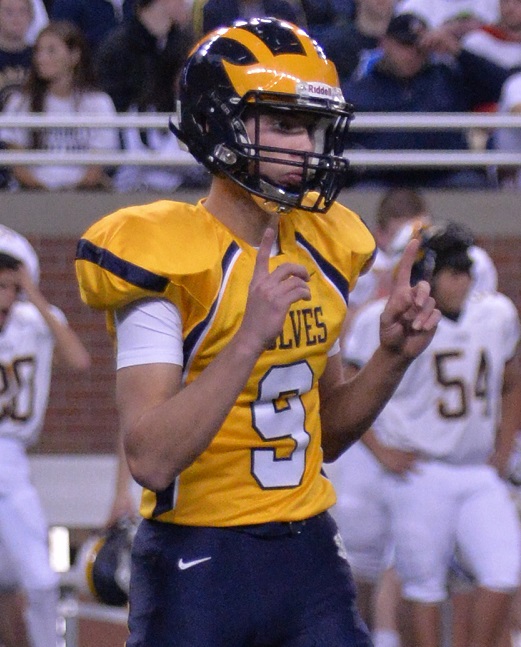
PHOTOS: (Top) Clarkston’s Alex Kessman lines up for a punt during last season’s Division 1 Final at Ford Field (Middle) Kessman signals before another punt. (Below) Kessman is considered a Division I college prospect as a kicker.
Rapid River Rumbles to History-Making Finish
November 17, 2018
By Geoff Kimmerly
Second Half editor
MARQUETTE – Since the opening kickoff of 8-Player Football Playoffs in 2011, Rapid River has been on the verge of winning its first MHSAA Finals championship in this sport.
In that first year’s title game, also at Northern Michigan University’s Superior Dome, the Rockets fell to Carsonville-Port Sanilac. The next year saw a Semifinal run. And then in 2013 at Greenville’s Legacy Field, another title game defeat, to Peck.
Four seasons of earlier-round playoff losses followed. But all of those are more distant memories after Saturday.
Rapid River hoisted its first championship trophy in football after a 30-18 win over Onekama back at the Superior Dome in the 8-Player Division 2 Final.
“It’s my senior year. Our coach has been here twice, but never won it. To get him one before he would retire … (we) did it for all the people on my team,” Rockets senior Gunner Larson said. “Just an amazing experience. Gotta go for the ride.”
Just a quick note: Rapid River coach Steven Ostrenga didn’t announce his retirement after his 20th season running the program came to a close. But Larson and his teammates know it will happen someday – but now without the “what if” of just missing out on a championship.
Rapid River and Onekama both earned their first trophies of 2018 during the playoffs after both finished third in their respective leagues, Onekama behind two contenders for the Division 1 title and Rapid River behind Division 1 runner-up Pickford and Engadine, which the Rockets then beat in the first round by two points after falling to the Eagles by 18 only two weeks prior.
And Rapid River certainly played like a champion Saturday, relying on its strengths especially up front to outgain Onekama 341-212 in yardage – but more importantly, hold onto the ball for 33½ minutes to the Portagers’ 14:30.
The Rockets ran 66 times for 305 yards as a team, with junior Tyler Sundling gaining 123 and scoring two touchdowns and Larson running for 107 and a score. Senior quarterback Brent Lundquist tossed a 14-yard touchdown pass to senior Nate Olson during a change of pace.
Rapid River carried a 22-8 lead into the fourth quarter and held on despite two Onekama scores over the final 12 minutes.
“We’ve never given up that many yards rushing and that many points,” said Onekama coach John Neph, whose defense was allowing only 8.1 points per game entering the day. “So I think that speaks to the quality of the Rapid River offensive line and their backs. They’re flying around and doing some good things defensively, and that was a huge difference.
“We never thought we were out of the game till maybe the last touchdown there that the Rockets had. We hung in and hung in, and the offense kinda left the defense out there way too long. (And) the conversions they could get on third and fourth down were just critical to keep the drives going.”
 Rapid River didn’t have a turnover and only six penalties. Onekama had five penalties but also lost two fumbles. And those Rockets conversions clearly were difference makers; Rapid River was 10 of 17 on third down and 4 of 6 on fourth, while Onekama was 4 of 10 on third downs and didn’t have a fourth down try.
“Every team that we have is unique. We had a lot of good football teams; other teams were just a little bit better than us in those games,” Ostrenga said of past playoff trips. “We made some mistakes today, but we were almost mistake-free. And that’s the key.”
He threw plenty of credit to his assistants for getting the team ready, to his linemen for their work up front, and to a host of other coaches – including one in basketball – who had influenced and taught him some things over the years. Ostrenga also has led his share of champions, including eight Upper Peninsula Finals winners in boys track & field.
And at the same time Saturday, it felt like Onekama could be following a similar path and only a few steps behind.
This championship game was the first in football for the Portagers, who are 19-5 over two seasons in 8-player after making the playoffs their last three seasons with 11 on the field.
Onekama will graduate some key contributors including running back/linebacker Ben Acton, who ran for 78 yards and a touchdown and also had a team-high 16 tackles including three for losses.
But the Portagers should also bring back 14 of 19 players next fall, including junior quarterback Luke Mauntler (188 yards, two touchdown passes Saturday) and junior tight end Wade Sedlar, who with senior tight end Rylan Clarke caught those scoring tosses.
Juniors Matthew Mallison and Taylor Bennett followed Acton with 15 and 13 tackles, respectively.
“We have five seniors, but we do have 11 juniors coming back,” Neph said. “So we’re hoping we can replicate this. It’s absolutely tasking on a team to repeat and get this far. There’s some outstanding teams we were able to overcome to get this far. We’d love to come here again, but it’s going to be a ton of hard work and effort moving forward.
“But again, this is an historic season for our program. The guys going to the state finals was just a dream come true for all of us.”
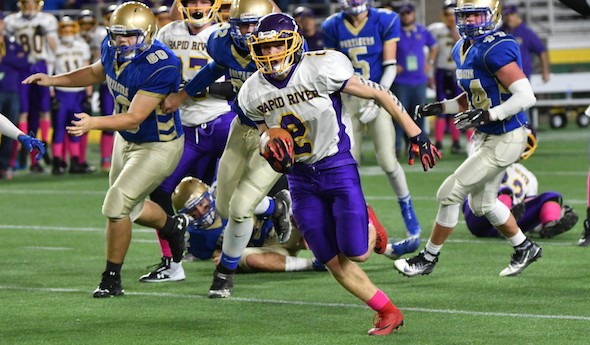
PHOTOS: (Top) Rapid River's Tyler Sundling (2) breaks several tackles and scores a touchdown Saturday. (Middle) Rapid River's Gunner Larson (33) is taken down by Onekama's Luke Mauntler (7) and Ben Johnson (12). (Photos by Cara Kamps.)