


Clarkston Kicker Grabs QB Opportunity
By
Tom Markowski
Special for Second Half
October 13, 2015
CLARKSTON – This season seemed to be going from bad to worse for Clarkston.
The Wolves were blitzed by Macomb Dakota, 35-10, in the opener and in their third game were tied 14-14 with West Bloomfield when starting quarterback Anthony Reiner suffered a broken hand.
 The two-time defending Division 1 champion went on to lose that game, 35-21, to fall to 1-2.
As poorly as Clarkston started the season, its fortunes changed. Alex Kessman, a senior who will in all likelihood be a place kicker at a Division I college next season, got an opportunity he really didn’t expect.
Kessman hadn’t played quarterback since the ninth grade, when he led Clarkston’s freshmen team to an undefeated season. When Reiner went out last month, coach Kurt Richardson went to Kessman – and he’s responded as if he was an experienced quarterback.
Kessman couldn’t rescue Clarkston against West Bloomfield, but the Wolves are 4-0 since with Kessman as the starter. He’s thrown seven touchdown passes including three in a 28-0 over Troy Athens.
If Kessman wasn’t such a fine place kicker and punter he likely would have started the season at quarterback. Instead he was in the secondary, kicked and was Reiner’s backup.
 “We wanted to groom (Kessman) during the summer but he was always at kicking camps,” Richardson said. “The other guy was working real hard and we went with (Reiner).
“When Anthony got hurt it was a natural thing. I told him he was our best quarterback. At first it didn’t come quick. He’s gotten better every week. He’s got a very strong arm. We still run the same offense. We’re throwing more (with Kessman).”
Kessman no longer plays defense but he is still kicking, and kicking well. He kicked a 56-yard field goal against Dakota and has since kicked one from 53 yards out.
Kessman made his third visit to University of Pittsburgh last weekend and said the Panthers are at the top of his college list at this point. Mississippi State has offered Kessman preferred walk-on status and other schools such as Michigan, Florida and Tennessee also are in the mix.
Physically, Kessman is not your typical kicker. He’s 6-3 and weighs 185 pounds. He played basketball until his sophomore year, when he decided to concentrate on his kicking.
Kessman started playing football in the seventh grade and was a kicker even back then. As a sophomore he played safety and kicked as a member of the junior varsity. Last season Kessman was the punter and place kicker on varsity but did not play defense.
Now he’s showing he’s more than just a kicker, at least at this level.
“I wasn’t really rusty,” he said. “I was prepared if Anthony went down. I didn’t practice a lot (at quarterback). I threw occasionally. The first couple of plays I was nervous. I got comfortable. It was at halftime of the West Bloomfield game. Thanks to my teammates I have no trouble getting comfortable now.”
As one would guess, one of his biggest challenges was learning an extensive playbook. Richardson’s quarterbacks have much responsibility making proper decisions on read option plays and checking down on second and third receivers.
“I know the ins and outs now,” Kessman said. “That comes from off-the-field stuff. I put a lot of time in on my own. The toughest part is reading the corners and reading the safeties.”
Clarkston is averaging 40 points a game in Kessman’s four starts but it would be unfair to give him all the credit. The five offensive linemen who started in last season’s MHSAA Final graduated, and Clarkston is starting three underclassmen up front including two sophomores. The line struggled early on, but is playing much better now.
Then there’s Nolan Eriksen, a senior running back. Eriksen suffered a high ankle sprain in Clarkston’s inter-squad game during the preseason and made his season debut against Troy Athens. He scored four touchdowns in last week’s 42-0 victory over Troy.
“Eriksen is obviously fantastic,” Kessman said. “I know when I hand it off to him he’ll get at least five yards or take it all the way.”
 Tom Markowski is a columnist and directs website coverage for the State Champs! Sports Network. He previously covered primarily high school sports for the The Detroit News from 1984-2014, focusing on the Detroit area and contributing to statewide coverage of football and basketball. Contact him at [email protected] with story ideas for Oakland, Macomb and Wayne counties.
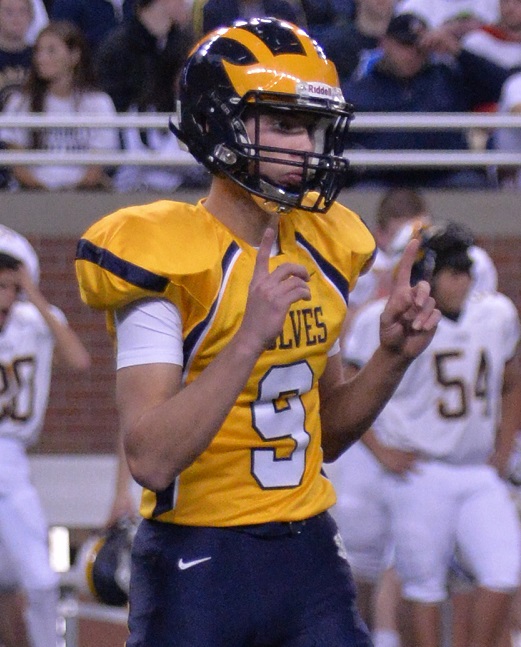
PHOTOS: (Top) Clarkston’s Alex Kessman lines up for a punt during last season’s Division 1 Final at Ford Field (Middle) Kessman signals before another punt. (Below) Kessman is considered a Division I college prospect as a kicker.
Performance: Muskegon's La'Darius Jefferson
November 29, 2017
 La’Darius Jefferson
Muskegon senior – Football
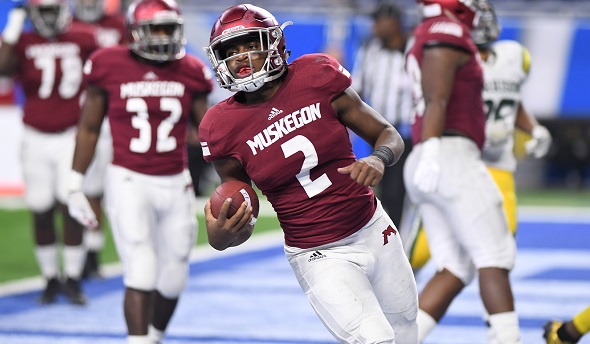
Muskegon’s 6-foot-2, 215-pound quarterback ran 32 times for 247 yards and four touchdowns to lead the Big Reds to a 28-10 win over Farmington Hills Harrison in Saturday’s Division 3 Final, earning Jefferson the Michigan Army National Guard “Performance of the Week.” The championship was Muskegon’s first since 2008 and came after the Big Reds fell by a point to Orchard Lake St. Mary’s in the 2016 championship game – when the Eaglets scored with four seconds to play.
Jefferson, who also celebrated his 18th birthday Saturday, finished this season with 2,097 yards and 33 touchdowns rushing and 1,205 yards and 21 touchdowns passing. His rushing touchdown total will make the MHSAA record book, and his performance Saturday earned four entries for accomplishments in a championship game. After splitting time at quarterback as a junior – and running for two touchdowns in the 2016 Final – Jefferson led arguably the best team in the state, regardless of division. The Big Reds scored 722 points, which rank third-most in state history, averaging 51.2 per game, which ranks 10th. Their average margin of victory was 45 points, and they outscored their five playoff opponents by a combined 221-36.
 Individual awards are piling up for Jefferson, who was named Division 3-4 Player of the Year by The Associated Press and statewide Michigan High School Football Player of the Year by MLive. He previously had committed to continue his football and academic careers at University of Central Florida, but has re-opened his recruiting with Michigan State and Georgia Tech among those recruiting him hardest. Jefferson, who also ran track last spring, has big plans aside from football; he carries a 3.4 cumulative grade-point average and is a member of National Honor Society, and he plans to study aerospace engineering wherever he ends up.
Coach Shane Fairfield said: “He is just a selfless kid that loves to win, that loves family. He’s driven by the relationships in his home. And he loves his teammates. And he was more vocal and determined this week to get this win, because his biggest thing is he wants all the kids who aren’t going to have the chance to experience what he’s going to experience after he graduates to have some type of experience that they can say either, ‘Hey, I played with La’Darius’ or ‘I won a state championship when I was in high school.’ And that’s it – he’s very aware of how lucky and fortunate he is to be in the position he is, and he just wants to share that with all of his teammates.”
Performance Point: “It’s amazing. It’s something people dream of,” Jefferson said. “People dream about scoring the last touchdown in their backyard, making the final hoop. It’s a blessing. I’m trying to hold my tears in. We worked so hard to get here. We’ve been gassed and pounded. It’s so special. … This is the best thing that’s ever happened to me besides my family.”
Team of destiny: “It’s something these boys have been dreaming about. I kid you not; I told Eli Jackson, 44, our eighth grade year that we were going to win it. I mean, we’re here.”
Motivated Muskegon: “We had a chip on our shoulder until (the clock) was zero-zero. We weren’t done. We had a chip on our shoulder all year. Everybody we played, we said we’re going to punish. … Everybody doubted us. Everybody said we lost Kalil Pimpleton, one of the best players in the state (who played this fall at Virginia Tech). We lost JaCorey Sullivan (Central Michigan) … Andrew Ward (Nebraska), one of the best defensive players in the state last year. We lost them big boys up front. So we overcame.”
 Checkmate: “I’ve been more humble (this season). I enjoy the moment. I feel like last year it was an amp moment; I wasn’t feeling it. I told myself, it’s all I’ve got. It’s my last job. I go through every day and I do a checklist. As a kid I dreamed about winning player of the year and breaking records and doing all this, and I did all that. The final checklist was win a state championship, and I can go home and check that off.”
Soaring on and off the field: “I know I want to be a successful young man beyond football. I want to go to college and study aerospace engineering, get my degree and help provide for my family. I’ve got goals beyond football. I thought as a kid that football was the only thing that I had, (but) I can do without football. I’m a great student. I work hard; I work my butt off in the classroom. I want to build planes. Who don’t want to build planes? Who don’t want to be like, ‘Oh, La’Darius built this big machine that’s flying?’ It’s cool; it’s unique.”
- Geoff Kimmerly, Second Half editor
Every week during the 2017-18 school year, Second Half and the Michigan Army National Guard will recognize a “Performance of the Week" from among the MHSAA's 750 member high schools.
The Michigan Army National Guard provides trained and ready forces in support of the National Military Strategy, and responds as needed to state, local, and regional emergencies to ensure peace, order, and public safety. The Guard adds value to our communities through continuous interaction. National Guard soldiers are part of the local community. Guardsmen typically train one weekend per month and two weeks in the summer. This training maintains readiness when needed, be it either to defend our nation's freedom or protect lives and property of Michigan citizens during a local natural disaster.
Previous 2017-18 honorees:
November 23: Ashley Turak, Farmington Hills Harrison swimming - Read
November 16: Bryce Veasley, West Bloomfield football - Read
November 9: Jose Penaloza, Holland soccer - Read
November 2: Karenna Duffey, Macomb L'Anse Creuse North cross country - Read
October 26: Anika Dy, Traverse City Central golf - Read
October 19: Andrew Zhang, Bloomfield Hills tennis - Read
October 12: Nolan Fugate, Grand Rapids Catholic Central football - Read
October 5: Marissa Ackerman, Munising tennis - Read
September 28: Minh Le, Portage Central soccer - Read
September 21: Olivia Theis, Lansing Catholic cross country - Read
September 14: Maddy Chinn, Pontiac Notre Dame Prep volleyball - Read
PHOTOS: (Top) La'Darius Jefferson crosses into the end zone for one of his four touchdowns during the Division 3 Final on Saturday at Ford Field. (Middle) Jefferson breaks into an opening while Harrison defenders pursue.