

Clarkston Surges by Kicking it Forward
By
Tom Markowski
Special for Second Half
October 27, 2016
CLARKSTON – Coach Kurt Richardson held a disdain for kickers. He didn’t trust them. He contends that a poor kicking game cost his Clarkston football team the 2000 Division 1 Semifinal, a 17-15 loss to eventual champion Grand Ledge.
 Three years before, Clarkston had lost one-point games to Rochester (20-19) and Troy (21-20) that cost the Wolves an opportunity to play in the playoffs. Again, the kicking game had let him down.
“We didn’t have kickers,” Richardson said. “We made kickers. We tried a soccer player once back then, and it didn’t work.”
Enter the Breen brothers, Andrew and Ryan. Andrew Breen was Clarkston’s kicker in 2003. Ryan Breen followed and was the kicker in 2005 and 2006. Maybe it’s a coincidence, but Clarkston hasn’t missed the playoffs since 2002. You won’t get Richardson to say that.
Andrew Breen went on to kick for Tiffin University (Ohio), and every place-kicker since has gone on to college as a kicker – including his brother, Ryan, who went to Penn State.
The others include Alex Barta, who went on to kick for the U.S. Naval Academy. Then there’s Shane Hynes, the place-kicker on the 2013 Division 1 championship team, who is currently Kent State’s place-kicker. Alex Kessman was the place-kicker on the 2014 Division 1 title team, and he’s at Pittsburgh after graduating from high school this past June.
Zach Mansour is Clarkston’s place-kicker this season. And although he hasn’t decided what college he will attend next year, rest assured Mansour will be on a roster somewhere, whether it’s at the Division I level or below.
“Andrew kind of broke up the ice,” Richardson said. “It’s made a big difference. What also comes out of making field goals and having good kickers is now we’re kicking the ball in the end zone and teams are starting from their 20.”
Ryan Breen doesn’t remember exactly when it happened, but his life changed when he was a freshman at Clarkston High.
Breen and his brother were soccer players throughout their childhood. Then his freshman year his brother was a senior and Clarkston’s kicker, and something clicked. Ryan was just having fun working with his brother, shagging footballs, when he got the urge to try it.
Something clicked for the Clarkston football program as well.
“Coach Kurt realized, after a while, that kicking is so much part of the game,” Ryan Breen said. “He started to trust me my junior and senior years. He’d been let down so much (by kickers). It’s frustrating.
“It opened his eyes that (Clarkston’s) kicking game could be so good.”
 Ryan gives credit to his brother for starting what has become a fraternity of kickers at Clarkston. And it continues today with Ryan Breen giving back – or paying it forward, if you will.
Clarkston is a sports-crazed community with football and basketball taking the lead. The fan support these teams receive is as fervent as any in the Detroit area. When an athlete experiences success at a school like this, often that person is motivated to give back. That’s what Breen has done.
“My brother kind of got me into it,” Ryan said. “We were athletes first. My freshman year I’d help him, chasing the footballs after he kicked them. I figured I’d do it for him. I never thought I’d kick. We never thought we’d kick.”
At first, his experience in college led Ryan to go back to Clarkston and share his expertise with the next kicker in line, Barta.
“I got with Alex and his dad,” Ryan said. “I tried to lend the knowledge I had.”
After coaching as a volunteer, Ryan came on staff at the junior varsity level for three seasons. He was there to start this season, but was forced to leave due to the time commitment he had with his business in Oakland County. He’s hoping that soon, perhaps in a year or so, his business will become less demanding and he’ll return to Richardson’s staff.
But he’s left his mark, and others have picked up his lead. Those who have followed, like Mansour, are reaping the benefits.
Mansour handles the place kicking and kickoff duties for Richardson, and he’s 5 of 7 on field goal tries with a long make of 45 yards. A junior, Jermaine Roemer, is the punter and, at this point, it appears he will replace Mansour as the team’s place-kicker next season.
“I was close with Shane (Hynes) and Alex (Kessman),” Mansour said. “I got a ton of knowledge from them. And Shane learned from Barta. I’m close with Jermaine. And Tristan Mattson is on (junior varsity). I’ll be working with him after the season.
“We’ve gotten so good with our kicking. It puts us ahead of other teams. When I worked with Shane and Alex, they were brutally honest. They’ll break you down. They yelled at me. It’s not to hurt your feelings. It’s all for the game.
“Paying it forward? It’s kind of my job. Jermaine and I developed a good relationship. We’ve had that reputation of having good kickers, and we want to keep it that way.”
 Tom Markowski is a columnist and directs website coverage for the State Champs! Sports Network. He previously covered primarily high school sports for the The Detroit News from 1984-2014, focusing on the Detroit area and contributing to statewide coverage of football and basketball. Contact him at [email protected] with story ideas for Oakland, Macomb and Wayne counties.
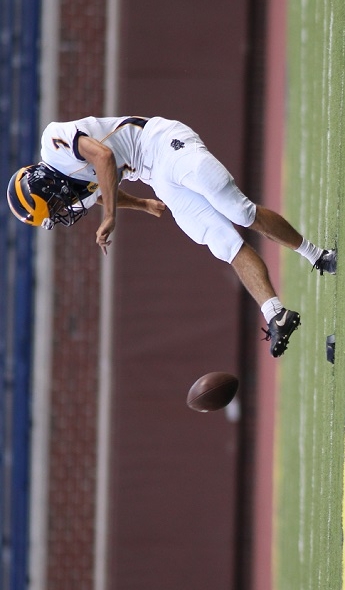
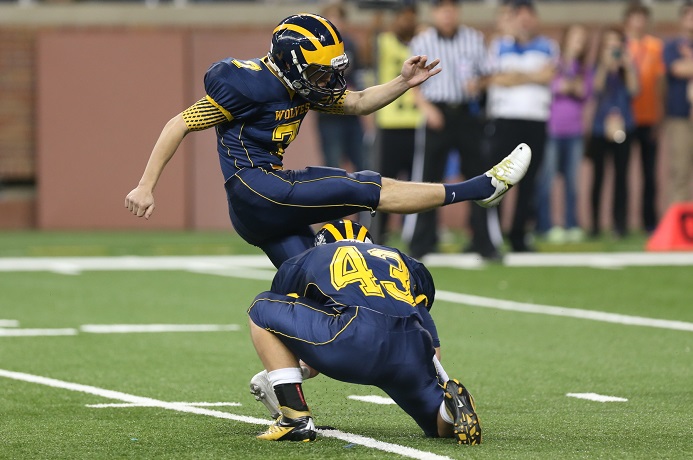
PHOTOS: (Top) Zach Mansour kicks off Clarkston's season against Lapeer on Aug. 26 at Michigan Stadium. (Middle) Shane Hynes follows through on a kick during the 2013 Division 1 Final at Ford Field. (Click to see more of top photo from HighSchoolSportsScene.com.)
A Game for Every Fan: District Openers
October 31, 2013
By Geoff Kimmerly
Second Half editor
A handful of MHSAA football teams always are safe to expect at Ford Field when we finish the annual five-week Finals run into Thanksgiving weekend.
But if the record number of at-large qualifiers – 31 – or the difficulty in picking the best first-round matchups are indications, this weekend could be ripe for plenty of the unexpected.
A total of 38 teams enter the playoffs perfect for the regular season. Ithaca is riding a national-record 51-game winning streak and seeking its fourth straight Division 6 title, while Detroit Cass Tech and Birmingham Brother Rice are going for their third straight each in Divisions 1 and 2, respectively.
How they might fare this time will be easier to predict over the next few weeks. But first things first, and in this case it’s our forecast of the best District openers all over the state this weekend. (Click to see the entire schedule, with dates, times and locations.)
Division 1
Detroit Catholic Central (7-2) at Northville (8-1)
Arguably the most competitive District in any division also includes Canton and Walled Lake Western, but Northville finished ahead of both to win the Kensington Lakes Activities Association. That doesn’t necessarily make the Mustangs favored. DCC’s only marks against came against reigning Division 2 champion Birmingham Brother Rice, and the Shamrocks have plenty of know-how in the postseason – they’ve finished Division 1 runner-up the last two seasons.
Others that caught my eye: East Kentwood (5-4) at Hudsonville (6-3), Rochester Hills Stoney Creek (6-3) at Rochester Adams (6-3), Belleville (6-3) at Saline (8-1), Canton (8-1) at Walled Lake Western (8-1).
Division 2
Southfield (7-2) at Birmingham Seaholm (8-1)
This is a meeting of Oakland Activities Association champions, with OAA White winner Southfield hoping to bounce back after last week’s loss to Red champ Clarkston. Blue champ Seaholm also lost in Week 9, to Detroit U-D Jesuit. The Bluejays have been considered MHSAA contenders since the preseason, but the Maples quietly are 16-3 over the last two years and poised to take the next step.
Others that caught my eye: Midland Dow (7-2) at Fenton (8-1), Muskegon Reeths-Puffer (7-2) at Muskegon (8-1), Ypsilanti Lincoln (7-2) at Wyandotte Roosevelt (9-0), Taylor Truman (7-2) at Allen Park (7-2).
Division 3
Zeeland East (5-4) at Zeeland West (8-1)
It’s fair to assume this won’t be much of a game – East got in with an at-large bid and its worst record since 2009. But there’s too much history to ignore. East did win their first matchup this season, in Week 2, 50-44. And after the Chix cruised to a 9-0 regular season in 2012, West upset them during the District opener. More payback would be the best way to end a four-game losing streak for East – although West hasn’t lost again this fall since that early defeat.
Others that caught my eye: Detroit Denby (7-2) at Detroit Mumford (7-2), Eaton Rapids (5-4) at Charlotte (7-2), Haslett (6-3) at DeWitt (9-0), Riverview (7-2) at Melvindale (7-2).
Division 4
Battle Creek Pennfield (8-1) at Paw Paw (8-1)
League champions clash in the best Division 4 game of opening night, Paw Paw from the Wolverine B Conference East and Pennfield from the Kalamazoo Valley Association. Pennfield has made the playoffs every season under the current format, which began in 1999 – but enters this run with perhaps its best defense of the bunch after giving up seven or fewer points in six games. Paw Paw is coming off a disappointing loss to Edwardsburg last week, but has been similarly sturdy stopping opponents – Week 9 was the first the Redskins gave up more than 14 points in a game.
Others that caught my eye: Harper Woods Chandler Park (7-2) at Richmond (8-1), Dowagiac (6-3) at Edwardsburg (9-0), Dearborn Heights Robichaud (6-3) at Pontiac Notre Dame Prep (7-2), Yale (6-3) at Saginaw Swan Valley (9-0).
Division 5
Grand Rapids West Catholic (5-4) at Portland (7-1)
Just as this matchup was tough to predict when these teams met for the Division 5 championship last season, it’s hard to read again this fall. The Raiders rebuilt quickly, with their lone loss two weeks ago to Division 3 contender DeWitt, 13-7. West Catholic made the playoffs with an at-large bid after a one-point win in Week 9 – but has won four straight after opening 0-3.
Others that caught my eye: Kingsford (7-2) at Grayling (8-1), Clare (7-2) at Reed City (9-0), Olivet (8-1) at Hopkins (7-2), River Rouge (8-1) at Monroe St. Mary Catholic Central (8-1).
Division 6
Reese (8-1) at Montrose (9-0)
Judging by last week’s Genesee Area Conference Blue deciding game, it's fair to guess this might not be much of a contest – Montrose ran past second-place Lake Fenton 37-0 to claim the title outright and also beat Reese 38-8 on opening night. But the Rockets haven’t loss since or scored fewer than 41 points since the first week of October.
Others that caught my eye: Elk Rapids (6-3) at Boyne City (7-2), Marlette (8-1) at Saginaw Nouvel (8-1), Schoolcraft (8-1) at Niles Brandywine (8-1), Manchester (7-2 at Grass Lake (8-1).
Division 7
Saugatuck (8-1) at Pewamo-Westphalia (8-1)
One of these teams has reached MHSAA semifinals each of the last three seasons and both have advanced to Ford Field once during that time. And each has prepared well this season against similar or bigger foes – Saugatuck’s lone loss was to playoff qualifier Decatur and it beat Division 6 qualifier Hartford. Pewamo-Westphalia beat Division 5 qualifier Lansing Catholic and lost only to Division 8 powerhouse New Lothrop.
Others that caught my eye: Traverse City St. Francis (5-4) at Iron River West Iron County (9-0), Royal Oak Shrine (6-3) at Madison Height Bishop Foley (6-3), St. Joseph Lake Michigan Catholic (6-2) at Cassopolis (6-3), Whittemore-Prescott (6-3) at Lake City (8-1).
Division 8
Bessemer (6-3) at Crystal Falls Forest Park (9-0)
We discussed this game at length when these teams met only two weeks ago and Forest Park celebrated avenging a 2012 loss to the Miners to this time clinch the Great Western Conference title outright. A win for Bessemer in this game would be even bigger as the Trojans are attempting to bounce back after failing to reach the District Finals last season for the first time since 2002.
Others that caught my eye: Munising (6-3) at Powers North Central (7-2), Mio (7-2) at Beal City (9-0), Clarkston Everest Collegiate (7-2) at Waterford Our Lady (7-2), Mount Pleasant Sacred Heart (6-3) at Coleman (7-2).
8-Player
Deckerville (5-4) at Peck (9-0)
Last season’s champion opens these playoffs against one of the favorites according to playoff points average. Deckerville won the MHSAA championship in 2012, the team's first season of 8-player, and won two of its final three regular season games this fall. Peck is one of three 9-0 teams in 8-player and owns the third-highest playoff point average in the division. The Pirates beat Deckerville 56-8 only two weeks ago.
Others that caught my eye: Akron-Fairgrove (7-2) at Owendale-Gagetown (8-1), Casonville Port-Sanilac (6-3) at Portland St. Patrick (7-2), Bellaire (5-4) at Kinde-North Huron (6-3), Engadine (5-4) at Cedarville (8-1).
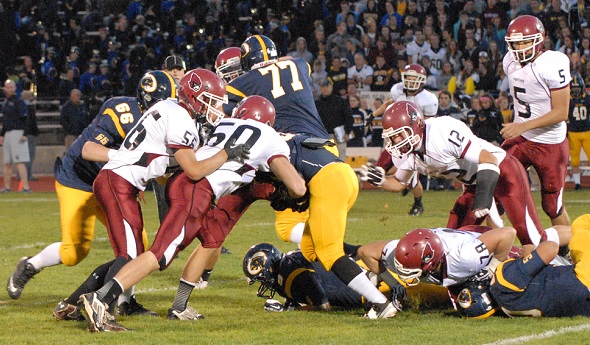
PHOTO: DeWitt (blue helmets) and Portland met in a Week 7 battle of undefeated teams, and both are considered Ford Field possibilities – DeWitt in Division 3 and Portland in Division 5. (Click to see more from High School Sports Scene.)