

Clarkston Surges by Kicking it Forward
By
Tom Markowski
Special for Second Half
October 27, 2016
CLARKSTON – Coach Kurt Richardson held a disdain for kickers. He didn’t trust them. He contends that a poor kicking game cost his Clarkston football team the 2000 Division 1 Semifinal, a 17-15 loss to eventual champion Grand Ledge.
 Three years before, Clarkston had lost one-point games to Rochester (20-19) and Troy (21-20) that cost the Wolves an opportunity to play in the playoffs. Again, the kicking game had let him down.
“We didn’t have kickers,” Richardson said. “We made kickers. We tried a soccer player once back then, and it didn’t work.”
Enter the Breen brothers, Andrew and Ryan. Andrew Breen was Clarkston’s kicker in 2003. Ryan Breen followed and was the kicker in 2005 and 2006. Maybe it’s a coincidence, but Clarkston hasn’t missed the playoffs since 2002. You won’t get Richardson to say that.
Andrew Breen went on to kick for Tiffin University (Ohio), and every place-kicker since has gone on to college as a kicker – including his brother, Ryan, who went to Penn State.
The others include Alex Barta, who went on to kick for the U.S. Naval Academy. Then there’s Shane Hynes, the place-kicker on the 2013 Division 1 championship team, who is currently Kent State’s place-kicker. Alex Kessman was the place-kicker on the 2014 Division 1 title team, and he’s at Pittsburgh after graduating from high school this past June.
Zach Mansour is Clarkston’s place-kicker this season. And although he hasn’t decided what college he will attend next year, rest assured Mansour will be on a roster somewhere, whether it’s at the Division I level or below.
“Andrew kind of broke up the ice,” Richardson said. “It’s made a big difference. What also comes out of making field goals and having good kickers is now we’re kicking the ball in the end zone and teams are starting from their 20.”
Ryan Breen doesn’t remember exactly when it happened, but his life changed when he was a freshman at Clarkston High.
Breen and his brother were soccer players throughout their childhood. Then his freshman year his brother was a senior and Clarkston’s kicker, and something clicked. Ryan was just having fun working with his brother, shagging footballs, when he got the urge to try it.
Something clicked for the Clarkston football program as well.
“Coach Kurt realized, after a while, that kicking is so much part of the game,” Ryan Breen said. “He started to trust me my junior and senior years. He’d been let down so much (by kickers). It’s frustrating.
“It opened his eyes that (Clarkston’s) kicking game could be so good.”
 Ryan gives credit to his brother for starting what has become a fraternity of kickers at Clarkston. And it continues today with Ryan Breen giving back – or paying it forward, if you will.
Clarkston is a sports-crazed community with football and basketball taking the lead. The fan support these teams receive is as fervent as any in the Detroit area. When an athlete experiences success at a school like this, often that person is motivated to give back. That’s what Breen has done.
“My brother kind of got me into it,” Ryan said. “We were athletes first. My freshman year I’d help him, chasing the footballs after he kicked them. I figured I’d do it for him. I never thought I’d kick. We never thought we’d kick.”
At first, his experience in college led Ryan to go back to Clarkston and share his expertise with the next kicker in line, Barta.
“I got with Alex and his dad,” Ryan said. “I tried to lend the knowledge I had.”
After coaching as a volunteer, Ryan came on staff at the junior varsity level for three seasons. He was there to start this season, but was forced to leave due to the time commitment he had with his business in Oakland County. He’s hoping that soon, perhaps in a year or so, his business will become less demanding and he’ll return to Richardson’s staff.
But he’s left his mark, and others have picked up his lead. Those who have followed, like Mansour, are reaping the benefits.
Mansour handles the place kicking and kickoff duties for Richardson, and he’s 5 of 7 on field goal tries with a long make of 45 yards. A junior, Jermaine Roemer, is the punter and, at this point, it appears he will replace Mansour as the team’s place-kicker next season.
“I was close with Shane (Hynes) and Alex (Kessman),” Mansour said. “I got a ton of knowledge from them. And Shane learned from Barta. I’m close with Jermaine. And Tristan Mattson is on (junior varsity). I’ll be working with him after the season.
“We’ve gotten so good with our kicking. It puts us ahead of other teams. When I worked with Shane and Alex, they were brutally honest. They’ll break you down. They yelled at me. It’s not to hurt your feelings. It’s all for the game.
“Paying it forward? It’s kind of my job. Jermaine and I developed a good relationship. We’ve had that reputation of having good kickers, and we want to keep it that way.”
 Tom Markowski is a columnist and directs website coverage for the State Champs! Sports Network. He previously covered primarily high school sports for the The Detroit News from 1984-2014, focusing on the Detroit area and contributing to statewide coverage of football and basketball. Contact him at [email protected] with story ideas for Oakland, Macomb and Wayne counties.
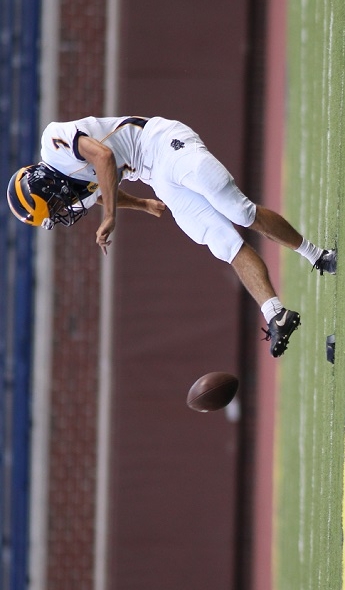
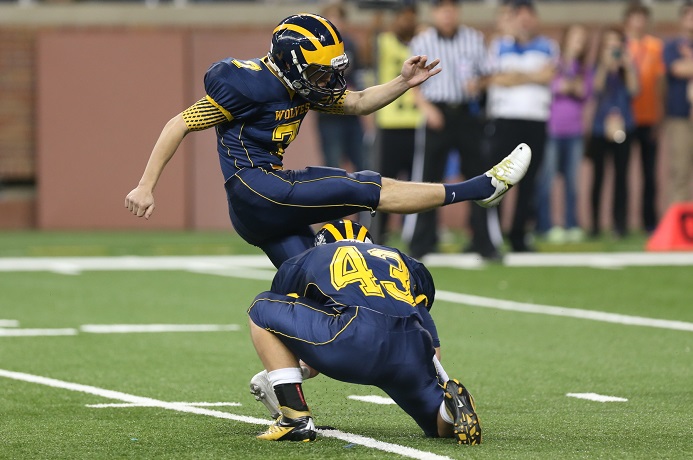
PHOTOS: (Top) Zach Mansour kicks off Clarkston's season against Lapeer on Aug. 26 at Michigan Stadium. (Middle) Shane Hynes follows through on a kick during the 2013 Division 1 Final at Ford Field. (Click to see more of top photo from HighSchoolSportsScene.com.)
Performance: Morrice's Hunter Nowak
November 15, 2018
 Hunter Nowak
Morrice senior - Football
Morrice’s third-year varsity quarterback continued the play Friday that has helped his team to the best season in program history. Nowak ran 28 times for 158 yards and three touchdowns to lead the Orioles to a 40-8 win over Colon in an 8-Player Division 1 Semifinal, earning the senior signal-caller the Michigan Army National Guard “Performance of the Week.”
Nowak has run 204 times for 1,922 yards (9.4 yards per carry) and 33 touchdowns this season, and completed 24 of 49 passes for 529 yards and eight more scores. His 232 points rank third all-time since MHSAA-sponsored 8-player football was added a decade ago. He took over the QB spot in 2016, and Morrice went 4-5, but the Orioles improved to 9-2 last season and this fall finished the regular season 9-0 for the first time in the program’s 11 or 8-player history. Last week’s Semifinal was the team’s second ever and first since 1996, and this Saturday’s championship game against Pickford at Northern Michigan University’s Superior Dome will be the Orioles’ first trip to the MHSAA Finals in this sport. Along the way, Morrice avenged last season’s playoff loss to North Central Thumb League Red rival Deckerville – which went on to finish 2017 Division 1 runner-up – and handed Wyoming Tri-unity Christian its only defeat this fall in the Regional Final two weeks ago.
 Nowak plays only football at Morrice, but does also play on a high school-level rugby club team based in Howell. He carries a 4.0 grade-point average while dually enrolled at Lansing Community College, and hopes to study aviation after high school with aspirations of becoming a commercial airline pilot.
Performance Point: “The defense played great. They played shutout. The defense really won us the game, I think,” Nowak said of the Semifinal win over Colon. “We were able to put up 40 points, but that was a great offense they had. … It’s the first time we ever went to a state final for this, and we’re just really excited about it. We’ve been playing football since third grade, and we’ve always had successful seasons. We always thought that especially our senior year, we always thought, man, we really need to do really good that year. For it to happen, I think it’s great, because we’ve been working hard all year (and) ever since we started playing varsity. We’re thankful to the town for showing up at the games. Everyone comes out. It’s a big deal.”
That’s when we knew: “Our sophomore year, we didn’t do too great. We got four wins as sophomores; we could’ve done better. Last year we were OK – we lost to Deckerville in the second round (38-0). … Our first game (this season), we beat Deckerville (34-14). I think that was big. We went there, we won by 20 points, and that’s when we realized we’re a good team this year – we really have a shot to go far. We had lost the second round of playoffs the year before by a lot there. So to have our first game, since playing there, be right there again, and to be able to win – it put behind all the doubt that we had last year.”
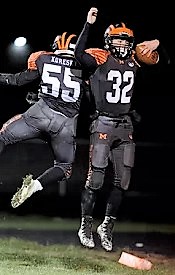 Taking this on together: “I think it’s the combination of a lot of us have been playing since third grade together. And there’s not a whole lot of us, so that bond has just grown through the years. And I think we’re just really good at football, and the whole speed thing really helps too. … I think it’s just knowing what someone else is going to do. If I’m running the ball, I can get a sense of where my lead blockers are going to go, what they’re going to do. We can try to get a sense of what other people are going to do. We can communicate easier. If something happens, we can fix it real quick, because we know how to talk to each other.”
It’s a speed thing: “I think 11-man was more about who’s going to be bigger on the line and then trying to work around that. (Eight-player) is not so much who is bigger on the line, it’s who can get off the line quicker and find the hole faster. We’re not the biggest team, but we’re a very fast team. That definitely helps us out.”
Revved and rallying: “When you’re done with the game and you’re walking back to the stands, there’s a lot of people I’ve never met before. But they’re all congratulating us, and they seem really excited about it. They’re there. They don’t know us personally, but they’re excited for the football team and they want to tell us, ‘Good job.’ There’s a lot of people talking about coming up (for the Final).”
- Geoff Kimmerly, Second Half editor
Every week during the 2018-19 school year, Second Half and the Michigan Army National Guard will recognize a “Performance of the Week" from among the MHSAA's 750 member high schools.
The Michigan Army National Guard provides trained and ready forces in support of the National Military Strategy, and responds as needed to state, local, and regional emergencies to ensure peace, order, and public safety. The Guard adds value to our communities through continuous interaction. National Guard soldiers are part of the local community. Guardsmen typically train one weekend per month and two weeks in the summer. This training maintains readiness when needed, be it either to defend our nation's freedom or protect lives and property of Michigan citizens during a local natural disaster.
Past 2018-19 honorees
November 8: Jon Dougherty, Detroit Country Day soccer - Read
November 1: Jordan Stump, Camden-Frontier volleyball - Read
October 25: Danielle Staskowski, Pontiac Notre Dame Prep golf - Read
October 18: Adam Bruce, Gladstone cross country - Read
October 11: Ericka VanderLende, Rockford cross country - Read
October 4: Kobe Clark, Schoolcraft football - Read
September 27: Jonathan Kliewer, Grand Rapids Forest Hills Northern soccer - Read
September 20: Kiera Lasky, Bronson volleyball - Read
September 13: Judy Rector, Hanover-Horton cross country - Read
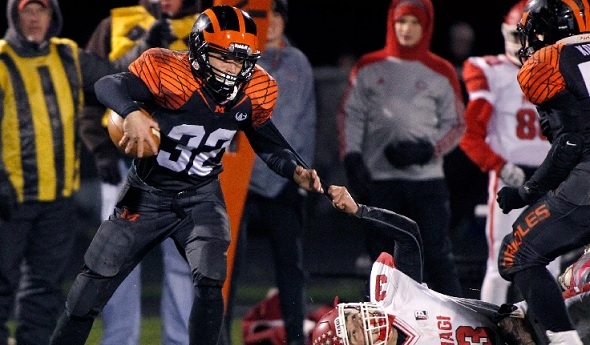
PHOTOS: (Top) Morrice quarterback Hunter Nowak (32) pulls away from a Colon defender during last week’s Semifinal win over the Magi. (Middle) Nowak and teammate Sam Koresky celebrate one of his touchdowns. (Photos courtesy of the Lansing State Journal.)