

Coach Comes Home to Lead Central's Rise
By
Tom Markowski
Special for Second Half
September 27, 2017
DETROIT – Thirty-three years ago, Lynn Sanders graduated from Detroit Central. And before he left, he made a promise.
 Last year, Sanders showed he is a man of his word.
Sanders, 51, is in his second season as the head football coach at Central. Once a proud program under legendary coach Woody Thomas (who died in 2002), the program had wavered a bit. Coaches like Michael Thornhill, who took over for Thomas in 2002, Eric Smith, Robert Hunt and others have had some success. But stability within the program, especially in recent years, had been missing.
Many of the high school-age students in the neighborhood were attending schools elsewhere in the city. Now-closed Detroit Allen Academy, a charter school near Central, was one alternative. Open enrollment throughout the school district also allowed students to attend any school in Detroit, and many were taking advantage of the opportunity.
Since Sanders’ arrival, and because of his standing in the community, many of those in the neighborhood have decided to remain. Sanders and his staff have been able to make the Trailblazers relevant again, and there’s a renewed respect for the program. Central is 4-1 and 2-1 in the Detroit Public School League Black division and faces Detroit Pershing (1-4, 0-3) this week before taking on Detroit Martin Luther King (4-1, 3-0), one of the state’s elite programs, on Oct. 6.
“When I was 18, I told Coach Thomas I would replace him,” Sanders said. “It took a while.”
The rewards have come quickly.
Last fall in Sanders’ debut, and for the second time in school history, the Trailblazers won two playoff games in a season and finished 7-5. And they led Millington 20-0 in a Division 6 Regional Final before falling 22-20.
 There had been success in the recent past. Central tied a school record for victories in a season with a 9-3 finish in 2010. In 2012, the Trailblazers began a run of making the playoffs in three of the next five years, each time finishing 6-4 – although the playoff appearances in 2014 and 2015 ended quickly as Central lost first-round games by a combined score of 107-14.
The Trailblazers took a sizable next step led by someone taking his first at the high school level. Sanders had never been a head coach, but he brought a long list of credentials while working with youth football. A 27-year veteran with the Michigan State Police, Sanders spent 10 years as the president of the Southfield Ravens, a Pop Warner program for players aged 8-11. He spent three years as a league commissioner within Pop Warner in southeastern Michigan. For two years he was a regional commissioner for American Youth Football (AYF).
Before getting the Central job, Sanders worked under coach Keith Stephens at Oak Park and then with Stephens at Southfield-Lathrup as his offensive coordinator.
Then there was a knock on the door of opportunity.
“I got a call from David Oclander, who was the (Central) principal then,” Sanders said. “We met and he told me what he was looking for. He knew of me, knew I was a Central grad, and he told me he wanted to turn things around.
“When I got here the team GPA was 1.9. The first day I called a meeting. I had all of the guys who wanted to play be there. When I gave that speech, I could tell they weren’t really happy. I was their third coach in three years, and I think they felt betrayed. They weren’t really interested. A number of them were looking at their phones, not paying attention. I told them here are my rules, my expectations and if you don’t like it you can leave. About half of them did. Fifteen stayed.”
It didn’t take long for Sanders to build upon those numbers. His association with Pop Warner and coaches in the area helped spread the word that expectations would rise.
In the meantime, Allen Academy closed following the 2015-16 school year and many of those students went to Central – including some athletes who had played on a Wildcats team that finished 5-4 in 2015.
 Central didn’t have a freshmen or junior varsity team, but Sanders was able to gather 36 for the varsity. He has 32 this season.
“When I took the job I got phone calls from all over the place,” he said. “Coaches, former players, they all wanted to help. They’d do anything for me. I was well-respected, and the kids started to come. Instead of taking buses out of the neighborhood and going elsewhere, they stayed home. And they were good kids. I set some high expectations. Those that didn’t want to follow got shipped out.”
Sanders and Oclander saw eye-to-eye on many issues. The main objective was to instill discipline, and both came from a background where discipline was paramount: Sanders with the state police, Oclander as a retired lieutenant colonel in the U.S. Army.
Sanders looked to improve the quality of coaching his players were to receive in two ways. The first came during the offseason. He knew his players didn’t have the finances to go to camps, even if they were close by at places like Wayne State University. Instead, Sanders brought the college coaches to Central. Staffs from Northwood University, Eastern Michigan and Wayne State all came to Central to conduct a camp.
“That had never been done before at Central,” Sanders said.
The second was to convince coaches in the area that Central was the place to be. Eighteen said yes. Do the math: That’s more than one coach for every two players. It’s safe to say that’s a unique situation – and has led to an almost unheard of type of mentoring process.
And the players are reaping the results. Eight players from last year’s team are playing college football. Five players from this year’s team have made verbal commitments to a college or university, including El Julian Jordan. Jordan, a 6-foot-2, 220-pound quarterback who played his first two years of high school football at King, has accepted a scholarship to Western Michigan.
It was a big change for Jordan to go from a program like King, with 1,400 students, to Central where the enrollment is 370.
“It was a tough transition,” he said. “The kids in school were different. This school is so small, but I like it that way. I can focus more on my grades and such.
“I look up to (Sanders). He’s molded me into a leader. I lead by example. My first impression of Coach was a positive one, and that’s good.”
Jordan has had a fine season to this point, completing 56 of 95 attempts for 1,239 yards, 13 touchdowns and with no interceptions. He’s scored three rushing touchdowns.
 “He’s a special kid,” Sanders said. “I don’t think anyone has put him in the position of being a leader before. After time, he knew he could trust me. He’s a phenomenal athlete. He’s a quiet kid until you get to know him. As we made our run in the (playoffs), the different (officiating) crews would watch him warm up. He can throw the ball 70 yards. And they couldn’t wait to see him in action.”
Other top players include a bevy of receivers including Jerodd Vines, TaQuan Snead and Brandon Cooper.
Central returned all five offensive linemen from a season ago including Jamauri’a Carter (5-10, 305). Carter, Snead and Jordan all played on the Eastside Raiders in the Police Athletic League (PAL) before high school.
Sanders’ stay at Central could be a brief one. He and wife, Kathy, who were high school sweethearts, have four children including three sons. One, Londale Sanders, is a junior linebacker at University of Arkansas-Pine Bluff. They recently returned on Sunday after watching their son play in last Saturday’s 34-27 overtime victory at Jackson State.
Another son, Lance Sanders, is one of the offensive line coaches at Central.
“I don’t know how long I’ll do it,” Lynn Sanders said. “I wanted to turn things around. I don’t know how long I’ll be here. I told my wife three years, tops, and see what happens. At least Central is back where parents, the people in the neighborhood are coming back. The kids are getting better. The test will be against King.”
 Tom Markowski is a columnist and directs website coverage for the State Champs! Sports Network. He previously covered primarily high school sports for the The Detroit News from 1984-2014, focusing on the Detroit area and contributing to statewide coverage of football and basketball. Contact him at [email protected] with story ideas for Oakland, Macomb and Wayne counties.
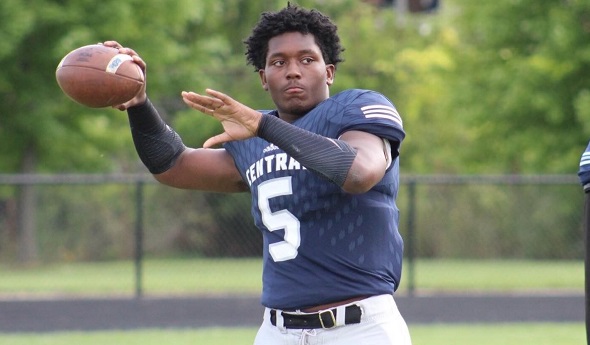
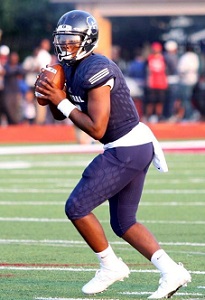
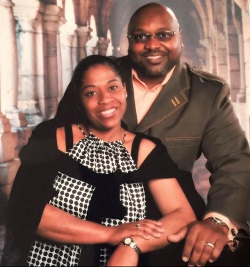
PHOTOS: (Top) Detroit Central quarterback El Julian Jordan warms up before a game. (Middle top) Lynn Sanders, left, and offensive coordinator Kevin Rogers. (Middle below) Jordan surveys the field looking for a receiver. (Below) Sanders and wife Kathy. (Photos courtesy of Lynn Sanders and Detroit Central football.)
Rouge Primed for 1st-Time Repeat Attempt
By
Tom Markowski
Special for Second Half
September 17, 2020
Mareyohn Hrabowski has a tough act to follow after a historic season for the River Rouge football program.
All the same, Hrabowski, now a senior quarterback for coach Corey Parker, is just thankful he and his teammates will get that opportunity.
Hrabowski’s three rushing touchdowns led the Panthers to a 30-7 victory over Muskegon in the Division 3 title game last November at Ford Field. The title was the school’s first in football, and the win over the Big Reds to earn it shocked many football enthusiasts throughout the state.
“It was awesome,” Hrabowski said. “To think the year before I was playing (on the junior varsity). To make the move up, the game was faster and the energy we got throughout the season was amazing.
“Before the season we talked about a state championship. When we got to the (MHSAA) playoffs we knew we had to put the foot on the gas.
“This year, expectations are the same. We don’t want to push anything. We don’t want to make this a one-man show. That title made us hungrier.”
River Rouge weathered a rugged schedule in 2019 finishing 13-1, highlighted in part by a 16-3 victory over state power Detroit Catholic Central in Week 8. Of its five playoff wins, only one, a 14-7 victory over Chelsea, came by fewer than 23 points.
With more than half his starters returning, Parker was optimistic heading into this season. Then COVID-19 hit. Normal preparations were all but cancelled, and until schools were given the go-ahead to begin preseason practice midway through the summer it looked like this season would be cancelled or postponed. The ups and downs continued when football shut down after the first week of practice and before teams were to begin training in full pads.
Earlier this month, Governor Gretchen Whitmer relaxed restrictions that in turn opened up the opportunity to play football again, and the MHSAA Representative Council voted to allow programs to resume practice with the start of the season pushed back to Sept. 18. What we’re left with is a shortened season, six regular-season games for most teams, with the playoffs set to begin Oct. 30.
“You’re setting up dates, scrimmages, games, then you’re shut down,” Parker said. “We didn’t know what was happening. Then we had to deal with the parents and fans, and explaining to them what we would do.
“(The virus) is very scary. Some of our players live with their grandparents. Some have younger siblings at home. (If you get infected) you don’t want to bring that home to them. I have (three) young children at home. We had one player who said he was in contact with someone who had tested positive. We couldn’t let him practice with us. He said he might transfer if he couldn’t practice and I said if that’s your best option, go ahead.”
Parker’s practices are highly monitored. He has what he terms a sanitation station for the players where, when they’re finished with a drill, they wash down and are told to keep their distance.
With its classrooms empty, River Rouge has adopted a virtual classroom schedule for all students from 8 a.m. until 1 p.m. As the dean of students and athletic director, Parker’s responsibilities have changed. In addition to the virtual classroom, students have the opportunity to safely meet with teachers, face-to-face, from 2-4 p.m.
“We call it a drop-in center,” Parker said. “It’s like a Q&A. If a student has a question about the work they did (virtually), they can come in and meet with their teacher. We allow two or three students, something like that, in an area at one time.”
 This is Parker’s 12th season as football coach and dean of students. In addition, four years ago he became athletic director. Since his arrival, the football program has taken off and the high school’s enrollment has more than doubled to more than 1,000 students.
In the six football seasons prior to Parker’s first (2009), the Panthers were a combined 13-41 with no playoff appearances. Before Parker arrived, over its football history, Rouge had made the playoffs four times with one playoff win.
River Rouge has made the playoffs the last 10 seasons including runs to Division 5 Regional finals in 2012 and 2014, Division 4 Semifinals in 2016 and 2017, and to a Division 5 runner-up finish at Ford Field in 2015.
Success has equated to an increase in participation. Parker had approximately 20 players in the program the first four seasons. This season he has 130 including a freshman team for the first time (River Rouge will not play a freshman schedule due to the lack of freshman teams in the area).
“When I got here, football was something they did before basketball,” Parker said. “We were successful and in 2012 our goal was to win a playoff game then a District title, and we did that. We beat Almont (44-22). That was a turning point. We kept it simple back then. We ran the ball. We’re still a single wing, but we spread it out now.
“(Defeating Muskegon) was huge. (Muskegon) is the cream of the crop. If you talk about football in Michigan, you have to talk about Muskegon. Winning a title changes everything. Our numbers are up, the most ever, and the fan base is different. We have people in their cars in the parking lot now watching practice. It puts our players under a microscope. They realize they’re representing something bigger than yourself.
“Sure there’s pressure. Pressure either bursts pipes or creates diamonds.”
The strength of this year’s team is experience on the offensive and defensive lines plus the play of Hrabowski. Many of River Rouge’s linemen are college-bound players like Jalen Johnson, Chance Moore and Tyler McMillan on the offensive side; Mark Gilbert, Pius Odjugo and Deavontae Miles on defense. Safety Armorion Smith is a playmaker. He had six sacks in the victory over Detroit Catholic Central.
Offensively the Panthers will pin their hopes on Hrabowski, who at 6-foot-3 and 215 pounds can control a game with his strength and athleticism. Hrabowski answered the bell time and time again during last year’s Final. He rushed for 175 yards on 15 carries and completed half of his 12 pass attempts for 45 yards. River Rouge did not commit a turnover.
“(Hrabowski) does not believe in turning it over,” Parker said. “He’s a bigtime teammate. He’s old school. At lunch, he’s always sitting with his offensive linemen. He’s a great runner and a better passer. When he has the opportunity to run, he makes plays.”
Lurking in the back of everyone’s mind is the virus. Coaches and players know they must be constantly on their guard, adhering to protocol and using caution at all times.
“I’m an only child, so there isn’t that many I come in contact with at home,” Hrabowski said. “I have my childhood friends, but I’ve noticed I’m not around as many people as I used to. I know my limits. Coach does a great job of reminding us of social distancing and wearing masks.”
River Rouge, which plays an independent schedule, opens the season at Ecorse on Friday. East Lansing is scheduled the following week and, later, Detroit Catholic Central and Detroit Renaissance.
As the COVID crisis continues to evolve, players are expected to wear masks, not only on the sidelines but while participating as well. As difficult as this sounds, Parker said his players are ready for the challenges that await.
“(Wearing masks) is going to be uncomfortable,” he said. “But we don’t mind dealing with that discomfort for these seniors to have a chance to perform and earn a scholarship to move out of their parents’ house.”
Tom Markowski is a correspondent for the State Champs! Sports Network and previously directed its web coverage. He also covered primarily high school sports for the The Detroit News from 1984-2014, focusing on the Detroit area and contributing to statewide coverage of football and basketball. Contact him at [email protected] with story ideas for Oakland, Macomb and Wayne counties.
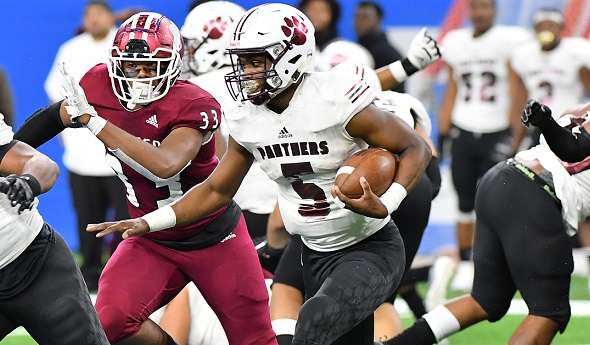
PHOTOS: (Top) River Rouge quarterback Mareyohn Hrabowski finds a path during last season's Division 3 Final against Muskegon. (Middle) Panthers coach Corey Parker and his players prepare to except their championship trophy at Ford Field.