

Coach Comes Home to Lead Central's Rise
By
Tom Markowski
Special for Second Half
September 27, 2017
DETROIT – Thirty-three years ago, Lynn Sanders graduated from Detroit Central. And before he left, he made a promise.
 Last year, Sanders showed he is a man of his word.
Sanders, 51, is in his second season as the head football coach at Central. Once a proud program under legendary coach Woody Thomas (who died in 2002), the program had wavered a bit. Coaches like Michael Thornhill, who took over for Thomas in 2002, Eric Smith, Robert Hunt and others have had some success. But stability within the program, especially in recent years, had been missing.
Many of the high school-age students in the neighborhood were attending schools elsewhere in the city. Now-closed Detroit Allen Academy, a charter school near Central, was one alternative. Open enrollment throughout the school district also allowed students to attend any school in Detroit, and many were taking advantage of the opportunity.
Since Sanders’ arrival, and because of his standing in the community, many of those in the neighborhood have decided to remain. Sanders and his staff have been able to make the Trailblazers relevant again, and there’s a renewed respect for the program. Central is 4-1 and 2-1 in the Detroit Public School League Black division and faces Detroit Pershing (1-4, 0-3) this week before taking on Detroit Martin Luther King (4-1, 3-0), one of the state’s elite programs, on Oct. 6.
“When I was 18, I told Coach Thomas I would replace him,” Sanders said. “It took a while.”
The rewards have come quickly.
Last fall in Sanders’ debut, and for the second time in school history, the Trailblazers won two playoff games in a season and finished 7-5. And they led Millington 20-0 in a Division 6 Regional Final before falling 22-20.
 There had been success in the recent past. Central tied a school record for victories in a season with a 9-3 finish in 2010. In 2012, the Trailblazers began a run of making the playoffs in three of the next five years, each time finishing 6-4 – although the playoff appearances in 2014 and 2015 ended quickly as Central lost first-round games by a combined score of 107-14.
The Trailblazers took a sizable next step led by someone taking his first at the high school level. Sanders had never been a head coach, but he brought a long list of credentials while working with youth football. A 27-year veteran with the Michigan State Police, Sanders spent 10 years as the president of the Southfield Ravens, a Pop Warner program for players aged 8-11. He spent three years as a league commissioner within Pop Warner in southeastern Michigan. For two years he was a regional commissioner for American Youth Football (AYF).
Before getting the Central job, Sanders worked under coach Keith Stephens at Oak Park and then with Stephens at Southfield-Lathrup as his offensive coordinator.
Then there was a knock on the door of opportunity.
“I got a call from David Oclander, who was the (Central) principal then,” Sanders said. “We met and he told me what he was looking for. He knew of me, knew I was a Central grad, and he told me he wanted to turn things around.
“When I got here the team GPA was 1.9. The first day I called a meeting. I had all of the guys who wanted to play be there. When I gave that speech, I could tell they weren’t really happy. I was their third coach in three years, and I think they felt betrayed. They weren’t really interested. A number of them were looking at their phones, not paying attention. I told them here are my rules, my expectations and if you don’t like it you can leave. About half of them did. Fifteen stayed.”
It didn’t take long for Sanders to build upon those numbers. His association with Pop Warner and coaches in the area helped spread the word that expectations would rise.
In the meantime, Allen Academy closed following the 2015-16 school year and many of those students went to Central – including some athletes who had played on a Wildcats team that finished 5-4 in 2015.
 Central didn’t have a freshmen or junior varsity team, but Sanders was able to gather 36 for the varsity. He has 32 this season.
“When I took the job I got phone calls from all over the place,” he said. “Coaches, former players, they all wanted to help. They’d do anything for me. I was well-respected, and the kids started to come. Instead of taking buses out of the neighborhood and going elsewhere, they stayed home. And they were good kids. I set some high expectations. Those that didn’t want to follow got shipped out.”
Sanders and Oclander saw eye-to-eye on many issues. The main objective was to instill discipline, and both came from a background where discipline was paramount: Sanders with the state police, Oclander as a retired lieutenant colonel in the U.S. Army.
Sanders looked to improve the quality of coaching his players were to receive in two ways. The first came during the offseason. He knew his players didn’t have the finances to go to camps, even if they were close by at places like Wayne State University. Instead, Sanders brought the college coaches to Central. Staffs from Northwood University, Eastern Michigan and Wayne State all came to Central to conduct a camp.
“That had never been done before at Central,” Sanders said.
The second was to convince coaches in the area that Central was the place to be. Eighteen said yes. Do the math: That’s more than one coach for every two players. It’s safe to say that’s a unique situation – and has led to an almost unheard of type of mentoring process.
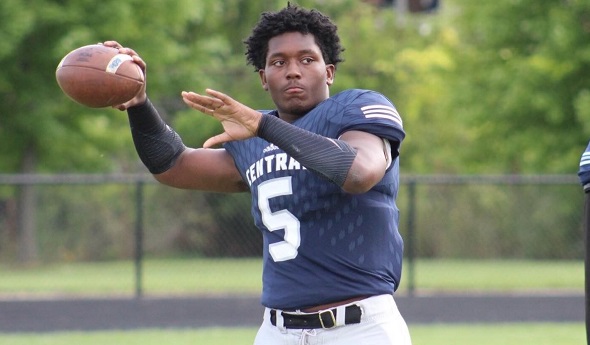
And the players are reaping the results. Eight players from last year’s team are playing college football. Five players from this year’s team have made verbal commitments to a college or university, including El Julian Jordan. Jordan, a 6-foot-2, 220-pound quarterback who played his first two years of high school football at King, has accepted a scholarship to Western Michigan.
It was a big change for Jordan to go from a program like King, with 1,400 students, to Central where the enrollment is 370.
“It was a tough transition,” he said. “The kids in school were different. This school is so small, but I like it that way. I can focus more on my grades and such.
“I look up to (Sanders). He’s molded me into a leader. I lead by example. My first impression of Coach was a positive one, and that’s good.”
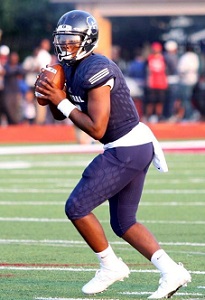
Jordan has had a fine season to this point, completing 56 of 95 attempts for 1,239 yards, 13 touchdowns and with no interceptions. He’s scored three rushing touchdowns.
 “He’s a special kid,” Sanders said. “I don’t think anyone has put him in the position of being a leader before. After time, he knew he could trust me. He’s a phenomenal athlete. He’s a quiet kid until you get to know him. As we made our run in the (playoffs), the different (officiating) crews would watch him warm up. He can throw the ball 70 yards. And they couldn’t wait to see him in action.”
Other top players include a bevy of receivers including Jerodd Vines, TaQuan Snead and Brandon Cooper.
Central returned all five offensive linemen from a season ago including Jamauri’a Carter (5-10, 305). Carter, Snead and Jordan all played on the Eastside Raiders in the Police Athletic League (PAL) before high school.
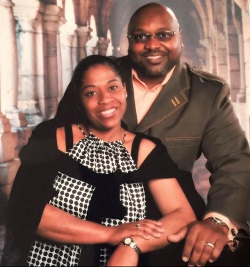
Sanders’ stay at Central could be a brief one. He and wife, Kathy, who were high school sweethearts, have four children including three sons. One, Londale Sanders, is a junior linebacker at University of Arkansas-Pine Bluff. They recently returned on Sunday after watching their son play in last Saturday’s 34-27 overtime victory at Jackson State.
Another son, Lance Sanders, is one of the offensive line coaches at Central.
“I don’t know how long I’ll do it,” Lynn Sanders said. “I wanted to turn things around. I don’t know how long I’ll be here. I told my wife three years, tops, and see what happens. At least Central is back where parents, the people in the neighborhood are coming back. The kids are getting better. The test will be against King.”
 Tom Markowski is a columnist and directs website coverage for the State Champs! Sports Network. He previously covered primarily high school sports for the The Detroit News from 1984-2014, focusing on the Detroit area and contributing to statewide coverage of football and basketball. Contact him at [email protected] with story ideas for Oakland, Macomb and Wayne counties.
PHOTOS: (Top) Detroit Central quarterback El Julian Jordan warms up before a game. (Middle top) Lynn Sanders, left, and offensive coordinator Kevin Rogers. (Middle below) Jordan surveys the field looking for a receiver. (Below) Sanders and wife Kathy. (Photos courtesy of Lynn Sanders and Detroit Central football.)
'Patriot Game' Unites Traverse City Rivals
September 9, 2016
By Geoff Kimmerly
Second Half editor
Twenty years ago this fall, Traverse City Central and Traverse City West faced each other in varsity football for the first time as new communities created by the split of the former Traverse City High School.
As was inevitable, the resulting rivalry has become one of the state’s most competitive, with West holding a 12-7 edge in varsity football after winning the first four games of the new series. But an idea five years ago to make the game about more has given an entirely new meaning to the annual neighborly get-together.
The “Patriot Game” was an idea first stoked by West football coach Tim Wooer, who suggested a military salute game in 2012 after the death of U.S. Marine Justin Hansen, who had been serving in Afghanistan and was one of Wooer’s players when the latter formerly coached at Kingsley.
Historic Thirlby Field was packed with 10,000 fans for that first Patriot Game, played Week 6 that fall. And it was just a start.
The Patriot Game has grown to also honor first responders, including police, fire and medical personnel, and for more reasons than football has become the game for the 3,000 students who attend either Central or West.
In their words, two of those students – Central senior Sarah Berry and West senior Dani Priest, the governors of their school’s respective student senates – explain why the Patriot Game has grown to mean so much, and also what it says about their communities.
Both Berry and Priest have attended all four Patriot Games, and of course will be on hand tonight after a full day of festivities at both schools. (Watch the game live with subscription on MHSAA.tv.) The game again is played at Thirlby, which is the shared home of Central and West as well as Traverse City St. Francis and has been hosting football games since 1896.
Priest: “My favorite memory of the Patriot Game was freshman year. Thirlby Field in itself is just a field where not many high school kids get to experience (that kind) of opportunity, because it an incredible thing that we share between the schools. The stands were completely filled, it was my first-ever high school football game, it was under the lights, it was 500+ kids from West, 500+ kids from Central. The whole community (went) back and forth, back and forth, the game was incredibly close and then West ended up winning (17-14). That was the only game since I’ve been in high school that we’ve won. The feeling after that was incredible especially because I was a freshman and it was new; there were no words. … Especially since our community is so intimate and small, that adds another component. No matter what, because we’re in the same conference, we’re going to play each other. But what is so important about the Patriot Game itself is the students are so involved in this game.”
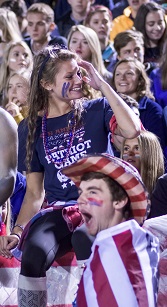
 As has become tradition, the student sections will wear patriotic colors – tonight, West will be a sea of Blue and Central of red. The schools hold various fundraisers, including selling T-shirts leading up to the game. Money raised this year will be donated to Veteran 2 Veteran, a local program that sets up mentors for veterans as they return to civilian life.
Berry: “Last year I helped to build a memorial at our field, so that was really special and really awesome to present that to the veterans who were at the game. This year, something that I think is going to be really special is we’re doing a thing called ‘Bucks for Vets.’ We’re going to bring all the student senators and run through the stands for two minutes and get all the donations from as many people as we can to go toward this organization. The organizations that we support every year are chosen through a council. I’ve been on the council for three years now and meeting with all of the organizations. They’re able to pitch to us why they need the money, where they’re going to use the money so it will affect veterans in the area, and we’re able to choose what organization – they all deserve money – but what organization needs the money. So all of the money from the game is going toward them and not just extra new special things.”
Classes began Tuesday, giving student officers at both schools limited time to drum up enthusiasm for today’s events – although there’s already ample buzz. Both schools will hold assemblies today. At Central, veterans and first responders will be welcomed in to tell some of their stories. At West, student leaders will hold more of a pep rally to make sure the entire student body, especially new classmates, know details for the night and why they should be there.
Berry: “We have an assembly every year right before the game where we honor all of our veterans and all of our first responders, and I think that really explains to (students) why it’s such a big deal. During that assembly, everyone is completely silent. They have so much respect. Our whole school still talks about how astounding that assembly was to thank all of them (last year), and I really think they know how much it means. It’s really hard not to be emotional about it during the assembly because we have families that come in and they lost a loved one in a war, and we have people who came back from combat a few years ago, so it’s really easy to understand how much it means to everyone. Normally, all of our other assemblies, people are rowdy, (but) this one assembly everyone has so much respect. It’s amazing. You always hear, ‘Oh yeah, the veterans are losing their lives in the war. They’re fighting for our country. They’re risking their lives.’ But to actually hear from someone who has experienced the death firsthand, it really opens your eyes.”
 Both teams are 2-0, and this will be the first time they'll match up with perfect records. Both also are expected to contend in the Big North Conference; Central won the league title and West was third a year ago. But those teams make up only a part of what is, of course, an educational event.
Priest: “What we learn from the Patriot Game is there’s so much more than just high school. There’s so much more than just a Central/West rivalry. There are people out there fighting for our country, and we all stand together. Both of our schools are at one place realizing there’s more than just us. We have to be thankful that we have the opportunity to be at this game, cheering on our teams.”
Berry: “People definitely learn a lot about respect. You definitely notice how much respect everyone has during the game, toward other people; it’s amazing. Definitely in past years, I’ve learned how much veterans do for us. And not only veterans, but the responders, police, everyone. It’s astounding. I guess I just wasn’t aware previously how much they really risk and how much they really do. That’s the main thing I learned, and I think a lot of people in the school could say the same thing. And you really learn a lot about your community as well. (The game) is sold out every single year. The student sections are covered in a sea of blue and red, and you just learn how much support can be given to our community.”
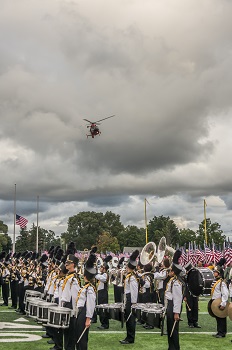
Ticket sales at the stadium gate begins at 2 p.m. Veterans, reservists, active military and first responders will be admitted free of charge through special entrances, and later student senators from both schools will camp out at the entrances to make sure no special guests are waiting in line when festivities begin. A motorcade of American Legion Riders, local motorcycle police and North Flight emergency medical transport personnel will ride into the stadium, and colors will be presented by member of the U.S. Coast Guard Color Guard and first responder Honor Guard.
 As the West marching band plays, student senators from both schools will form a tunnel for veterans and first responders to walk through as they enter the field and then line up at the 50-yard line, where they will be greeted by both football teams.
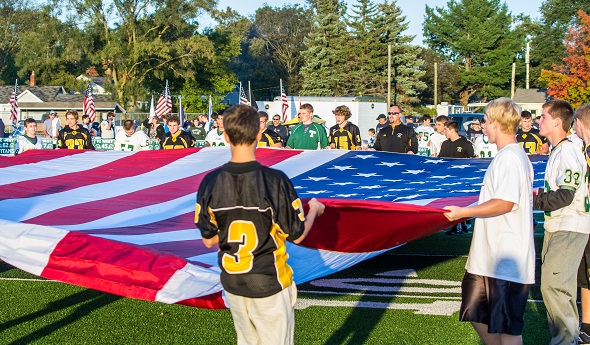
After the playing of taps and a memorial announcement of names, the junior varsity football teams from both schools together will take hold of a giant American flag stretching sideline to sideline as the band plays the national anthem. There will then be a flyover before the coin toss and opening kickoff.
Berry: “I think doing (the Patriot Game) with West makes it extremely special. Because not only do we have friends on the other side, but using the game in this way is extremely smart. We’re able to come together for a common cause, on common ground, in that we want to honor all these people and honor what they’ve done for us, and that really ties it all together. … I’ve been asked if I want more people to be in the student section from Central supporting the veterans or more people from West, but really, we want everyone there. We want everyone to do well. We want everyone to be able to thank everyone, and it’s just an extremely supportive thing. Of course we want to win, but win or lose, it’s a great experience.
Priest: “I think what makes it special with Central is honestly, we know these kids. We see them, we’re friends with them. The only thing that makes us different is we go to different schools. We live in the same town, we do the same things, in our free time we go to the same ski hills, we go to the same beaches, we go to the same restaurants, we see each other around town, we participate in the same social events. Seeing your friends and people that you care about as well, not only as your rival but you care about them, makes it so much better.”
An estimated 100-150 veterans and first responders attended the 2015 Patriot Game, and 150 or more are expected tonight with moderate temperatures and mostly clear skies expected. The schools are preparing for a crowd that could eclipse 8,000 fans total.
 Priest: “I know people who don’t have kids in high school. My neighbors, actually, have elementary school kids, and they’re like, ‘We’re coming to the game. We bought T-shirts.’ Because they just want to help out with the cause. It’s broadcast on the news, it’s on the radio, it’s everywhere. It just shows so much how no matter if it’s your school or if it’s your kids, people just want to get involved and they want to know how they can help.”
Berry: “It explains so much about Traverse City’s personality and just how giving the entire community is, and accepting. Traverse City is such a special place in that everyone comes at you with open arms. Our community is so giving towards veterans. The hearts of everyone grow bigger during this game. Going there can definitely affect the way you view the city.
“There’s so much love in that stadium. And everyone wants to be there. It’s the event of Traverse City for the high schools. If you’re going to go to any of the games, I would tell you, you have to be at the Patriot Game.”
Click for more information from the Patriot Game website.
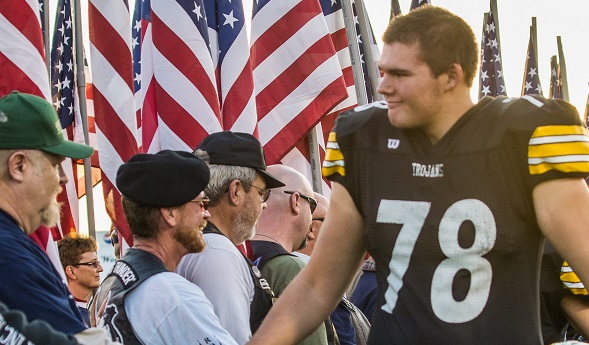
PHOTOS: (Top) Traverse City Central players shake hands with veterans before the first "Patriot Game" in 2012. (Top middle) Junior varsity players from Central and West hold the giant flag during last season's national anthem. (Middle) West players converge on a Central ball-carrier in front of a packed Thirly Field in 2015. (Below middle) A helicopter provides a fly-over as the Traverse City Central band takes the field. (Below) Students dress in blue and red in support of veterans and first responders saluted during the game. (Photos by Rick Sack/TC Rick Photo.)