

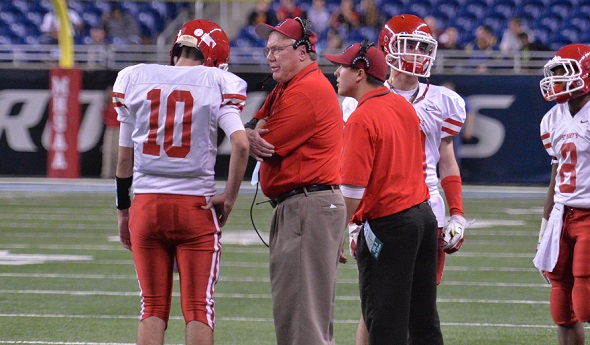
'Coaching Bug' Still Drives St Mary's Porritt
By
Tom Markowski
Special for Second Half
August 19, 2015
ORCHARD LAKE – George Porritt never seriously considered entering the coaching profession when he graduated from Hillsdale College in 1979 with a degree in both parks and recreation and physical education.
At age 14 he had worked part time in the parks and recreation department in Independence Township, a few miles south of Clarkston where he grew up. With that experience, Porritt thought he had found a career path.
 But a year after graduating from college, Porritt, like most in their early 20s, was looking for work – any kind of work. During the fall of 1980, Dan Fife, the head varsity boys basketball coach at Clarkston, hired Porritt as his freshmen coach. The next school year he became an assistant football coach, along with current head coach Kurt Richardson, under Walt Wyniemko at Clarkston.
“I got the coaching bug,” Porritt said.
And he’s been a coach ever since.
Competing in the Detroit Catholic League Central, considered by many the state’s best football conference, is a challenge every year. Butting heads with legendary coaches such as Al Fracassa (now retired) at Birmingham Brother Rice and Tom Mach at Detroit Catholic Central is a daunting task, but Porritt and St. Mary’s have proved worthy adversaries.
The Eaglets are coming off a 12-2 finish and Division 3 title, their fifth under his leadership.
Most who follow high school sports link the name Porritt with football. It’s understandable.
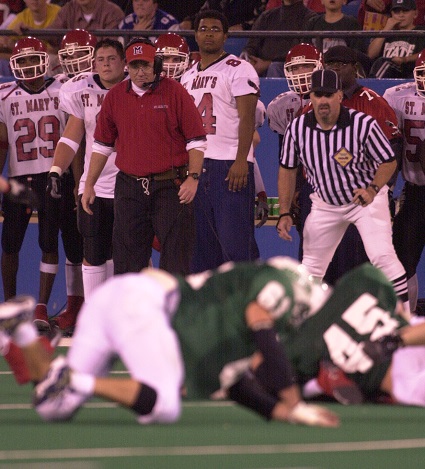 In 1986, St. Mary’s hired Porritt as a teacher, and that summer he became a varsity assistant football coach under Rob Haeger. Porritt replaced Haeger in 1989.
His record heading into this season is 234-66, which ranks 10th among active coaches. Since 2006, St. Mary’s has reached the MHSAA finals six times. He’s coached 15 players who have gone on to play in the NFL.
There’s more. His brother Rich is the offensive coordinator at Clarkston. His uncle, Bob Porritt, coached at Okemos and a cousin, Rob Porritt, coached at Haslett and Perry.
George Porritt loves coaching football, and it’s likely he’ll coach few more seasons.
But there’s something Porritt loves more than football, and that’s being a part of St. Mary’s.
He’s been the school’s athletic director since 1989, and the year before he was hired as the varsity basketball coach. He coached basketball for 22 seasons (he took six years in the mid-90s off to help his wife, Terry, raise their three children) before he retired from that position this past July.
Porritt’s success in football often overshadowed his success as a basketball coach. He coached the Eaglets to the Class B title in 2000, they reached the Class A Semifinals in 2006 and his teams won 10 Catholic League Central titles, six league championships, 12 district titles and six regional titles. His career record is 336-180.
When asked why he stepped away from basketball, Porritt said he pondered that move two years ago but continued on because of his relationships with the coaching staff and, of course, the players.
In the end he got out of coaching basketball to spend more time with his family. His son Kenny lives in Maryland and he and his wife are expecting their third child. His daughter, Marilyn, graduated from University of Oregon and recently moved to Nashville, Tenn., to begin working for Vanderbilt University. The Porritts’ third child, Mason, is a senior at Grand Valley State University.
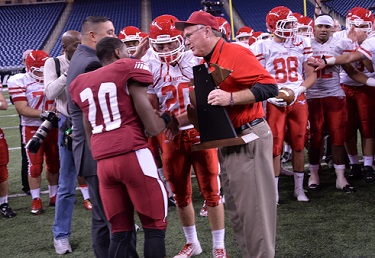 Terry Porritt travelled from Maryland and Tennessee earlier this month to visit her children, leaving her husband at home to coach football. Family time is precious, and the Porritts plan to spend more time with their family in the years to come.
But don’t expect George Porritt to leave St. Mary’s. Though he’s not coaching basketball, he’ll be at every home game because of his duties as athletic director. And aside from long road trips, he’ll be at the away games, too.
“I enjoyed my coaching at Clarkston,” he said. “And I wanted to get a teaching job there. But getting into education was tough then, as it is now.
“I love St. Mary’s. When you drive on this campus, it’s an awesome place to be. I want to work here as long as I can. I’ve met so many great people. Msgr. (Stanley) Milewski was awesome. (Headmaster) Larry Reeside has been tremendous. He inspired me and taught me so much. Then there’s the kids.”
Porritt mentioned one player, in particular, on the team this season as being a special person. His name is Josh Ross and his brother, James, plays for University of Michigan. Josh Ross is a 15-year-old junior but one of the team leaders, and he's already received scholarship offers from Michigan State, U-M and Notre Dame. Porritt said Ross is a no-nonsense type of player and one who helps maintain discipline, on the field and off.
Total, the Eaglets will return five starters on both offense and defense. Senior quarterback Brendan Tambone is back and joined by returning starting running backs Brandon Adams and Justin Myrick; Adams scored the lone touchdown in last season's MHSAA Final. Others of note include junior receiver/defensive back Kaylee Hamlee, who has offers from a handful of Big Ten programs, and 6-foot-5, 275-pound two-way lineman Cameron Kolwich, who will sign with Northwestern this fall.
 Tom Markowski is a columnist and directs website coverage for the State Champs! Sports Network. He previously covered primarily high school sports for the The Detroit News from 1984-2014, focusing on the Detroit area but also contributing to statewide coverage of football and basketball. Contact him at [email protected] with story ideas for Oakland, Macomb and Wayne counties.
PHOTOS: (Top) Orchard Lake St. Mary's football coach George Porritt huddles with one of his players during last season's Division 3 Final. (Middle) Porritt watches a play unfold against Coopersville during his team's 2000 championship game win. (Below) Porritt receives last season's champion's trophy from Muskegon running back and MHSAA Student Advisory Council member Jared Pittman and the Representative Council's Orlando Medina, athletic director at Harrison Township L'Anse Creuse.

MHSA(Q&)A: NFL official Ronald J. Winter
July 19, 2012
By Brian Spencer
Second Half
 Kalamazoo's Ron Winter has officiated in the National Football League for nearly two decades, and became a referee in 1999. But long before he joined the highest level of the game, he got his start on Michigan's high school fields.
Winter has officiated that sport at all three levels and also high school and college basketball. He's also served as a source of knowledge for officials around the state -- and an example for those hoping to start at the high school level and climb to the pros.
Winter remains registered as an MHSAA official, as he's been for 42 years. An associate professor emeritus of human performance and health education at Western Michigan University, Winter was appointed earlier this month to serve a two-year term on the Governor's Council on Physical Fitness, Health and Sports. The council focuses on increasing physical activity and health improvements.
He served on the WMU faculty first beginning in 1969 and then again from 1992-2008. Winter earned bachelor and master's degrees at Michigan State University.
Did you play any sports in high school or college?
I played football, basketball, baseball, and track in high school. However, once I got to Michigan State University, I started playing lacrosse. A couple guys that lived near me played lacrosse and asked me to come out to throw the ball around. After throwing with them a couple times they asked me to come out for the team. I ended up playing lacrosse for MSU for four years.
How did you decide to choose football as the sport you would officiate?
I started officiating as a student at MSU in their intramural program, officiating touch football and basketball. The next logical step was to then officiate in the high school leagues. From there, I began to proceed to all the different levels.
Are there specific requirements for becoming an NFL official?
The biggest requirement is experience. The progression that I went through went like this:
After officiating high school games, I went to the MIAA (Michigan Intercollegiate Athletic Association). They (MIAA) were looking for people that had 3-5 years of experience at the high school level. From there I went to the Mid-Continent conference. I wasn’t able to go to the Mid-American Conference because I was employed at Western Michigan University.
From there I went to the Big Ten. The Big Ten was looking for people with 5 to 10 years of experience in high school and people that had experience at different positions as an official. I ended up officiating in as a Big Ten football official for 10 years and a Big Ten basketball official for 15 years. I then submitted an application to the National Football League. Coincidentally, the NFL was scouting officials, and had followed me for four years before they finally asked me to be a part of the staff. The NFL decides on who they want to pursue through recommendations and personal interest. They look for personality traits as well as how (officials) carry themselves through different situations.
What has been your favorite level to officiate; High school, college or professional?
I enjoyed officiating all of them, but for different reasons.
I found high school to be the most fascinating because it’s all about the kids; they are playing the game for the love of the game. That is the purest sense of the sport. I loved being involved with kids simply because they love the game.
I found the Big Ten to be most exciting because of the kind of atmosphere that exists on a Big Ten campus on a Saturday afternoon. It’s electric. You don’t get that same sense or the same feel on Sunday afternoon in a pro stadium.
I found the NFL to be most intense. The NFL really has three or four different levels of play during the season. There is preseason play, the first third of the season, the second third of the season, and the last five games of the season. Each level is ramped up another notch as the season progresses. Playoffs are entirely different all together. In terms of the intensity and pure speed of the game, there is nothing like the NFL playoffs.
How important is getting along with your fellow officials on the field?
It’s imperatively important if you want to have a smooth and well-run game. This doesn’t mean that you have to buddy-buddy off the field, but on the field you have to be committed to one goal. We spend two or three hours on meetings Saturday afternoon to go over rules tests, tape, and more to prepare for the next game (and) to get over rough patches that develop on a personal level in a previous week. I need to know that the other six guys are focused and thinking about football like me. Everyone has to have confidence in one another. We spend plenty of time on Saturday to get to the point that we need to on Sunday.
What has been the most exciting game you’ve officiated?
I’ve been in plenty of exciting games from NFL playoff games, to the first Orange Bowl game, to the Rose Bowl, to the Division III Hope vs. Calvin basketball game, to when Indiana played Purdue in basketball. All of them were incredible to be a part of. During the Indiana vs. Purdue game, the arena was electric. The players, coaches, fans were intense. Everybody is totally focused on the game. Each coach had a tremendous respect for one another. Neither one wanted to show up or embarrass their counterpart. This game wasn’t that drastically different at the Division III level, however. The intensity of both was very similar.
Are there games that you get excited to officiate more than others, presently?
Not in terms of specific teams. It really just depends on the circumstances, of course. Pittsburgh vs. Baltimore is an intense game. The Jets vs. Patriots game is great. There are clearly rivalries that are very exciting to be a part of. The level of play and intensity of the athletes in the NFL is unmatched and can provide excitement every week.
What is the most difficult aspect of being a NFL official?
I would say that preparation and being able to maintain intensity on the field on Sunday are key aspects. The preparation is difficult because it’s time-consuming. It is a misconception that we simply show up on Sunday to work the game. By the time Sunday rolls around, I’ve spent over 20 hours during the week trying to prepare for a Sunday game. It isn’t hard in terms of physical labor, but difficult in terms of a time commitment. You have to have an understanding family to be in the occupational field that I am in.
Do you have any advice for aspiring officials who hope to make it to the league?
Practice, practice, practice. Be able to work any game at any level and get as much experience as you can. Be a good partner on the field. It takes time; it isn’t something that just happens. Like anything else, it takes practicing your trade to be able to make it to the top level.