


Committees Fail Critical Issues
June 7, 2013
Typically, each sport committee meets once each year for three to five hours, during which time it considers proposals that come from schools, leagues and the state’s coaches association for the sport; and the proposals most often deal with allowing more regular-season events and more qualifiers to the MHSAA postseason tournament.
Occasionally there is a proposal that might improve sportsmanship. But much more often the proposals would increase conflicts between academics and athletics and/or strain overstressed local budgets. And almost never is there a proposal that would address the health and safety of participants (the Wrestling Committee has been an occasional exception and the Competitive Cheer Committee is a routine exception).
While coaches associations must shoulder some of the blame because they’ve brought MHSAA committees “trivial” topics, at least in comparison to the tougher health and safety topics, much of the cause of MHSAA committee ineffectiveness is that the committees don’t meet long enough or often enough to research serious problems and develop well-thought-out solutions. That is forgivable because it is difficult to get commitments from busy people all across Michigan to be absent from their regular jobs and travel dozens or even hundreds of miles, and to do so multiple times each year – which is what it takes to more fully understand complex problems and more carefully construct solutions. Meetings have to be few and they have to be efficient.
However, facing the worst publicity football has seen since the mid-1970s, we knew we had to supplement the football committee process. We did so by appointing a special Football Task Force of optimum size and experienced, representative makeup to meet on however many occasions are necessary during 2013 to accomplish three purposes:
- Review practice policies to improve acclimatization of players and reduce head trauma.
- Review competition rules to reduce head trauma and the frequency of the sport’s most injurious game situations.
- Develop promotions that extol the value of football to students, schools and communities and the safety record of school-based football.
The promotional efforts have begun to be rolled out; game rule modifications are being investigated; and four proposals for changing football practice policies have been prepared. They will be the topic of our next posting.
Thank Roosevelt for Football Weekends
December 20, 2013
By Rob Kaminski
MHSAA benchmarks editor
The next time you find yourself immersed in a tense crosstown football rivalry on a Friday night followed by a Saturday pilgrimage to the nearest college campus and a Sunday afternoon with a remote and your favorite snacks and beverages, take a moment to consider what the weekend would be like if it weren’t for Teddy Roosevelt.
The man who became our 26th President shortly after the turn of the 20th Century following the assassination of William McKinley in 1901 was a football fan like you. Maybe more so.
Today’s game of football has reached a critical crossroads. Player size and speed have increased across the board. Savage use of equipment as weapons rather than protective gear has been glorified on television networks and social media. Leaders of the game at all levels have recognized the need for change, employing new rules and widespread educational efforts to aid in preserving the sport.
History, as they say, is repeating itself.
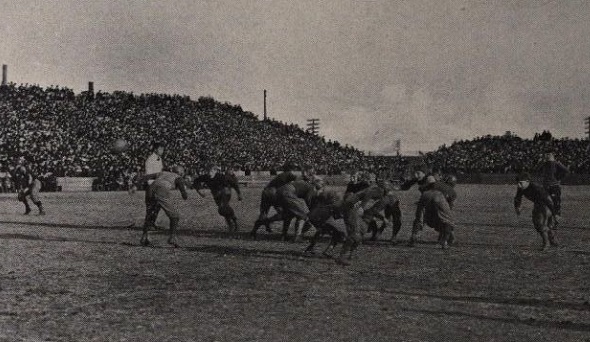
In an ironic twist, it was Roosevelt who saved the then-brutally violent game of football from itself more than 100 years ago. Yes, the same “Rough and Ready Teddy” who led the charge up San Juan Hill during the Spanish-American War and often sparred in the boxing ring while in office from 1901-09 opined that football was becoming so gruesome that he delivered an ultimatum: clean up the game or it would be outlawed.
The Chicago Tribune reported that in 1904 alone, there were 18 football deaths and 159 serious injuries, mostly among prep school players. Football deaths suffered by younger players were reported on a nearly weekly basis, as outraged citizens called on colleges and high schools to banish football outright.
In stepped Roosevelt, who called head coaches and representatives from Harvard, Yale and Princeton – college powers at the time – to the White House in 1905 urging them to eliminate excessive violence and set an example of fair play for the rest of the country. When the casualties actually rose by one during the ensuing season, Roosevelt reacted with greater resolve and convened leading football authorities for the purpose of authoring drastic rules changes. What emerged was an intercollegiate conference which was the predecessor of the NCAA.
Among the most effective changes for the 1906 season were the legalization of the forward pass, the elimination of mass formations, and the creation of a neutral zone. Football fatalities fell to 11 in each of the next two seasons, and severe injuries fell drastically.
Thanks to the introduction of protective equipment and ever-evolving rules changes, football during the 100-plus years to follow has become an exponentially safer game. Yet, the game’s leaders always will need to adjust and react to scrutiny that comes with the territory.
So, as the game once again undergoes rules modifications in the name of safety, give a tip of the cap to President Roosevelt while you enjoy college bowl season and the NFL playoffs and begin to think ahead to the first high school practice of 2014.