


Committees Fail Critical Issues
June 7, 2013
Typically, each sport committee meets once each year for three to five hours, during which time it considers proposals that come from schools, leagues and the state’s coaches association for the sport; and the proposals most often deal with allowing more regular-season events and more qualifiers to the MHSAA postseason tournament.
Occasionally there is a proposal that might improve sportsmanship. But much more often the proposals would increase conflicts between academics and athletics and/or strain overstressed local budgets. And almost never is there a proposal that would address the health and safety of participants (the Wrestling Committee has been an occasional exception and the Competitive Cheer Committee is a routine exception).
While coaches associations must shoulder some of the blame because they’ve brought MHSAA committees “trivial” topics, at least in comparison to the tougher health and safety topics, much of the cause of MHSAA committee ineffectiveness is that the committees don’t meet long enough or often enough to research serious problems and develop well-thought-out solutions. That is forgivable because it is difficult to get commitments from busy people all across Michigan to be absent from their regular jobs and travel dozens or even hundreds of miles, and to do so multiple times each year – which is what it takes to more fully understand complex problems and more carefully construct solutions. Meetings have to be few and they have to be efficient.
However, facing the worst publicity football has seen since the mid-1970s, we knew we had to supplement the football committee process. We did so by appointing a special Football Task Force of optimum size and experienced, representative makeup to meet on however many occasions are necessary during 2013 to accomplish three purposes:
- Review practice policies to improve acclimatization of players and reduce head trauma.
- Review competition rules to reduce head trauma and the frequency of the sport’s most injurious game situations.
- Develop promotions that extol the value of football to students, schools and communities and the safety record of school-based football.
The promotional efforts have begun to be rolled out; game rule modifications are being investigated; and four proposals for changing football practice policies have been prepared. They will be the topic of our next posting.
1st & Goal: 2021 Week 3 Preview
By
Geoff Kimmerly
MHSAA.com senior editor
September 9, 2021
Every week of the football regular season we learn something more about who we might be watching when playoffs roll around in November.
And we should know quite a bit once we’ve reached the end of Week 3 this weekend.
League play will have begun in almost every conference across the state, and with some particularly intriguing matchups of possible state contenders today and Saturday – a few of which we detail below.
Once again, more than 150 games will be viewable live on MHSAA.tv, with Bally Sports Detroit broadcasting Friday's Detroit Cass Tech/Detroit Martin Luther King matchup on its PLUS cable channel and State Champs! Sports Network streaming live Saturday's Bloomfield Hills Cranbrook Kingswood/Waterford Our Lady of the Lakes matchup. See the full schedule from the MHSAA Score Center.
Bay & Thumb
Grand Blanc (2-0) at Midland Dow (2-0)
Add next week’s Davison game as well, and only a few statewide can match the strength of Grand Blanc’s opening schedule, which has included wins over East Lansing and Grand Rapids Forest Hills Central so far. Last season’s game against Dow wasn’t played because of the late start to the regular season, but the two previous matchups were both Grand Blanc wins – but decided by a combined five points. Dow followed an impressive opening win over Fenton with a shutout of Flint Carman-Ainsworth last week, and moving to 3-0 against the Division 1 Bobcats would be put the Chargers firmly on the Division 2 radar.
Keep an eye on these FRIDAY Harrison (2-0) at Gladwin (2-0), Millington (2-0) at Hemlock (1-1), Ortonville Brandon (2-0) at Lake Fenton (2-0), Fraser (2-0) at Port Huron Northern (2-0).
Greater Detroit
Detroit Cass Tech (2-0) at Detroit Martin Luther King (1-1)
Simply put, this could end up as the premier game statewide this regular season. Both went to Muskegon County last weekend and came back with big wins over annual title contenders, King 40-19 over two-time reigning Division 2 champion Muskegon Mona Shores and Cass Tech 49-14 over a Muskegon program coming off its fifth straight Semifinals appearance with four consecutive Finals also during that run. High-profile talent will be everywhere, but of course many eyes will be on the quarterbacks – King’s Dante Moore and Cass Tech’s Leeshaun Mumpfield have been making plenty of headlines already. The Technicians won both meetings last season as the teams have taken turns defeating (or on those few occasions with multiple matchups sweeping) their top rival over the last seven seasons.
Keep an eye on these FRIDAY Belleville (2-0) at Livonia Churchill (2-0), Romeo (2-0) at Macomb Dakota (1-1), Harper Woods (2-0) at Orchard Lake St. Mary’s (2-0), Detroit Loyola (2-0) at Pontiac Notre Dame Prep (2-0).
Mid-Michigan
East Lansing (1-1) at DeWitt (1-1)
This has been viewed as the premier matchup in the Lansing area going back a few seasons – although they didn’t play each other last year because of the late start – and East Lansing in Division 2 and DeWitt as reigning champion in Division 3 both have major postseason aspirations again. But first things first, and the winner tonight will take a notable step forward in what’s shaping up to be the strongest Capital Area Activities Conference Blue in a while. The Trojans lost by six in their high-scoring opener to Grand Blanc (see above) and followed with a 33-7 win last week over a Fenton team that lost only once in 2020. The Panthers are coming off a 20-17 last-minute loss at Portland – but DeWitt’s offense is capable of supercharging again like when it scored 47 against Traverse City Central in Week 1.
Keep an eye on these FRIDAY Hartland (2-0) at Brighton (1-1), Northville (1-1) at Howell (2-0), Williamston (1-1) at Mason (1-1), Battle Creek Central (1-1) at Lansing Everett (2-0).
Northern Lower Peninsula
Traverse City West (2-0) at Cadillac (2-0)
West vs. Traverse City Central has long been viewed as “The Game” in the Big North Conference, but Cadillac reaching last season’s Division 4 Final has certainly added an argument or two – and it will only get stronger if the Vikings can defeat the Titans tonight for the first time since 2014. Both opened with notable victories – Cadillac over Reed City and West over Midland – and followed up with good wins in Week 2. West surely won’t be looking past this week even with its annual rivalry matchup with Central coming up next, while Cadillac’s meeting with Central isn’t until Week 6. But the winner tonight will have some serious work already accomplished in the league title race when it meets the reigning champ Trojans.
Keep an eye on these FRIDAY Maple City Glen Lake (1-1) at Boyne City (2-0), Mancelona (2-0) at Elk Rapids (1-1), Lake City (2-0) at Manton (2-0), Oscoda (2-0) at Frankfort (1-1).
Southeast & Border
Hudson (2-0) at Clinton (2-0)
With wins over annual state power Ithaca and reigning Tri-County Conference champ Erie Mason, Hudson has been one of the early stories of the 2021 season. The story has a chance to get even better this week as the Tigers take on reigning Division 6 runner-up Clinton in the Lenawee County Athletic Association opener. With a combined 111 points over its first two games, Clinton’s offense quickly has found its usual high-powered stride but will have an interesting test against a Hudson defense that’s given up just 14 points, shut out Mason and was similarly tough much of last year minus its season-ending playoff defeat.
Keep an eye on these FRIDAY Adrian Madison (2-0) at Ottawa Lake Whiteford (2-0), Saline (2-0) at Ypsilanti Lincoln (1-1), Carleton Airport (1-1) at Monroe St. Mary Catholic Central (2-0), Union City (1-1) at Jonesville (2-0).
Southwest Corridor
River Rouge (1-1) at Battle Creek Lakeview (2-0)
This is another great test for two teams that have had plenty of success the last two seasons. River Rouge goes back on the road after falling 38-29 in a late-added matchup with reigning Division 2 runner-up Warren De La Salle Collegiate. Lakeview looks early like a player in the competitive Southwestern Michigan Athletic Conference, and facing the reigning Division 3 runner-up will only prepare the Spartans more. The Panthers, playing as independents, have trips to Ohio and back west to Portage Northern lined up later this regular season as they look to build for a possible third-straight trip to the Finals.
Keep an eye on these FRIDAY Edwardsburg (2-0) at Niles (2-0), Portage Northern (0-2) at St. Joseph (2-0), Saugatuck (1-1) at Niles Brandywine (2-2), Comstock (2-0) at Cassopolis (1-1).
Upper Peninsula
Kingsley (2-0) at Sault Ste. Marie (2-0)
Sault Ste. Marie found a new home last season in the Northern Michigan Football League, playing in the Legends division and going 3-1 in league play with that lone defeat 40-6 to Kingsley. They welcome the Stags for the rematch having yet to surrender a point with shutouts of St. Ignace and Tawas so far. Kingsley similarly has given up just eight points, in its opener to McBain, before shutting out Glen Lake last week. But the key stat might be that the Stags haven’t been held under 36 points in a game since a 2019 Semifinal loss to eventual Division 5 champion Lansing Catholic.
Keep an eye on these FRIDAY Marquette (1-1) at Escanaba (1-1), Menominee (2-0) at Gladstone (1-1), Calumet (0-2) at Ishpeming Westwood (2-0). SATURDAY Iron Mountain (1-1) at Houghton (1-1).
West Michigan
Muskegon (1-1) at Zeeland West (1-0)
The Ottawa-Kent Conference reshuffled prior to the 2020 season, and the result was as predicted – the Green is now one of the strongest leagues in the state. The success last season of Muskegon High and Mona Shores is noted above, with Zeeland West winning a Finals title as recently as 2015, Zeeland East reaching the Semifinals in 2018, and among others Reeths-Puffer seemingly on the verge of taking a step the last few seasons and Grand Rapids Union off to a 2-0 start this fall. If last season was an indication though, this will always be a game that plays into the league title hunt – Muskegon won the 2020 meeting 15-14 on the way to finishing second.
Keep an eye on these FRIDAY Grand Rapids West Catholic (2-0) at Allendale (2-0), Grandville (1-1) at Caledonia (2-0), Hudsonville Unity Christian (2-0) at Hamilton (2-0), Ravenna (2-0) at Whitehall (1-1).
8-Player
Genesee (2-0) at Deckerville (1-0)
The Eagles long ago established themselves as among the elite in 8-player statewide, and last week’s 50-26 win over Mount Pleasant Sacred Heart seems a sign that’s continuing this fall. Deckerville has won all three of its matchups with Genesee since the latter moved to 8-player in 2018, but last season’s game was a competitive 56-36 – and the Wolves are piling up points this fall with a combined 102 over a 56-52 win over Mayville and 46-40 victory over Kingston to start the season.
Keep an eye on these FRIDAY Mio (2-0) at Au Gres-Sims (2-0), Suttons Bay (2-0) at Merrill (1-1). SATURDAY Kinde North Huron (2-0) at Mount Pleasant Sacred Heart (1-1), Norway (1-1) at Lake Linden-Hubbell (2-0).
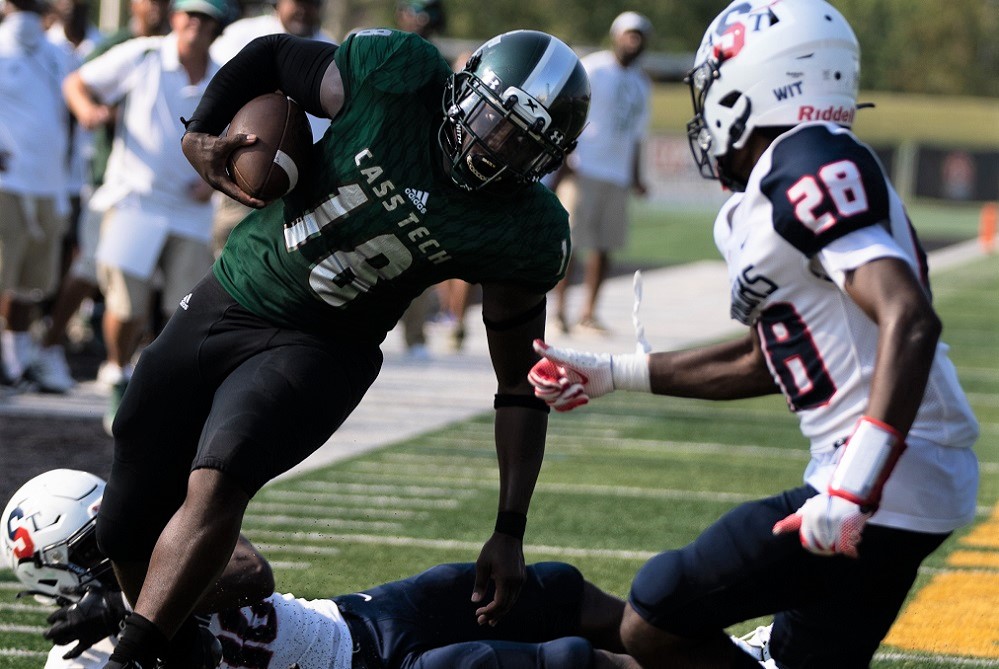
PHOTO: Detroit Cass Tech’s Julius Faulkner (18) breaks a tackle and prepares to take on another defender during his team’s Week 1 win against Southfield Arts & Technology. (Photo by Quintin Love Jr.)