


Committees Fail Critical Issues
June 7, 2013
Typically, each sport committee meets once each year for three to five hours, during which time it considers proposals that come from schools, leagues and the state’s coaches association for the sport; and the proposals most often deal with allowing more regular-season events and more qualifiers to the MHSAA postseason tournament.
Occasionally there is a proposal that might improve sportsmanship. But much more often the proposals would increase conflicts between academics and athletics and/or strain overstressed local budgets. And almost never is there a proposal that would address the health and safety of participants (the Wrestling Committee has been an occasional exception and the Competitive Cheer Committee is a routine exception).
While coaches associations must shoulder some of the blame because they’ve brought MHSAA committees “trivial” topics, at least in comparison to the tougher health and safety topics, much of the cause of MHSAA committee ineffectiveness is that the committees don’t meet long enough or often enough to research serious problems and develop well-thought-out solutions. That is forgivable because it is difficult to get commitments from busy people all across Michigan to be absent from their regular jobs and travel dozens or even hundreds of miles, and to do so multiple times each year – which is what it takes to more fully understand complex problems and more carefully construct solutions. Meetings have to be few and they have to be efficient.
However, facing the worst publicity football has seen since the mid-1970s, we knew we had to supplement the football committee process. We did so by appointing a special Football Task Force of optimum size and experienced, representative makeup to meet on however many occasions are necessary during 2013 to accomplish three purposes:
- Review practice policies to improve acclimatization of players and reduce head trauma.
- Review competition rules to reduce head trauma and the frequency of the sport’s most injurious game situations.
- Develop promotions that extol the value of football to students, schools and communities and the safety record of school-based football.
The promotional efforts have begun to be rolled out; game rule modifications are being investigated; and four proposals for changing football practice policies have been prepared. They will be the topic of our next posting.
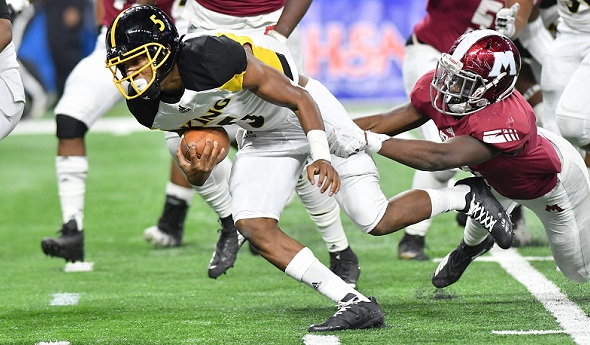
Performance: Detroit King's Dequan Finn
November 29, 2018
 Dequan Finn
Detroit Martin Luther King senior – Football
The Crusaders’ standout quarterback capped his high school career by leading his team to a 41-25 win over Muskegon to clinch the Division 3 championship Saturday at Ford Field. Finn completed 9-of-13 passes for 173 yards and four touchdowns and ran for another 73 yards and a score on 11 carries to earn the Michigan Army National Guard “Performance of the Week.”
This wasn’t Finn’s first time succeeding on the state’s biggest stage – the 6-foot-1, 195-pound signal-caller also quarterbacked King to the Division 2 championship in 2016, and the Crusaders fell just shy of making the Finals in 2017 as well, losing by a point in their Semifinal against Warren DeLaSalle. King was 35-6 over his three seasons as the varsity starter, and this fall he threw for 2,109 yards and 26 touchdowns and ran for 1,262 yards and 21 scores. He was further recognized Tuesday by being awarded this season’s statewide Mr. Football Award from State Champs Sports Network.
 King finished 12-2 this fall, winning the Detroit Public School League Black division championship and defeating league champs River Rouge, Warren Woods Tower and DeWitt plus Allen Park on the way to Ford Field. The Crusaders’ losses came Week 2 – at Muskegon, 24-21 – and then in the PSL playoffs final to Detroit Cass Tech, 42-8. But Finn led the team’s rebound after each defeat and will get the chance to continue leading an offense at the college level. (He has been committed to sign with Central Michigan University, although the Chippewas recently fired coach John Bonamego and Finn didn’t have a comment on his future plans in the immediate aftermath of the championship win.) Finn also owns an MHSAA Finals championship in track & field – he helped King win the 800-meter relay in Lower Peninsula Division 2 this past spring – and excels academically, carrying a 3.1 grade-point average.
Coach Tyrone Spencer said: “He did a phenomenal job. That’s our 35th win together. I’m just proud of him, the way he did for us. He’s a great leader, a great competitor and a great football player. … Just his play-making ability, his decision-making. He was calm. He’s been here before, and he looked like it. He didn’t look rattled, or he wasn’t doing too much. He just played in the moment, and that’s why he plays so well.”
Performance Point: “It’s just a real moment right now,” Finn said during postgame interviews. “I’m just thankful for having it, for my team, and for just going hard these three years. It was a good experience. … I just tried to be the best me I could be – the best version of me.”
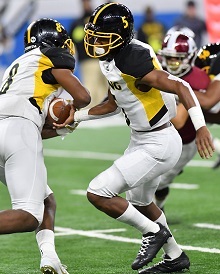 Second time’s the charm: “(Playing Muskegon twice) helped a lot, just (with) pre-snap reads – I knew where to go every single play. It was a big advantage for us to go against them Week 2. We still had that 24-21 loss in our minds. … It was an emotional game. We took it personally.”
Playoff rebound: “Coach Spencer said there’s a state championship out there (after the Cass Tech loss). If you want to get it, you’ve got to go get it. We just had to lock in mentally and prepare. That’s all we had to do, prepare and execute.”
From last season to this one: “(My) maturity, me knowing what to do and what not to do at certain points. Knowing down and distance; for instance, knowing what plays to run and what plays not to run. It’s just the little stuff.”
From Week 2 to today: “I learned I just had to calm down, not get too high, not get too low. Just remain calm at all times.”
- Geoff Kimmerly, Second Half editor
Every week during the 2018-19 school year, Second Half and the Michigan Army National Guard recognizes a “Performance of the Week" from among the MHSAA's 750 member high schools.
The Michigan Army National Guard provides trained and ready forces in support of the National Military Strategy, and responds as needed to state, local, and regional emergencies to ensure peace, order, and public safety. The Guard adds value to our communities through continuous interaction. National Guard soldiers are part of the local community. Guardsmen typically train one weekend per month and two weeks in the summer. This training maintains readiness when needed, be it either to defend our nation's freedom or protect lives and property of Michigan citizens during a local natural disaster.
Past 2018-19 honorees
November 22: Paige Briggs, Lake Orion volleyball - Read
November 15: Hunter Nowak, Morrice football - Read
November 8: Jon Dougherty, Detroit Country Day soccer - Read
November 1: Jordan Stump, Camden-Frontier volleyball - Read
October 25: Danielle Staskowski, Pontiac Notre Dame Prep golf - Read
October 18: Adam Bruce, Gladstone cross country - Read
October 11: Ericka VanderLende, Rockford cross country - Read
October 4: Kobe Clark, Schoolcraft football - Read
September 27: Jonathan Kliewer, Grand Rapids Forest Hills Northern soccer - Read
September 20: Kiera Lasky, Bronson volleyball - Read
September 13: Judy Rector, Hanover-Horton cross country - Read
PHOTOS: (Top) Detroit Martin Luther King's Dequan Finn pulls away from a Muskegon defender during Saturday's Division 3 championship win at Ford Field. (Middle) Finn hands off to teammate Peny Boone.