

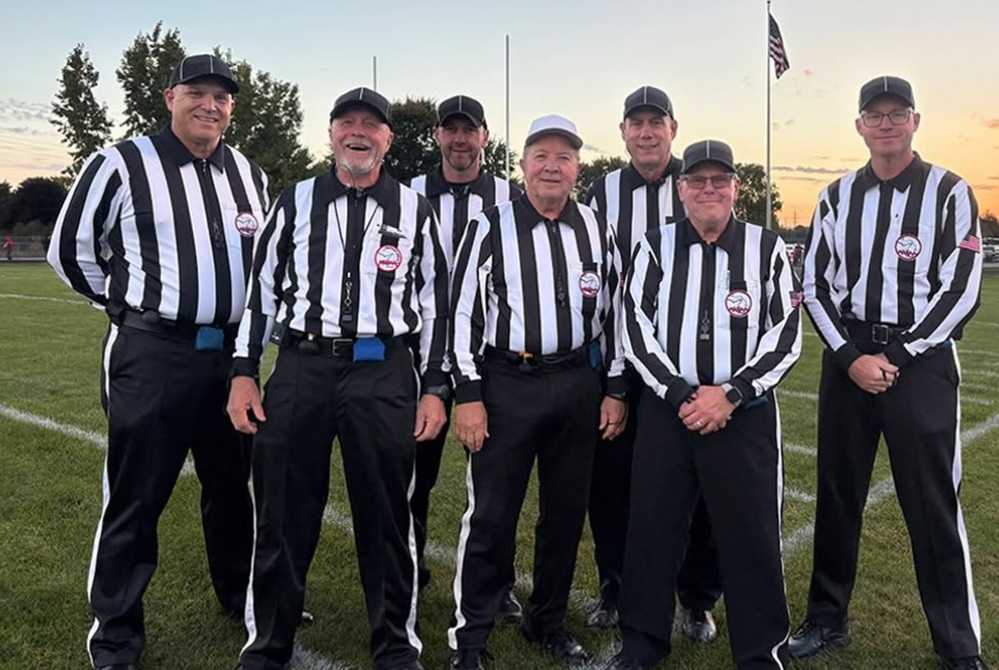
'Crew of the Month' Recognized for Excellence On Field, Impacts as Mentors & Recruiters
By
Geoff Kimmerly
MHSAA.com senior editor
November 11, 2026
Valued for their work on the field and off, the Eastern Michigan Officials Association football crew led by referee Joel Venia has been named the Michigan “High School Officiating Crew of the Month” for October by the Detroit Lions.
Venia, from Marysville, is joined by umpire John Schwelhofer (Marysville), head linesman Mike Roosen (Macomb), line judge Tom Mailoux (Capac), back judge Ken Marzka (Lakeport), side judge Paul Guttowsky (Allentown) and field judge David Wood (Jeddo). The crew was one of the first in the EMOA to expand to seven officials and is often requested by schools for their biggest games.
They are noted for the wisdom and leadership they individually supply during local association meetings, with multiple serving as board members. They also are recognized for their mentorship of developing officials – and this crew has recruited a total of 12 new football officials over the last few years.
The Lions, in partnership with the MHSAA and National Federation of State High School Associations (NFHS), are recognizing an officiating crew monthly this season.

Sweating the Small Stuff - #3
June 5, 2018
I’m sure it discouraged some of our state’s high school football coaches to learn that the Representative Council of the Michigan High School Athletic Association did not approve at its May 6-7 meeting what some people refer to as the “enhanced strength of schedule proposal” for determining 256 qualifiers to the MHSAA’s 11-player football playoffs.
There was desire among some Council members to appease those who keep trying to reduce the difficulties that a football tournament causes for regular season scheduling and conference affiliations. Others noted that the proposal, as presented, could cause as much harm to some schools and conferences as it would help others, that it did not solve the scheduling problem but shifted it.
During spirited discussion, some Council members resurrected two ideas that have been rejected previously, such as (1) doubling the playoffs once again (and shortening the regular season to eight games), and (2) coupling a six- or seven-win minimum with the revised strength of schedule criteria. The pros and cons of each idea flowed freely.
And therein is the problem. If one digs down into the details of proposals, both old and new, there are both positive and negative aspects apparent, both intended and unintended consequences likely.
There can be paralysis in analysis; but when we are dealing with more than 600 high school programs and a physically demanding sport with fewer regular-season contests permitted than in any other sport, one cannot be too careful. Eliminating one of just nine regular-season games? Increasing first-round tournament mismatches? Disadvantaging larger schools locked in leagues or areas of the state where smaller schools predominate? These are not minor matters.
And until there are sensible answers, these are not trivial questions.