

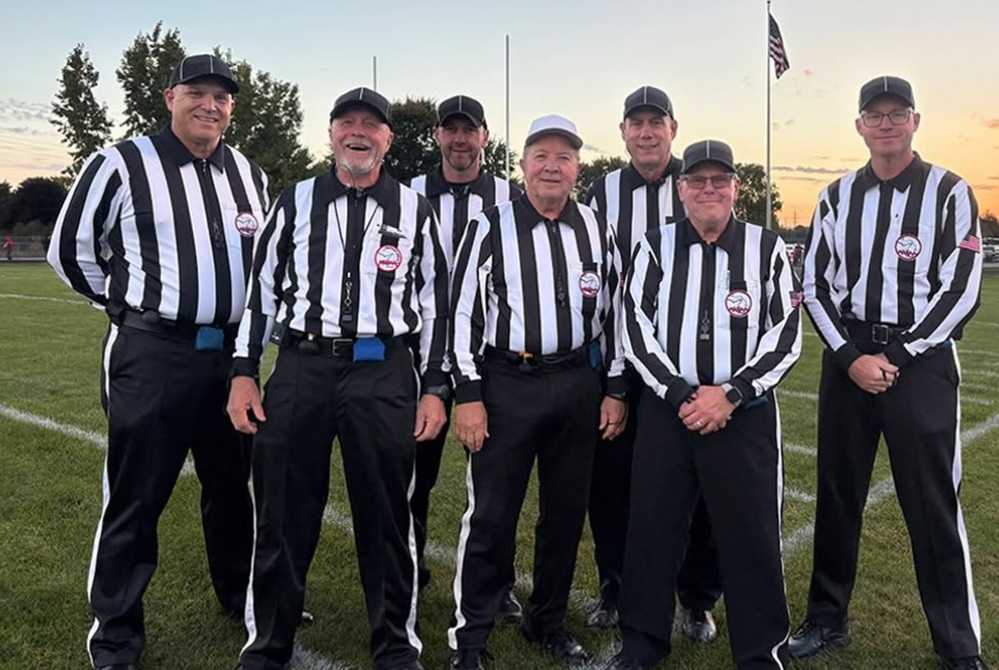
'Crew of the Month' Recognized for Excellence On Field, Impacts as Mentors & Recruiters
By
Geoff Kimmerly
MHSAA.com senior editor
November 11, 2026
Valued for their work on the field and off, the Eastern Michigan Officials Association football crew led by referee Joel Venia has been named the Michigan “High School Officiating Crew of the Month” for October by the Detroit Lions.
Venia, from Marysville, is joined by umpire John Schwelhofer (Marysville), head linesman Mike Roosen (Macomb), line judge Tom Mailoux (Capac), back judge Ken Marzka (Lakeport), side judge Paul Guttowsky (Allentown) and field judge David Wood (Jeddo). The crew was one of the first in the EMOA to expand to seven officials and is often requested by schools for their biggest games.
They are noted for the wisdom and leadership they individually supply during local association meetings, with multiple serving as board members. They also are recognized for their mentorship of developing officials – and this crew has recruited a total of 12 new football officials over the last few years.
The Lions, in partnership with the MHSAA and National Federation of State High School Associations (NFHS), are recognizing an officiating crew monthly this season.

Official Results
August 15, 2017
We enjoy some privileges serving on the Michigan High school Athletic Association staff. However, one privilege we do not have is to ignore rules when we don’t enjoy their application.
One of the rules of Michigan school sports for very many years is that there is no protest of or appeal to the decisions of contest officials. Whether it is a traveling call in basketball, a safe/out call in baseball or softball, a five-yard illegal motion call, a 10-yard holding call, or a 15-yard unsportsmanlike conduct call in football with player or coach ejection, the call is final; and if the penalty calls for next-game disqualification, that is final too.
If after a contest, an official wishes he or she could take back a call, it’s too late. If after a contest, folks pressure an official to rescind the next-game disqualification, the outcome is unchanged: ejection from one contest for unsportsmanlike conduct requires suspension from the next day of competition.
The finality of high school officials’ calls has been challenged multiple times in courts across the country – twice in Michigan – and the nearly unanimous result nationwide has been that judges will not allow themselves to become super-referees, second guessing onsite contest officials.
On some higher levels of sports – e.g., college and professional – where there are dozens of cameras covering a handful of contests each week, league offices may review some decisions. But our level of sports lacks sophisticated cameras positioned at all angles, and it involves many hundreds of contests in several different sports every week. We have neither the time nor the technology at every venue to be involved in reviewing the calls of contest officials.
Last school year, there were nearly 1,000 player ejections and more than 200 coach ejections. School sports is not equipped to review 30 to 40 of these situations that arise each week; nor should we do so.
Officials see a play and make an instantaneous decision. Their calls are final; and living with the outcome is one of the valuable lessons we try to teach and learn in school-based sports.