

Culture Change Creates More Organized, Motivated & Successful Manchester
By
Doug Donnelly
Special for MHSAA.com
September 27, 2022
Manchester’s football team is going through a re-birth.
 One of the team’s top players – senior Jaxon McGuigan – calls it a change in culture.
“This summer, when we were having workouts or lifting, we had 30 guys show up every time,” said McGuigan, the team’s leading receiver. “When I was younger, there were times we would have only 10 guys. If we had 10 guys there now, we knew something would be wrong.”
Manchester is one of the oldest prep football programs in the state. It also has been one of the most successful. From 2003-16, the Flying Dutchmen made the playoffs 13 of 14 seasons, including a streak of nine straight. Then, for a variety of reasons, the bottom fell out.
Manchester went from 9-2 and a Cascades Conference championship in 2015 to back-to-back 4-5 seasons in 2017 and 2018, a 2-5 record in 2020 and 3-6 last season.
Head coach Ben Pack was brought in to make changes to the program. He’s delivered. Now in his third season, the Dutchmen have a signature win over three-time reigning league champion Addison and stand 4-1 midway through the season. They are firmly in the playoff hunt and are just a game behind league leader Napoleon, the only team to beat them this season. Even that was a close game until the end.
“Our numbers were so low when I got here,” Pack said. “We struggled. That first year, the COVID year, we could barely put together a scout team.
“When I got here, we had four guys returning from the previous year and six juniors who were on JV as sophomores,” Pack said. “Ten guys in the program. I had to do a lot of recruiting in the hallways. We had to get kids out for football.”
Pack is a veteran coach. He is a Jackson native who started his coaching career at Jackson High School while in college. He became the head coach at Parma Western in 1983 and headed home to Jackson after that. The Vikings put together a string of good teams, including the 1999 group that was Jackson’s first playoff qualifier.
Pack left Jackson in 2002 to become an administrator, but remained in football when he joined the Albion College staff. He returned to the high school ranks a couple of seasons ago at Parma Western as a volunteer assistant. Two seasons later he was named head coach at Manchester.
Pack has not only been recruiting in the Manchester hallways, but he’s also been busy implementing a strength program.
“We had no organized lifting program,” he said. “We had guys who would come in to lift, but nothing organized. Now the kids come in and they are working, they are getting stronger and more mature. Those kids who were freshmen and sophomores when I got here are stronger and more mature. With strength and maturity comes confidence.”
One of his players that first year was a freshman quarterback, Kannon Duffing, who made one start.
“He competed,” Pack said. “He was definitely a half-pint, but he played, and he did a nice job. He completed passes. He wasn’t ready to win, yet, but he grew from it and learned from the experience.”
Duffing completed 60 percent of his passes last year for 1,273 yards and nine touchdowns. This season, he’s been even better. Through five games, Duffing has completed 57 of 82 passes, a healthy 69.5 percent, for 821 yards and nine touchdowns. His interceptions have dropped from eight last year to just two this fall.
“We don’t throw deep a lot,” Pack said. “But what we do throw, he’s very accurate. He gets the job done. He’s the unsung hero for us. He’s the catalyst. He is the key to the whole thing.”
Wide receiver Andrew Campbell, running back Wyatt Carson and McGuigan are benefactors of Duffing’s accuracy.
“He is so good,” McGuigan said. “I know he’s going to put the ball right there. We have other good receivers, too, and he does a great job at getting us the ball. Our game plan is not to just get the ball to me.”
McGuigan is a former quarterback himself. He shifted to receiver early on in his career at Manchester and likes the move. He’s now a 6-foot-2, 170-pound college prospect. He’s a three-sport athlete with a 4.0 GPA.
Pack said McGuigan has great technique in the way he runs routes.
“Every successful team has a player or two that the other kids count on,” Pack said. “Jaxon has accepted that responsibility and is a role model for handling the pressure.”
Through five games, McGuigan has caught 37 passes for 554 yards and seven touchdowns. The biggest came with time running out against Addison and helped the Flying Dutchmen overcome a two-score deficit to defeat the Panthers. The Flying Dutchmen defense came up big in that game, too, when they put together a goal-line stand during the final moments to keep Addison out of the end zone.
“To be honest, that’s the type of game the last couple of years that we wouldn’t win,” McGuigan said. “To beat them just shows that everyone has buy-in now. It just shows how we’ve changed the culture here.”
Two weeks ago, Manchester bounced back from the Napoleon loss to win against East Jackson. McGuigan had one of his biggest games with eight catches for 106 yards and two touchdowns.
East Jackson coach Joe Niehaus said McGuigan is one of the most complete receivers he’s coached against.
“He runs great routes and catches virtually everything thrown to him,” Niehaus said. “On top of that, he is a threat to go the distance after the catch every single time.”
Manchester has conference games remaining against Michigan Center, Hanover-Horton, and Grass Lake. The Dutchmen are a top-10 team in Division 7 playoff points and are sitting nicely as they attempt to get back into the postseason.
“Ever since Coach Pack came here, it’s been drilled into us to trust the process,” McGuigan said. “We’re still far from where we could be as a team.”
 Doug Donnelly has served as a sports and news reporter and city editor over 25 years, writing for the Daily Chief-Union in Upper Sandusky, Ohio from 1992-1995, the Monroe Evening News from 1995-2012 and the Adrian Daily Telegram since 2013. He's also written a book on high school basketball in Monroe County and compiles record books for various schools in southeast Michigan. E-mail him at [email protected] with story ideas for Jackson, Washtenaw, Hillsdale, Lenawee and Monroe counties.
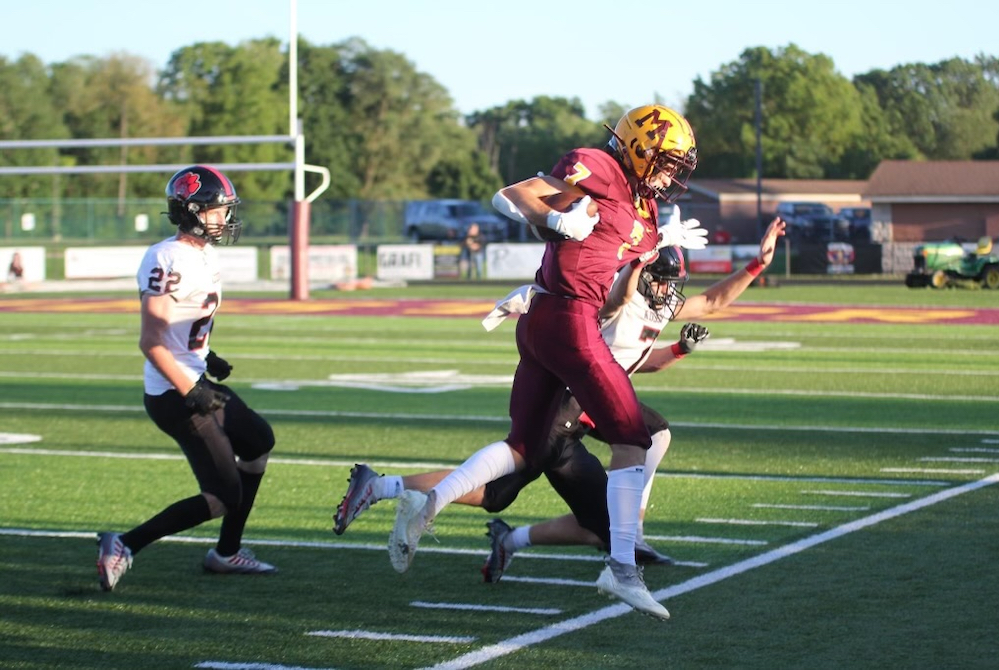
PHOTO Manchester receiver Jaxon McGuigan holds on to the ball while Addison defenders take him out of bounds. (Photo by Mark Ball, courtesy of the Manchester football program.)

P-W Triumphs in Clash of Unbeatens
November 30, 2019
By Geoff Kimmerly
Second Half editor
DETROIT – This week was the right time for Carter Thelen to pull out the film from sixth grade, to remember the start of this year’s seniors playing football together a third of their lifetimes ago.
“It was kinda emotional, because this was our last game playing with each other,” Thelen said Saturday after that final game was complete. “Just thinking back to when we kept blowing everybody out in sixth grade and seventh grade and eighth grade. Coach was saying how it was the last game for us seniors … (it was) emotionally sad, but physically it pushed me to go out and be better in practice and stay locked in and push everybody else.”
Every ounce of that focus and every ounce of that push was necessary Saturday as the Pirates faced Jackson Lumen Christi and its 35-game winning streak in the Division 7 Final at Ford Field.
The teams entered with five MHSAA Finals championship over the last three seasons between them, and P-W emerged with the sixth over four, coming out just ahead in a physical matchup 14-0 to claim its third Division 7 title in four years to go with those won in 2016 and 2017. Lumen Christi had won the last three Division 6 championships before moving into Division 7 for this playoffs as one of seven undefeated teams in that 32-team field to start the postseason.
Their matchup indeed was 48 minutes of tug of war. P-W gained 119 yards, and Lumen Christi had 109 as both averaged 2.3 per play. The Pirates (14-0) were held under 35 points for just the second time this season, to go with a 14-0 Week 1 victory over Friday’s Division 8 champion Reading. Lumen Christi hadn’t been shut out since a 2010 playoff loss.
“They’re the three-time defending Division 6 state champs, and they are obviously one of the storied programs in the state of Michigan,” P-W coach Jeremy Miller said. “And when you’re going up against them, you have to execute. So to do it against a quality opponent like that is obviously just a tremendous credit to our kids.”
 P-W scored its first touchdown when senior Aaron Bearss pulled in a pass from senior Ethan Thelen with three seconds left in the first half after a Bearss interception gave the Pirates an opportunity at the Titans’ 40-yard line with 27 seconds remaining in the half.
After nearly 22 more minutes of back-and-forth, the Pirates locked up the title on Carter Thelen’s 16-yard scoring run with 2:16 to play, as he burst through the middle of the line and shucked two Lumen Christi defenders at the 1 before gliding into the end zone.
The Titans (12-1) reached P-W territory on three of their 10 possessions, but only inside the 35 once – and that drive ended with a missed field-goal attempt 10 seconds into the second quarter. The three straight Lumen championships saw at least one runner gain at least 200 yards (and in 2017 two did so). Senior Walker Plate entered Saturday averaging almost exactly 200 yards per game rushing this season, but was held to just 49 on 22 carries as the team rushed for only 80 total. Lumen also completed just 6-of-16 passes for 29 yards.
“They were really physical up front, and they played eight men in the box – but we’ve seen that all year long,” Titans coach Herb Brogan said. “We’ve been able to take advantage of what that gives you, and we couldn’t do that today.”
P-W senior lineman John Martin and Lumen senior defensive end Matt Saunders led their respective defenses with 11 tackles apiece. Lumen Christi had 12 tackles for loss, including five by junior Brody Dalton. Senior linebacker Grant Stump added eight more tackles for the Pirates.
Sophomore Tanner Wirth led P-W 63 yards rushing on 23 carries, pushing past 1,600 yards on the year as he stepped in for his senior brother Hunter, who missed the entire season after tearing a knee ligament during the summer. Ethan Thelen completed 5-of-11 passes for 52 yards and a score, two years after tearing a knee ligament as well in his final game sophomore year.
Carter Thelen said this year’s P-W team was defined by how it pushed the pile in short-yardage situations and others when a full team effort was necessary. How the Pirates emerged from those two potentially success-stopping injuries on the way to a second-straight perfect regular season, defeating two unbeaten teams on the way to Ford Field – reigning champion New Lothrop and Iron Mountain – and then winning one of the most power-packed Finals this decade only seemed to back up Thelen’s analogy.
“It’s every time we get in the moment,” Thelen said. “Everybody goes behind and tries to push the pile.
“We’re stronger than them and we’ve got more heart, and that pile just keeps going our way.”
PHOTOS: (Top) Pewamo-Westphalia’s Grant Stump (22) and Aaron Bearss celebrate during Saturday’s Division 7 Final. (Middle) Bearss locks in on what will be a second-quarter touchdown catch.