

Cvengros Leaves Lasting Impact
By
Geoff Kimmerly
MHSAA.com senior editor
April 1, 2014
Retired Associate Director Jerry Cvengros, who served at the Michigan High School Athletic Association for more than 13 years after three decades at Escanaba High School, died Monday evening in Lansing. He was 80.
As lead assistant to Executive Director John E. “Jack” Roberts from August 1988 until retiring in January 2002, Cvengros served as director of football and briefly hockey in addition to coordinating the Program of Athletic Coaches Education (PACE), presenting annual in-service training for administrators and serving as MHSAA liaison to statewide principals, athletic directors and coaches associations.
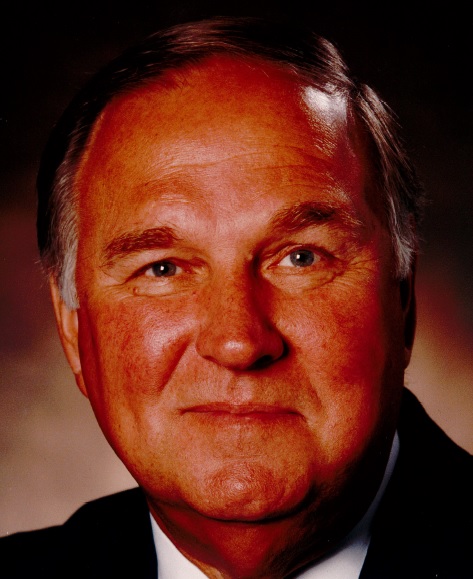 He came to the MHSAA after 30 years at Escanaba, where he taught, coached, served as athletic director and later principal during a tenure stretching from August 1958 through July 1988. While at Escanaba, Cvengros also represented Upper Peninsula Class A and B schools on the MHSAA Representative Council from 1983-88 and served as the Council’s president from 1986-88.
Cvengros received the MHSAA’s Charles E. Forsythe Award in 2000 in recognition of his many and significant contributions to interscholastic athletics.
“During his lifetime, Jerry Cvengros impacted every area of interscholastic athletics as a coach, athletic director, principal and then associate director of the MHSAA," Roberts said. “He was the perfect combination of fairness, toughness and diplomacy, able to draw on a vast knowledge of MHSAA rules and an understanding of educational athletics fostered by his various experiences.
“Jerry was known and respected statewide for his dedication, and his contributions have had a lasting impact.”
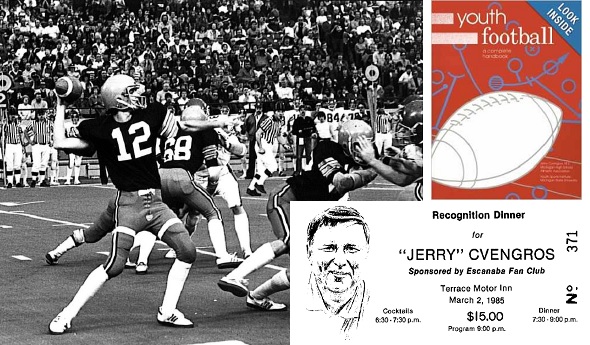
Cvengros built an elite football program at Escanaba as varsity head coach from 1962-84, leading the Eskymos to a 161-42-3 record, a Class A runner-up finish in 1979 and the MHSAA championship in 1981. That team remains the only Class A/Division 1 team from the Upper Peninsula to win an MHSAA football title. Cvengros was inducted into the Michigan High School Football Coaches Association Hall of Fame and served on its original Board of Directors.
His 1979 team fell to Detroit Catholic Central 32-7, but he brought the Eskymos back to the Finals for a 16-6 win over Fraser two seasons later. Cvengros' championship lineup included quarterback Kevin Tapani, who would go on to pitch for the Minnesota Twins among five major league clubs, and tailback Dean Altobelli, who later played at Michigan State University. The title run included a 15-14 Semifinal win over Dearborn Fordson that included a savvy two-point conversion call by Cvengros, who wanted to avoid overtime after a late score drew Escanaba to within a point of tying the score.
As the MHSAA’s director of football, Cvengros was instrumental in creating the current playoff format that expanded the field from 128 to 256 teams beginning with the 1999 season. He also co-authored “Youth Football: A Complete Handbook,” a guide to coaching at that level.
Among many additional honors, Cvengros was inducted into the Upper Peninsula Sports Hall of Fame and Michigan High School Coaches Association Hall of Fame and received the Distinguished Service Award from the Michigan Interscholastic Athletic Administrators Association. The National Federation of State High School Associations twice awarded Cvengros with a Citation – the NFHS’ highest honor – for his service as a coach and then as a member of the MHSAA staff.
Since his retirement, Cvengros and his wife Shelley have continued to reside in Okemos. A visitation will take place beginning at 10 a.m. Monday, April 7, at St. Martha Parish in Okemos, with a funeral Mass to follow at 11 a.m.
Cvengros was a 1951 graduate of Ironwood High School and went on to study and play football at the University of Wisconsin in Madison. He earned his bachelor’s degree in secondary education and teaching from the University of Wisconsin-Superior and a master’s from Northern Michigan University.
He taught English, history and physical education at Escanaba High School and also coached basketball and track and field. He became the school’s athletic director in 1970, added the duties of activities director in 1975 and became principal in 1983.
Cvengros is survived by his wife and children Michael, Steven and David, and seven grandchildren. He was preceded in death by his daughter Lee Ann (Cvengros) Swasey in May 2013.
PHOTOS: (Clockwise from left) Escanaba quarterback Mike Beveridge fires a pass during the 1979 Class A Final; Cvengros co-authored a book on coaching youth football; Cvengros was celebrated once more in Escanaba following his final season as football coach.

Committees Fail Critical Issues
June 7, 2013
Typically, each sport committee meets once each year for three to five hours, during which time it considers proposals that come from schools, leagues and the state’s coaches association for the sport; and the proposals most often deal with allowing more regular-season events and more qualifiers to the MHSAA postseason tournament.
Occasionally there is a proposal that might improve sportsmanship. But much more often the proposals would increase conflicts between academics and athletics and/or strain overstressed local budgets. And almost never is there a proposal that would address the health and safety of participants (the Wrestling Committee has been an occasional exception and the Competitive Cheer Committee is a routine exception).
While coaches associations must shoulder some of the blame because they’ve brought MHSAA committees “trivial” topics, at least in comparison to the tougher health and safety topics, much of the cause of MHSAA committee ineffectiveness is that the committees don’t meet long enough or often enough to research serious problems and develop well-thought-out solutions. That is forgivable because it is difficult to get commitments from busy people all across Michigan to be absent from their regular jobs and travel dozens or even hundreds of miles, and to do so multiple times each year – which is what it takes to more fully understand complex problems and more carefully construct solutions. Meetings have to be few and they have to be efficient.
However, facing the worst publicity football has seen since the mid-1970s, we knew we had to supplement the football committee process. We did so by appointing a special Football Task Force of optimum size and experienced, representative makeup to meet on however many occasions are necessary during 2013 to accomplish three purposes:
- Review practice policies to improve acclimatization of players and reduce head trauma.
- Review competition rules to reduce head trauma and the frequency of the sport’s most injurious game situations.
- Develop promotions that extol the value of football to students, schools and communities and the safety record of school-based football.
The promotional efforts have begun to be rolled out; game rule modifications are being investigated; and four proposals for changing football practice policies have been prepared. They will be the topic of our next posting.