

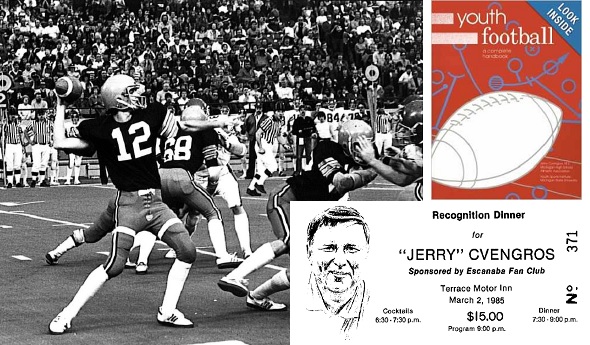
Cvengros Leaves Lasting Impact
By
Geoff Kimmerly
MHSAA.com senior editor
April 1, 2014
Retired Associate Director Jerry Cvengros, who served at the Michigan High School Athletic Association for more than 13 years after three decades at Escanaba High School, died Monday evening in Lansing. He was 80.
As lead assistant to Executive Director John E. “Jack” Roberts from August 1988 until retiring in January 2002, Cvengros served as director of football and briefly hockey in addition to coordinating the Program of Athletic Coaches Education (PACE), presenting annual in-service training for administrators and serving as MHSAA liaison to statewide principals, athletic directors and coaches associations.
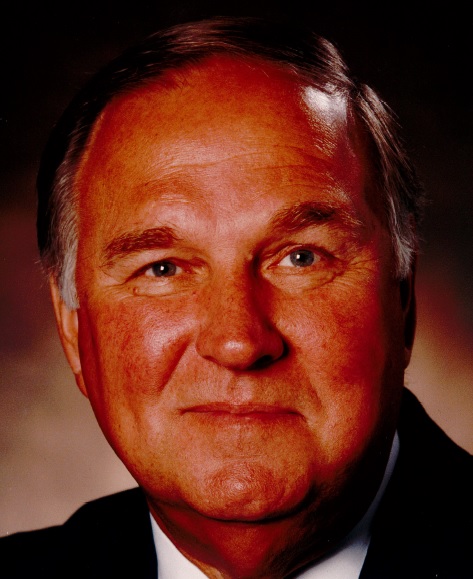 He came to the MHSAA after 30 years at Escanaba, where he taught, coached, served as athletic director and later principal during a tenure stretching from August 1958 through July 1988. While at Escanaba, Cvengros also represented Upper Peninsula Class A and B schools on the MHSAA Representative Council from 1983-88 and served as the Council’s president from 1986-88.
Cvengros received the MHSAA’s Charles E. Forsythe Award in 2000 in recognition of his many and significant contributions to interscholastic athletics.
“During his lifetime, Jerry Cvengros impacted every area of interscholastic athletics as a coach, athletic director, principal and then associate director of the MHSAA," Roberts said. “He was the perfect combination of fairness, toughness and diplomacy, able to draw on a vast knowledge of MHSAA rules and an understanding of educational athletics fostered by his various experiences.
“Jerry was known and respected statewide for his dedication, and his contributions have had a lasting impact.”
Cvengros built an elite football program at Escanaba as varsity head coach from 1962-84, leading the Eskymos to a 161-42-3 record, a Class A runner-up finish in 1979 and the MHSAA championship in 1981. That team remains the only Class A/Division 1 team from the Upper Peninsula to win an MHSAA football title. Cvengros was inducted into the Michigan High School Football Coaches Association Hall of Fame and served on its original Board of Directors.
His 1979 team fell to Detroit Catholic Central 32-7, but he brought the Eskymos back to the Finals for a 16-6 win over Fraser two seasons later. Cvengros' championship lineup included quarterback Kevin Tapani, who would go on to pitch for the Minnesota Twins among five major league clubs, and tailback Dean Altobelli, who later played at Michigan State University. The title run included a 15-14 Semifinal win over Dearborn Fordson that included a savvy two-point conversion call by Cvengros, who wanted to avoid overtime after a late score drew Escanaba to within a point of tying the score.
As the MHSAA’s director of football, Cvengros was instrumental in creating the current playoff format that expanded the field from 128 to 256 teams beginning with the 1999 season. He also co-authored “Youth Football: A Complete Handbook,” a guide to coaching at that level.
Among many additional honors, Cvengros was inducted into the Upper Peninsula Sports Hall of Fame and Michigan High School Coaches Association Hall of Fame and received the Distinguished Service Award from the Michigan Interscholastic Athletic Administrators Association. The National Federation of State High School Associations twice awarded Cvengros with a Citation – the NFHS’ highest honor – for his service as a coach and then as a member of the MHSAA staff.
Since his retirement, Cvengros and his wife Shelley have continued to reside in Okemos. A visitation will take place beginning at 10 a.m. Monday, April 7, at St. Martha Parish in Okemos, with a funeral Mass to follow at 11 a.m.
Cvengros was a 1951 graduate of Ironwood High School and went on to study and play football at the University of Wisconsin in Madison. He earned his bachelor’s degree in secondary education and teaching from the University of Wisconsin-Superior and a master’s from Northern Michigan University.
He taught English, history and physical education at Escanaba High School and also coached basketball and track and field. He became the school’s athletic director in 1970, added the duties of activities director in 1975 and became principal in 1983.
Cvengros is survived by his wife and children Michael, Steven and David, and seven grandchildren. He was preceded in death by his daughter Lee Ann (Cvengros) Swasey in May 2013.
PHOTOS: (Clockwise from left) Escanaba quarterback Mike Beveridge fires a pass during the 1979 Class A Final; Cvengros co-authored a book on coaching youth football; Cvengros was celebrated once more in Escanaba following his final season as football coach.
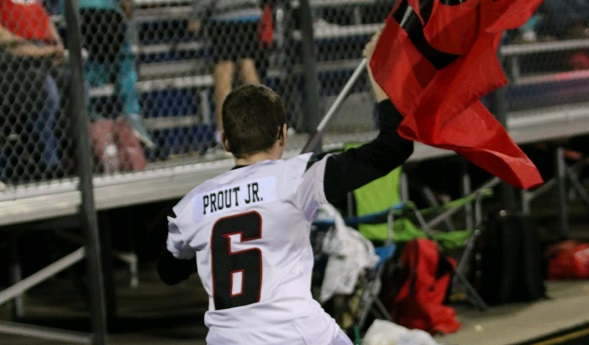
Prout Powers Pinckney with Inspiration
September 12, 2019
By Tim Robinson
Special for Second Half
Larry Prout, Jr., who wears Pinckney football jersey number 6, stands 4-foot-8 and 85 pounds.
 Or slightly less than one pound for each of the 105 surgeries he’s had in his young life.
He can’t play football — his body is much too fragile, despite a strong desire to play the game — but he makes his mark with the Pirates as an inspiration.
And the Pirates put a spark into a young man who has spent a large portion of his life in hospitals.
“Everyone gets pumped when he’s around,” Pirates senior quarterback Joe Bona says. “How could you not? Larry’s a great kid, an awesome, awesome character, and what he’s gone through should push us, because it’s way harder than what we’ve ever done. I think it pushes and makes us work harder.”
Larry is the sixth of six children of Kathy and Larry Prout Sr., who have made countless trips to emergency rooms when a medical emergency has cropped up in young Larry’s life.
At one point, their living room was a hospital room for Larry, complete with bed and medical equipment as the Prout family rallied around him.
He was born with no skin covering the lower half of his torso, leaving his internal organs exposed.
He spent most of the first 18 months of his life in the hospital, and didn’t breathe on his own until he was 3 years old.
“His first word was ‘lucky,’” Kathy Prout said in a 2016 interview. “It was the craziest word. It’s like a three-legged dog named Lucky, you know? That was his first word, and we would die laughing.”
He was included as much as he could be in his siblings’ hijinks, although he spent much of his time at C.S. Mott Children’s Hospital in Ann Arbor. But Larry Jr. became well-known among Wolverines fans during the 2016 season for the inspiration he was providing to the U-M football team, with Bleacher Report referring to him as the “heartbeat of Michigan football” in a 2017 report.
 He’s making that level of impact on his favorite high school team now as well.
"Being part of Pinckney and Michigan means a lot," Larry Jr. said. "It’s been really fun, seeing the players and coaches; it’s the same as at Michigan. I love going to the games and sitting on the sidelines before kickoff, and seeing my players and my friends, my best friends, and seeing Coach Jim (Harbaugh) and Coach Rod (Beaton).
Larry is home-schooled because his body isn’t strong enough to allow him to attend school on a regular basis. He takes electives at Pinckney, including photography, and loves being at school, although his parents had to set some limits.
“We found out that every time we dropped him off at school, he would go out and find Rod (Beaton, Pinckney’s football coach),” Kathy said.
“We told him, once a week,” Larry Sr. said. “Rod’s got work to do.”
That may be, but Beaton returns Larry Jr.’s admiration.
“It goes without saying that he’s truly an inspiration,” Beaton says. “I’ve never met a young person with a more positive attitude than Larry. He really does bring it every single day, every time he’s here.”
Larry also has carried the flag during Pinckney's "No Quarter," the pause between the third and fourth quarters where a student picks up a black or red flag, depending on how the Pirates are faring, and runs back and forth in front of the bleachers to rev the Pirates crowd for the fourth quarter.
He practiced at home before carrying the flag in both of Pinckney's games so far this season.
His peers return the love, too.
Last spring, Larry Jr. planned to attend Pinckney’s prom, but had to miss it due to a hospitalization.
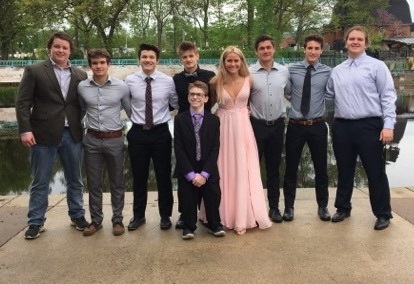
When Larry Jr. got out of the hospital, a classmate, Alex Williams, put on her prom dress and with some fellow students put on a prom for Larry.
“We have some outstanding kids here,” Beaton said, “and it goes to speak to what we have in this community. Our kids come from such great households, with parents who raise these kids the right way. They understand what Larry’s situation is, and it uplifts us all, every time he’s out here.”
The same, the Prouts say, goes for Larry.
“I remember I loved school,” Kathy said. “I loved it when my older kids were in school. You get the pencils and the pictures and the new clothes. With Larry, I have anxiety and stress because he wants to fit in and make friends and take six classes when he can only do two or three.”
Including Larry Jr. in activities like the prom and football means a lot to all of the Prouts.
“We have a lot of gratitude, and we don’t know how to show it enough,” Kathy said, ‘We want to show our gratitude to Rod and all of the players because they’ve made Larry feel important, such a part of this Pinckney football team. It’s something we’ll never forget, something Larry will never forget.”
 Larry Jr. was a part of the Michigan football team for three seasons, and among his close friends is reserve Buck West, a former Pinckney standout who often is seen at the Prout house watching game shows with Larry Jr.
“I love watching Family Feud and Steve Harvey,” Larry Jr. said. “(The Pirates) are like my brothers, just like Michigan was.”
Larry Jr. got connected to the Michigan team through an organization called Team Impact, which connects youths with life-threatening or chronic illnesses to college football teams.
Dan Kraft, the son of New England Patriots owner Robert Kraft, invited the Prouts to Ford Field when the Patriots played a preseason game there last month and got them passes to be on the field during pregame.
“As I was hanging out, the camera was filming me and they said Team Impact had a surprise for me,” Larry Jr. said. “And the craziest thing is, I see Tom Brady coming up and giving me a fist-bump and a high five. I shook his hand and told him I loved seeing him play. He pointed to my (Michigan) hat and told me to make sure to beat the Buckeyes this season. I told him I would make sure to do that.”
After Brady left, Larry Jr. jumped for joy, no mean feat for a young man who uses a wheelchair for anything but short walks.
“When he gets excited, he jumps,” Kathy said. “He can clear eight inches, which is pretty awesome, because they said he would never walk.”
At Pinckney practice, Larry Jr. hands out encouragement and banters with players who are, in many cases, a foot taller than him.
While he basks in the glow of being part of a team, he contributes to the Pirates something they might not have learned otherwise.
“The lesson I take is that it’s not as bad as what it’s going to be,” senior running back Sal Patierno said. “What we go through, you just think of what he’s gone through, and it makes you want to go harder. Just keep fighting. I know he’s fought harder than any of us.”
“It makes you think,” Bona said. “It makes you work harder.”
“He uplifts us all, every time he’s out here,” Beaton said.
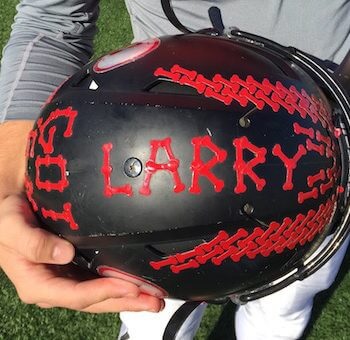
PHOTOS: (Top) Larry Prout Jr. carries the Pinckney "No Quarter" flag in front of the crowd during the Pirates’ Week 2 game at Chelsea. (Middle) Then-senior Pirates quarterback Jack Wurzer spelled out Prout’s name on his helmet in 2017 from bones the players receive for outstanding efforts. (Below) Prout’s friends put on a prom for him after Prout, in purple shirt and tie, missed the school’s event this spring while hospitalized. (Photos courtesy of the Prout family and Tim Robinson.)